

Across the limestone cliffs of Behistun, Darius the Great carved not only his victories but his words — wedges pressed into stone that would echo across millennia. These inscriptions, in the distinctive Persian cuneiform script, were not merely administrative tools. They were acts of creation, a way to give shape to empire itself through language.
Unlike the complex logographic scripts of Mesopotamia from which it drew distant inspiration, Old Persian cuneiform was simple, deliberate, and royal. It was designed not for scribes, but for the gods and posterity — a script that, like the empire it served, spoke with clarity, authority, and permanence.
1. The Legacy of the Wedge: From Sumer to Persia
Cuneiform writing first emerged in Mesopotamia around 3200 BCE, developed by the Sumerians of Uruk as a means of recording trade, religion, and law [1]. These wedge-shaped impressions, made by stylus on clay tablets, gradually evolved into a writing system capable of representing both sound and meaning. The Akkadians, Babylonians, and Assyrians adopted and adapted it, spreading the script across the Near East.
By the first millennium BCE, Elamite scribes in southwestern Iran — Persia’s western neighbour — were already using a local adaptation of the cuneiform system. When the Achaemenids rose to power, they inherited this ancient world of symbols and statecraft. But rather than adopting it wholesale, they reinvented it.
Old Persian cuneiform borrowed little from its predecessors. In fact, only one sign, the la glyph (𐎾), was directly derived from Akkadian [2]. Everything else was reimagined — simplified, ordered, and standardised. The result was not a continuation of Mesopotamian tradition, but a deliberate break from it: a new script for a new civilisation.
2. The Birth of Old Persian Script
The origins of Old Persian cuneiform are closely tied to the reign of Darius I (550–486 BCE). In his Behistun Inscription, Darius declares that he commissioned the text in three languages — Old Persian, Elamite, and Babylonian— around 520 BCE [3]. The Old Persian version appears to be the youngest of the three and the only one written in this unique script.
Many scholars believe that Darius personally ordered the creation of the script to immortalise his reign and distinguish his language from those of conquered peoples [4]. Yet others see hints of an earlier origin — perhaps experimental inscriptions from the time of Cyrus the Great at Pasargadae or even the attributed works of Ariaramnes and Arsames at Hamadan.
A fascinating theory links the script’s development to Atossa, daughter of Cyrus and wife of Darius. Ancient traditions describe her as an educated and politically astute figure, fluent in multiple languages and deeply involved in court affairs. Some historians have speculated that Atoosa’s influence may have extended to the codification of Persian writing, ensuring that the new royal script could stand as a cultural counterpart to the languages of Babylon and Elam [5].
Whatever its exact genesis, by the time of Darius’s great inscriptions at Behistun, Persian cuneiform had matured into a distinct alphabetic system — royal, geometric, and elegant in its austerity.
3. The Language of Kings
The Old Persian language, used in all Achaemenid monumental inscriptions, belonged to the southwestern Iranian branch of the Indo-European family. It was likely the vernacular of the royal court and nobility of Pārsa (modern Fars province) [6].
Unlike Akkadian or Elamite cuneiform, which relied on hundreds of symbols, Old Persian used just 36 basic signs. Each represented a syllable (consonant + vowel) rather than a full word or concept, making the script remarkably simple to read and learn.
Vowels were always written explicitly, a significant innovation compared to earlier scripts that often left them implied. The system also included numerals, represented by simple wedge patterns for units, tens, and hundreds.

Persian Cuneiform Alphabets
Persian Cuneiform Numbers
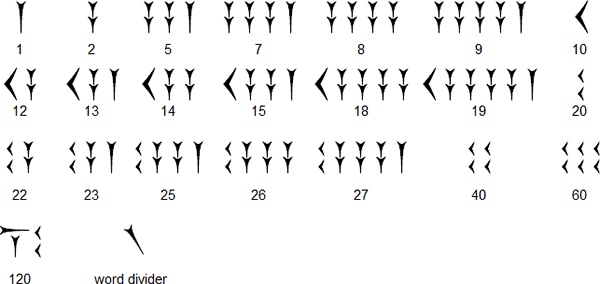
This streamlined design suggests intent: to be read by those outside the scribal class. Old Persian cuneiform was not a tool of bureaucracy but a symbolic script of sovereignty — a visual manifestation of Persian order (asha) in contrast to the chaos of the drauga (the Lie) Darius so vehemently condemned at Behistun.
4. Simplicity by Design
The structure of Old Persian cuneiform reflects the same principle of cosmic clarity that underpinned Persian religion and administration. Its forms are highly regular, built from a combination of vertical and diagonal wedges, arranged with architectural precision.
Where the Babylonian scribe used stylus and clay, the Persian stonemason used chisel and hammer. Each wedge is deliberate, angular, monumental. The inscriptions at Behistun, Persepolis, and Naqsh-e Rustam demonstrate a remarkable uniformity — suggesting that trained specialists worked under strict royal supervision [7].
Unlike the dense, multi-layered tablets of Mesopotamian bureaucracy, Persian inscriptions were public texts, carved for the gods, the people, and the ages. Their purpose was not administrative record-keeping but moral proclamation. Darius’s choice of script thus embodied his ideology: transparency, order, and divine truth.
5. The Trilingual Inscriptions of Empire
The Achaemenid inscriptions are almost always trilingual, appearing in Old Persian, Elamite, and Babylonian. This was not redundancy but strategy.
- Old Persian addressed the royal lineage — the emperor and his Iranian subjects.
- Elamite communicated with the administrative apparatus inherited from earlier Iranian kingdoms.
- Babylonian spoke to the vast Semitic-speaking population of the western empire.
This multilingual policy reflects the pluralistic philosophy of Achaemenid rule: unity without uniformity. Each script and language held its place within the imperial order, mirroring the empire’s own harmony of diversity.
The Behistun Inscription exemplifies this synthesis. The same text, rendered three times, proclaims not just Darius’s victories but his linguistic dominion. In every language, he stands as the chosen of Ahura Mazda, the restorer of truth and order to the world [8].
6. The Script as Symbol of Legitimacy
Old Persian cuneiform functioned as a visual signature of kingship. Its use was almost exclusively royal; private or administrative documents in this script are virtually unknown. To read or write it was to invoke the voice of the Great King himself.
In this sense, Persian cuneiform was more than a writing system — it was a monumental art form. Each inscription combined linguistic, theological, and architectural elements to project an image of unshakeable authority.
The aesthetic precision of the script echoed the Zoroastrian ideals of asha (order) and vahu manah (good thought). The act of carving it was a ritual, transforming stone into testimony — just as Darius claimed to transform chaos into truth.
7. Decline and Obsolescence
Following the death of Darius III and the conquests of Alexander the Great in 330 BCE, the use of Old Persian script declined rapidly. It survived briefly under Artaxerxes III and Darius III, but with the empire’s collapse, so too fell its linguistic monument.
By the early Hellenistic period, the script was obsolete. Administrative and literary activity shifted to Aramaic, Greek, and later to Middle Persian scripts such as Pahlavi and Avestan [9].
Yet the disappearance of the script did not erase its legacy. The Achaemenid inscriptions continued to adorn Persepolis and other royal sites, silent witnesses to a vanished empire. For over two thousand years, the meaning of their wedges remained a mystery — until a British soldier climbed a cliff in western Iran and gave them voice once more.
8. Rediscovery: Henry Rawlinson and the Key to an Empire
In the summer of 1835, Henry Creswicke Rawlinson, a young officer stationed in Kermanshah, began copying the Behistun Inscription. Risking his life on rope and ledge, he traced each wedge by hand, later comparing the characters to inscriptions at Persepolis.
Rawlinson recognised recurring patterns, including the royal name “Dârayavauš” (Darius). When he learned of the earlier work of the German scholar Georg Friedrich Grotefend, who had independently identified some Old Persian signs, Rawlinson realised he was holding the key to cuneiform itself [10].
By 1846, he had deciphered the Old Persian script completely. With its phonetic values known, scholars could then unlock the parallel Elamite and Babylonian texts — rediscovering the forgotten languages of Mesopotamia.
Thus, Darius’s monument, conceived to assert imperial truth, became the Rosetta Stone of the Near East, restoring the voices of empires long buried in dust.
9. The Philosophy of a Script
Old Persian cuneiform stands apart from all other ancient writing systems. It is not an organic evolution of earlier scripts but a conceptual creation, designed to embody an idea — that language, truth, and kingship are inseparable.
Each wedge carved into stone represents not only a syllable but a cosmic assertion: that order triumphs over the Lie. This is why Darius and his successors used it so sparingly — to preserve its sanctity. It was a sacred script of sovereignty, not of administration.
The elegance of its geometry mirrors the philosophical clarity of Persian thought — a belief that truth must be seen as well as spoken. Even in silence, the inscriptions proclaim faith in divine reason and human order.
10. Legacy and Reflection
Today, the Old Persian script has been fully catalogued, digitised, and even encoded into Unicode. Scholars study its grammar, while travellers still stand beneath the cliffs of Behistun and Persepolis, gazing at the same symbols that once proclaimed Darius’s truth to the world.
But the script’s deeper legacy lies in what it represents: the power of language to define civilisation. Just as empire sought to unify diverse peoples, Persian cuneiform unified diverse tongues under a single written ideal.
Its invention, perhaps guided by Atoosa’s intellect and Darius’s vision, marks the moment when Persia not only ruled the world but gave it a new alphabet of truth.
The wedges carved into stone may have fallen silent, but their shape remains eternal — a reminder that words, once made divine, outlive even the empires that forged them.
Footnotes
- Kramer, S. N. History Begins at Sumer: Thirty-Nine Firsts in Recorded History, University of Pennsylvania Press, 1959.
- Schmitt, R. “Old Persian Writing and Language,” Encyclopaedia Iranica, Vol. XI (2011).
- Kent, R. G. Old Persian: Grammar, Texts, Lexicon, American Oriental Society, 1953.
- Briant, P. From Cyrus to Alexander: A History of the Persian Empire, Eisenbrauns, 2002, pp. 115–121.
- Henkelman, W. F. M. “The Invention of Old Persian Script,” Iranica Antiqua 44 (2009).
- Kuhrt, A. The Persian Empire: A Corpus of Sources from the Achaemenid Period, Routledge, 2007.
- Lincoln, B. “The Construction of Truth in the Achaemenid World,” History of Religions 46 (2007).
- Lecoq, P. Les Inscriptions de la Perse Achéménide, Gallimard, 1997.
- Frye, R. N. The Heritage of Persia, Weidenfeld & Nicolson, 1962.
- Rawlinson, H. C. “The Persian Cuneiform Inscription at Behistun,” Journal of the Royal Asiatic Society (1846–1857).


 Kam Austine
Leave a comment