

The Cyrus Cylinder, the oldest known declaration of human rights, and the proud document of Iranians’ coexistence with peaceful aspirations and respect for the beliefs and thoughts of all subject peoples at the time of the establishment of the world’s first empire. The ancient world has always been plagued by the flames of endless wars and invasions, and peace-loving countries have been forced to confront and conquer their restless neighbours for the liberation of their people from perpetual conflicts. But what matters is how the victors of the battlefield and the conquerors of cities behaved towards the defeated army and the subdued people? Human history recounts the noble behaviour of Cyrus the Great, the king of the most powerful country of his time, and the contrasting actions of other arrogant rulers.


In the year 1258 AH / 1879 AD, following the excavations of a British group at the Great Temple of Isagila (the sanctuary of Marduk, the great god of Babylon) in the ancient city of Babylon in Mesopotamia (between the rivers), a cylinder made of baked clay was discovered by Chaldean archaeologists named “Hormuz Rasam,” which is now housed in the British Museum in London.
Initial examinations indicated that around this cylinder, there were inscriptions in the Babylonian script and language (Akkadian) which were believed to be inscriptions of Assyrian and Babylonian rulers. However, further examinations conducted after its retrieval, transcription, and translation revealed that this inscription was written in 538 BC by the order of Cyrus the Great of the Achaemenid Empire (550-530 BC) and at the time of his entry into the city of Babylon. From the time of writing this decree until today , 2550+ years have passed.
The physical form of this decree resembles a cylinder, seen narrower in the middle than its two sides. The dissemination and recording of official decrees and memorials on clay cylinders and flat tablets have a long history in Iran and Mesopotamia, with the cylinder type having greater stability and durability compared to others. Undoubtedly, this decree was written in multiple copies for dispatch to various regions, of which only one has survived to this day.
The Cyrus Cylinder has suffered serious damages. Many of its lines have been lost or are unreadable due to excessive erosion. The inscriptions of the damaged sections can only be partially reconstructed based on the size of the empty space and some remaining letters, and even in this reconstruction, there is undoubtedly the possibility of errors. Therefore, careful attention to the content of the inscription and especially the keywords should be paid with great care and precision. Undoubtedly, reference to the inscription becomes more reliable when a specific word or concept has been translated more or less uniformly in most studies.
At Yale University, a small and damaged tablet is kept, which Richard P. Berger in 1975 considered a missing part of the Cyrus Cylinder. This section was added to the original inscription by Hormuz, forming its current final nine lines (lines 37 to 45).
The decree of Cyrus the Great has been translated, edited, and researched many times since its discovery. Above all, Henry Creswicke Rawlinson, the enthusiastic young decipherer of ancient Persian cuneiform, in 1880, and later F. Weissbach in 1890, G. Richter in 1952, A. Oppenheim in 1955, W. Eilers in 1974, J. Harmatta in 1974, P. Berger in 1975, A. Kuhrt in 1983, P. Briant in 1999, and many others repeated and improved it. The Persian text presented in this book has also been provided with a view to previous studies and the progress of understanding Babylonian or Akkadian letters and words, as well as the latest readings of the Cyrus Cylinder, and some notes have been provided in the footnotes.

Translation and dissemination of the decree of Cyrus the Great (Cyrus II) revealed numerous unexpected truths and soon gained widespread fame as the “Cyrus Cylinder” and the “First Universal Declaration of Human Rights.” Representatives and jurists from various countries around the world gathered in 1348 AH to commemorate him as the first founder of human rights and praised him at the Tomb of Cyrus in Pasargadae. The rights that humanity today has developed and aspires to expand after two thousand five hundred years of thought.
(A replica of the Cyrus Cylinder, recognised as the oldest known decree of understanding and coexistence among nations, is housed in the United Nations building in New York. This inscription is located in the space between the main hall of the Security Council and the General Assembly hall).
What caused the decree of Cyrus to reach this level of fame? The answer to this question is obtained when we compare the decree of Cyrus with the writings of other contemporary rulers and present-day rulers and judge between them.
Assyrian King Ashurnasirpal (884 BC) wrote in his inscription: “… by the order of Ashur and Ishtar, the great gods and my protectors … I beheaded six hundred enemy soldiers without consideration and burned three thousand of their prisoners alive… I flayed the ruler of the city alive and hung his skin on the city wall… I roasted many in the fire and cut off many hands, ears, and noses, pulled out thousands of eyes from their sockets, and hung severed heads from the trees in the city.”
In the inscription of Sennacherib, the king of Assyria (689 BC), it is written: “… When I conquered the city of Babylon, I took all the people of the city captive. I destroyed their houses to such an extent that it turned into a mound of earth. I set fire to the entire city to the extent that its smoke rose to the sky for many days. I diverted the Euphrates River through the city to take even the ruins with it.”
In the inscription of Ashurbanipal (645 BC) after the conquest of the city of Susa, it is said: “… I conquered Susa, the great sacred city… according to the desire of Ashur and Ishtar… I destroyed the ziggurat of Susa, which was made of glazed bricks of lapis lazuli… I levelled the temples of Elam with the ground and gave their gods and goddesses to the wind. My soldiers entered its holy groves, which no foreigner had ever entered, saw them, and set them on fire. In the distance of one month and twenty-five days, I turned the land of Susa into ruins and a desert uncultivated… Human cry and… shouts of joy… I picked up the booty from there, dragged the earth there into heaps, and allowed snakes and scorpions to occupy it.”
And in the inscription of Nebuchadnezzar II, the king of Babylon (565 BC), it is stated: “… I commanded to put out a hundred thousand eyes and break a hundred thousand legs. I burned thousands of young girls and boys alive and destroyed the houses to such an extent that no living sound rose from there.”
However, despite the undesirable behaviours of the Assyrian and Babylonian kings and the rulers of today’s world, when Cyrus entered the city of Babylon and possessed any practical power as the king of the most powerful country in the world, he not only did not crucify the defeated king, but he appointed him as a regional governor and also behaved similarly with the people of the city: “… When I entered Babylon without any battle or conflict, all the people welcomed my steps with joy … Marduk (the Babylonian god) made the pure hearts of the people of Babylon aware of me; for I honoured and esteemed him. My great army entered Babylon in peace and tranquility … I did not allow any suffering or harm to come to the people of this city and this land. The internal situation of Babylon and its holy places moved my heart. I sought peace. I abolished slavery. I put an end to their miseries. I commanded that all people be free in the worship of their God and not be coerced. I ordered that no one should harm the inhabitants of the city. The great God was pleased with me … I commanded … to open all the closed temples. I restored all the gods of these temples to their places. I gathered the people of these places and rebuilt their houses, which had been destroyed. I granted peace and tranquility to all the people.”
After entering the city of Babylon (alongside the Euphrates River, in present-day southern Baghdad), Cyrus issued a decree of freedom for thousands of Jews who had been in captivity in Babylon for almost seventy years. He returned the thousands of gold and silver vessels that the king of Babylon had taken from them and allowed them to build a great temple for themselves in their homeland. Cyrus’ behaviour towards the Jews led many of them to migrate to Iran, where for twenty-five centuries there has never been war, violence, or conflict between them and the Iranians, and they have considered Iran their second homeland. In various passages of the Books of Ezra and Isaiah in the Torah (Old Testament), Cyrus is referred to as the “anointed of the Lord” and it is said: “The Lord stirred up the spirit of Cyrus king of Persia to make a proclamation throughout his realm and to put it in writing: ‘This is what Cyrus king of Persia says: The Lord, the God of heaven, has given me all the kingdoms of the earth and he has appointed me to build a temple for him at Jerusalem in Judah …’ So everyone who was willing and whose heart moved them came and took part in the building of the house of God in Jerusalem. … And King Cyrus brought out the articles belonging to the temple of the Lord, which Nebuchadnezzar had carried away from Jerusalem and had placed in the temple of his god.”
The Cyrus Charter is a gift from the land of Iran to a world tired of war and violence and suffering from it.
Here is a translation of the inscription line by line:
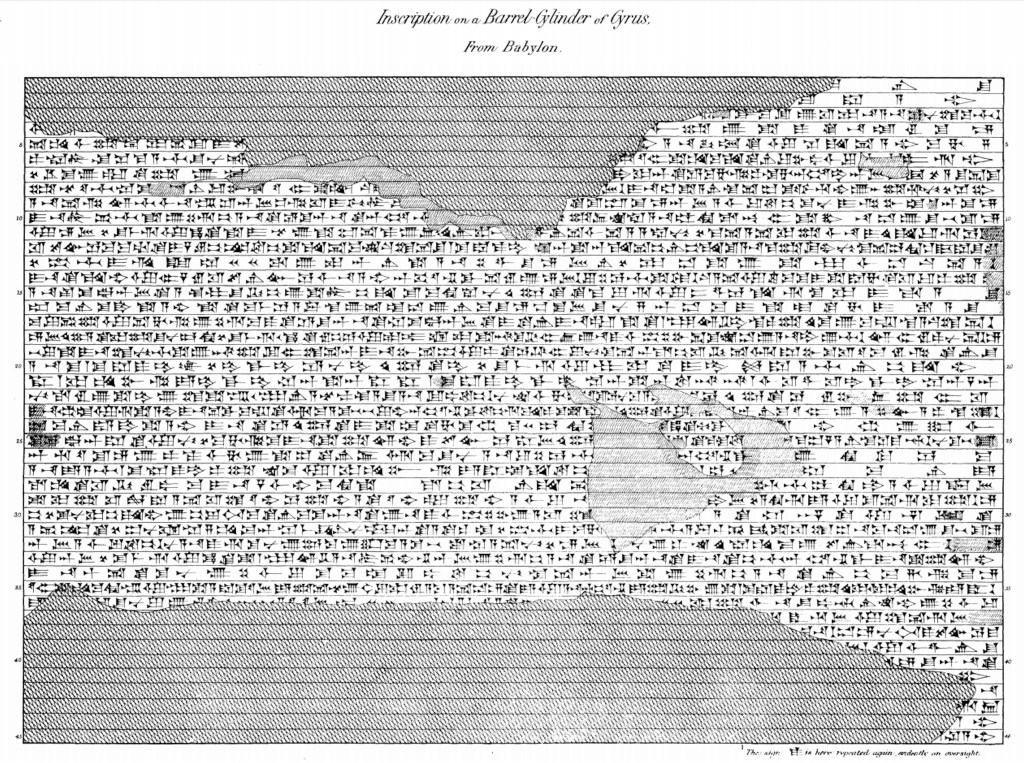
Line 1: …
Line 2: … the whole world
From here until the end of line nineteen, the narrative is not from Cyrus himself, but is recounted by an unidentified observer who might reflect the views of the people and dignitaries of Babylon.
Line 3: … an unworthy man had come to rule over his country.
Line 4: He abolished ancient rites and replaced them with artificial ones.
Line 5: He built a temple as a replacement for the “E-sagila” temple in the city of “Ur” and other cities.
“E-sagila” or “Ezagila” is the name of the great temple of “Marduk” or the great god. This name bears a striking resemblance to the Iranian temple “Ezagin” in “Aratta,” which is narrated in the Sumerian epic “Enmerkar and the Lord of Aratta.” Mr. Jahan Shahanshah in Aryan, the Shining in the Aryans, the People of Kashi, and other Iranians (Tehran, 2003, p. 507), interprets “Ezagin” to mean “lapis lazuli.” On the other hand, the Romans considered blue as the color of God, and “Kashya/Kashu,” their great god, means “blue.” Today, the word “Kas” is still used for the color blue in local dialects. For example, in Gilan, men with blue eyes are called “Kas Agha.” Also, to understand the connection of Aratta with the ancient regions of the Helmand River in the south of Jiroft, refer to: Majidzadeh, Youssef, Jiroft: The Oldest Civilization in the East, Tehran, 2003.
Line 6: He introduced the practice of sacrifices, which did not exist before … He did unpleasant things every day, violence and misconduct.
Line 7: He made daily life difficult … He interfered with people’s lives with inappropriate regulations. He spread sorrow and grief in the cities. He turned people away from the worship of “Marduk” the great god.
It is believed that the name “Marduk” is related to the Aryan and Avestan word “Amertat,” meaning “immortality.” But other characteristics of Marduk resemble “Ahura Mazda” and, like him, he is manifested on the planet “Jupiter.” Just as Marduk was known as “Amertat,” he was also remembered by the Aryans and Kassites as “Shugur,” which means “the greatest lord” and is associated with the meaning of Ahura Mazda (the wise lord).
Line 8: He made the people suffer hard living conditions. Every day, he tormented the residents of the city in his own way. He destroyed people with his harsh actions … all the people.
Line 9: “Enlil” (Illil), the great god (= Marduk), was upset by the complaints and cries of the people … The other gods had abandoned the land. (Meaning prosperity, abundance, and tranquility)
Line 10: The people asked the great god to attend to the condition of all the inhabitants of the earth, whose lives and livelihoods were going towards ruin. Marduk, the great god, decided that the gods should return to “Babylon.”
Line 11: The inhabitants of the land of “Sumer” and “Akad” had become like corpses. Marduk noticed them and showed mercy to them.
Line 12: Marduk sought a righteous ruler throughout all the countries, seeking a good king to help him. Then he read the name “Cyrus,” the king of “Anshan” (Anshan). He mentioned him as the king of the world.
Line 13: He brought all the land of “Guti” under the dominion of Cyrus. Also, all the people of “Medes.” Cyrus dealt justly with every “black-headed” person (all humans).
In circulation, the name “Omanmende” is considered equivalent to “Medes.” But it seems that this name has been applied to all or one of the Aryan tribes who immigrated to the Middle East in the second millennium BCE.
Line 14: Cyrus ruled the country with truth and justice. Marduk, the great god, was pleased with the good deeds and good thoughts of this supporter of the people.
Line 15: He stirred up Cyrus to take the path to Babylon; while himself, like a true supporter, walked side by side with him in struggle.
It is possible that the reference could have been to the sighting of the planet Jupiter. In Iranian beliefs, the planet Jupiter has been a celestial symbol of Ahura Mazda/Marduk. See: Bartel L. Vanderwerden, The Emergence of Astronomical Knowledge, translated by Homayoun San’atizadeh, 1372. He even interprets the “countless army” as the stars of the sky.
Line 16: His countless army, like the waters of an inexhaustible river, entrusted themselves with various weapons alongside him.
Line 17: Marduk decreed that Cyrus should enter the city of Babylon without war and bloodshed. He kept Babylon safe from any harm. He handed over the king “Nabonidus” (Nabunaid) to Cyrus.
Line 18: The people of Babylon, the entire land of Sumer and Akkad, and all the local rulers accepted Cyrus’s rule. They rejoiced in his kingship and kissed his shining face.
Line 19: The people hailed him as their saviour, through his help they found deliverance from the clutches of death and sorrow, returning to life. All the gods honored him and held his name in reverence.
Line 20: I am Cyrus, the king of the world, the great king, the mighty king, the king of Babylon, the king of Sumer and Akkad, the king of the four corners of the world.
From here on, the narrative is recounted in the first person and from the perspective of Cyrus. Strabo reports that “Cyrus” is a name he adopted after becoming king, inspired by the “Kur” river in southern Pasargadae. Previously, his name was “Agradatus” (Agradad). Ref: Strabo’s Geography, translated by H. San’atizadeh, p. 319.
Line 21: The son of “Cambyses,” the great king, the king of Anshan, the grandson of “Cyrus” (Cyrus the First), the great king, the king of Anshan, the descendant of “Chishpish,” the great king, the king of Anshan.
Line 22: From a lineage that has always been royal, and they hold his kingship in reverence, calling his rule “Bel” (lord/deity = Marduk) and “Nabu” (Nabu) with heartfelt joy. When I entered Babylon without war or conflict;
“Nabu” was the god of writing and scribes, and his temple was called “Ezida.” Cyrus’s entry into Babylon “without war or conflict” is not only reported by him but also confirmed in Babylonian texts such as the “Nabonidus Chronicle” and also in “Histories” by Herodotus (Book 1). See for reference: Hinz, W., Darius und die Perser, I, 1976, p. 106.
Line 23: All the people accepted my steps with joy. I sat on the throne of kingship in the court of Babylon. Marduk understood the pure hearts of the people of Babylon, for I esteemed and honored him.
The acceptance of Cyrus by the people is also confirmed in the “Cyrus Cylinder” (Curou Paideia) written by Xenophon. Xenophon states that the people of all countries had accepted the kingship and authority of Cyrus willingly (Curou Paideia, Book I).
Line 24: My great army entered Babylon in peace and tranquility. I did not allow any suffering or harm to come to the people of this city and land.
Line 25: The internal situation of Babylon and its sacred places moved my heart… I endeavored for peace. Nabonidus had led the distressed people of Babylon into servitude, a deed unworthy of them.
Line 26: I abolished slavery. I put an end to their misfortunes. I commanded that all people be free in worshiping their God and not to oppress them. I ordered that no one should harm the inhabitants of the city. Marduk was pleased with my good deeds.
Line 27: He, Marduk, was gracious to me, Cyrus, his worshiper, to my son Cambyses, and also to all my soldiers,
Line 28: He esteemed and showed kindness to us. We all joyfully praised his high status in peace and harmony. By the command of Marduk, all the kings who sat on the throne of the world,
Line 29: And all the kings of the lands, from “the Upper Sea” to “the Lower Sea” (from the Mediterranean Sea to the Persian Gulf), all the people of distant lands, all the kings of Amurru, all the tent-dwellers,
Line 30: Paid homage to me and kissed me in Babylon. From… to “Assyria” and “Susa”.
Line 31: I rebuilt the cities of “Agade”, “Isin”, “Zamua”, “Meturnu”, “Dir”, the land of “Guti”, and the ancient cities beyond the “Tigris” that were in ruins.
Line 32: I commanded that all closed temples be reopened. I returned all the gods of these temples to their rightful places. I brought back all the scattered and displaced people to their homelands. I restored their ruined homes. I called all people to unity.
Although there is no conclusive evidence of Cyrus the Great’s Zoroastrianism, he adhered to the ancient Iranian belief that everyone is free to worship their own God and choose their own religion, much like Zoroaster. Unfortunately, the Zoroastrian priests of the Sasanian era damaged this valuable achievement of Iranian culture with countless harshnesses and personal preferences in distorting the Zoroastrian faith.
Line 33: I returned the statues of the gods of Sumer and Akkad, which Nabonidus had brought to Babylon without any hesitation, to the delight and joy of Marduk,
Line 34: To their own temples, so that hearts may rejoice. So that the gods, whom I restored to their original sacred places,
The opening and reconstruction of the temples by Cyrus’ command is also recognised in another text. In the four-line tablet discovered in “Arakh,” it is said: “I am Cyrus, the son of Cambyses, the mighty king, who rebuilt Esagila and Ezida.” For more information, see page 156 of W. Eilers’ article in Bibliography.
Line 35: Every day, in the presence of the Great God, I prayed for a long life. So that they may find blessed and benevolent words for me. So that they may say to my God Marduk: “To Cyrus the king, the king who honors you, and to his son Cambyses, a place in the exalted hall of Spenta.”
In Iranian beliefs, “the hall of Spenta” or “Angareha Raeengah” (Angaran/Anahram) means “endless brightness and the place of the great god or Ahura Mazda and the heavenly paradise.”
Line 36: Undoubtedly, during the days of construction, all the people of Babylon honored the king, and I provided a peaceful society for all the people. (I granted peace and tranquility to all the people). . . .
Line 37: … geese, two ducks, ten pigeons. For geese, ducks, and pigeons…
From line 37 to 45 is an untranslated section mentioned in the prologue. These nine lines are not a direct continuation of the previous lines.
Line 38: … the great gate of the city of Babylon named “Emgur-Enlil” (Emgur-Enlil) firmly established…
Line 39: … the brick wall and moat of the city,
Line 40: … that none of the previous kings had brought to an end the subjugation of captives taken to degradation;
Line 41: … I accomplished.
Line 42: I set up great gates for them with doors of cedar wood and a covering of copper…
Line 43: …inscription of the reign before me named “Ashurbanipal” (Ash-Shoor-Baanipal)
Line 44: …
Line 45: … forever!
You might be interested to continue reading on:
Eternal Majesty: The Tomb of Cyrus the Great from Past to Present
The Immortals: Unveiling the Secrets of the Achaemenid Elite Guard
Articles related to Cyrus the Great


 Kam Austine
Leave a comment