
Introduction
Bardiya, also known as Smerdis, remains one of the most enigmatic figures in the annals of the Persian Empire. Brother to Cambyses II and possibly an imposter according to some historical accounts, his brief reign is shrouded in mystery and controversy. This blog post aims to delve deep into the historical threads that define Bardiya’s rule, exploring his contributions and influences on the Persian and Egyptian civilizations under the Achaemenid dynasty.
Historical Context
The Achaemenid Empire, founded by Cyrus the Great, was the first Persian Empire and during its zenith, it stretched from the Balkans and Eastern Europe proper in the west, to the Indus Valley in the east. It was a melting pot of diverse cultures and populations. Cyrus’s policies of tolerance and efficient administration laid the groundwork for a stable and prosperous empire. His death led to the succession of his son, Cambyses II, who expanded the empire further into Egypt.
Cambyses II’s reign, however, was marked by alleged madness and brutality, which culminated in his mysterious death in 522 BC. It was during this period of uncertainty that Bardiya allegedly took the throne. Historical records from this period are conflicting, with some suggesting that an imposter named Gaumata, assuming Bardiya’s identity, ruled instead. This uncertainty sets the stage for the exploration of Bardiya’s actual role in the empire’s history.
Bardiya’s Rise to Power
The period following Cyrus the Great’s expansive conquests saw his son Cambyses II inherit an empire at its zenith. While Cambyses II extended their realm into Egypt, there is scant but intriguing evidence that suggests Bardiya, his brother, might have held significant administrative roles, potentially even as a satrap. The administrative structure of the Achaemenid Empire, highly bureaucratic and yet accommodating to local governance, could have facilitated such a role for a royal family member, aiding in the empire’s consolidation and management.
Following Cambyses II’s mysterious death in 522 BC, a power vacuum threatened the stability of the empire. It was during this critical juncture that Bardiya is said to have ascended to the throne. Historical accounts vary, with some sources implying a smooth transition, while others suggest political intrigue and deception were at play.
The Question of Identity: True Bardiya vs. Imposter Gaumata
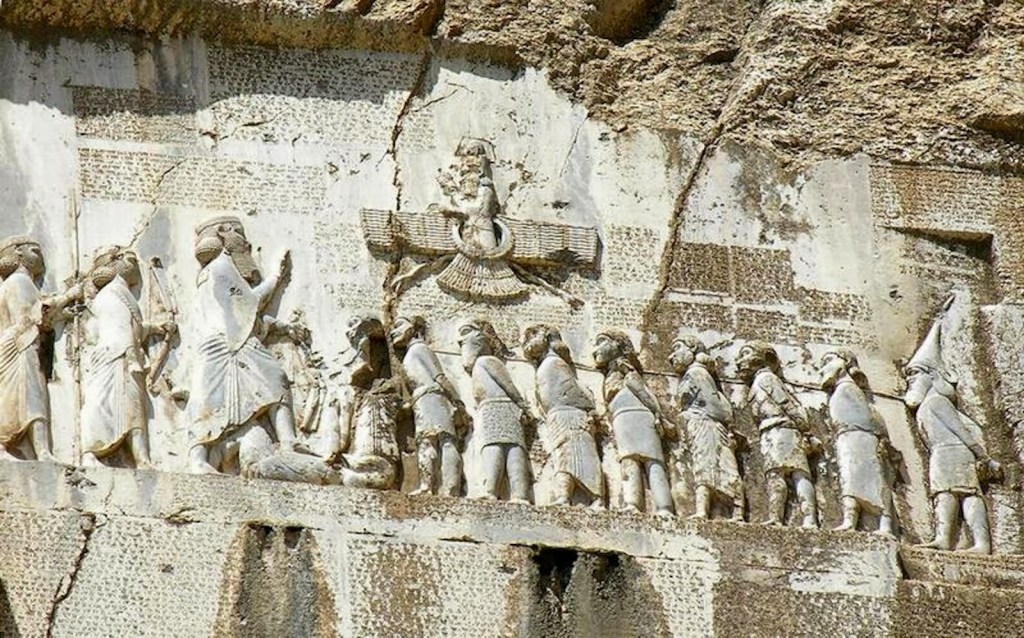
The true identity of the man who ruled as Bardiya during this period remains one of the great debates in ancient Persian history. The Bistoon Inscription, commissioned by Darius the Great, claims that the usurper was not Bardiya but an imposter, Gaumata, who deceived the empire by masquerading as the king. This inscription is a critical piece in understanding the narrative crafted by Darius, who benefited significantly from discrediting the rule of his predecessor to legitimize his own reign.
On the other hand, some scholars argue that the narrative of an imposter might have been a propaganda tool used by Darius. They suggest that Bardiya could indeed have been the legitimate ruler, whose policies might have threatened the existing power structures, prompting elite factions to support Darius’s coup.
The debate extends to the analysis of governance during this period. If Gaumata was indeed an imposter, his ability to maintain control and govern effectively over a significant period suggests a high level of political skill and acceptance, if not legitimacy, among the ruling classes.

Bardiya’s Reign and Policies
The reign of Bardiya, whether as the true prince or as Gaumata the imposter, was brief yet notable in the annals of the Persian empire. While contemporary records beyond the Bistoon Inscription are sparse, the governance strategies implemented during his tenure can be inferred through the administrative continuity and regional stability of the period.
Governance and Administrative Policies
The Persian empire under Bardiya saw the continuation of the administrative practices established by Cyrus and Cambyses. This period likely focused on consolidating power and maintaining the empire’s vast bureaucracy, which was essential for managing its diverse and expansive territories. If Bardiya was indeed an imposter as claimed, his ability to manage this complex system suggests not only his adeptness but also the robustness of the Persian administrative framework, which could function effectively under different rulers.
Economic and Social Policies
There are indications that the ruler known as Bardiya may have attempted to enact reforms aimed at reducing the burdens on the common people. According to some interpretations of the historical texts, these reforms could have included tax reductions and the implementation of measures to protect the peasantry from feudal exploitation. Such policies would have been significant, as they could indicate a shift towards a more populist approach, contrasting with the more militaristic and expansionist policies of his predecessors.
Bardiya’s Influence on Egypt
As a vital satrapy of the Persian empire, Egypt’s relationship with Persia during Bardiya’s reign is crucial to understanding his impact on the broader imperial structure. His rule came at a time of relative calm before the tumultuous periods that would follow, suggesting that his policies might have helped stabilize the region temporarily.
Administrative Integration
Bardiya’s (or Gaumata’s) approach to Egyptian governance might have continued the integration policies started by Cambyses. This would involve maintaining Persian authority while respecting local customs and traditions, a hallmark of Persian rule that aimed to prevent rebellions and ensure loyalty across diverse cultures within the empire.
Military and Strategic Implications
While there is no direct evidence of military campaigns initiated by Bardiya in Egypt, his role in maintaining the security and stability of such a strategically important region would have been crucial. The Persian military presence, reinforced by local garrisons, likely continued to secure trade routes and suppress any dissent, ensuring the flow of resources critical to the empire’s economy.
Mystery of His Death and Succession
The end of Bardiya’s reign is as enigmatic as its beginning. According to the Bistoon Inscription, Darius the Great, a distant relative and former lance-bearer of Cambyses II, led a small group of conspirators to overthrow the ruler they claimed was the imposter Gaumata. The narrative provided by Darius states that in September 522 BC, they killed the usurper in a fortified stronghold, after which Darius ascended to the throne.
The Power Struggle and Darius’s Ascension
Darius’s rise to power, immediately following the death of Bardiya, was fraught with challenges. He faced multiple rebellions across the empire, indicating either widespread unrest or a significant lack of legitimacy. Darius’s extensive campaigns to quell these uprisings are well-documented in his inscriptions, suggesting that his consolidation of power was both military and propagandistic in nature.
Implications for the Persian Empire
The transition marked a significant shift in Persian imperial policy. Darius restructured the administration, dividing the empire into satrapies with appointed governors, which could be seen as a move to centralize and tighten control following the instability that might have been exacerbated during Bardiya’s controversial reign.
Legacy and Historical Interpretations
Bardiya’s legacy is complex, primarily due to the uncertainty about his true identity and the legitimacy of his rule. His reign, whether as a legitimate king or as an imposter, is a critical episode in the history of the Achaemenid Empire, raising questions about the nature of power and legitimacy.
Historical Perspectives
The dominant narrative, influenced heavily by Darius and later by Greek historians like Herodotus, paints Bardiya as either a victim of royal fratricide or a cunning imposter who seized the throne through deceit. This dual narrative has led to varied interpretations by modern historians, with some viewing him as a pivotal figure in understanding the dynamics of Persian royal succession and others seeing him as a mere footnote in the empire’s storied history.
Re-evaluating Bardiya’s Impact
Despite the brevity of his reign, the policies attributed to Bardiya and the subsequent reforms under Darius indicate a period of significant administrative evolution. If indeed his policies were populist and aimed at reducing the burdens on the lower classes, as some suggest, then his impact might be seen as a catalyst for some of the more enduring reforms implemented by Darius.
Conclusion
The story of Bardiya is a fascinating reflection of the complexities of ancient Persian politics. Whether as a legitimate ruler or an ambitious imposter, his brief tenure highlights the fluidity of power and the precarious nature of royal authority in the vast Persian Empire. His legacy, shaped by both the sword and the script, continues to intrigue and inform our understanding of Persian imperial history, serving as a poignant reminder of history’s ability to be shaped by both those who wield power and those who write it.


 Kam Austine
Leave a comment