
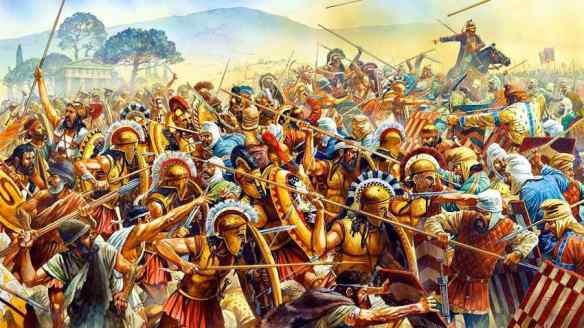
The interactions between the Greeks and Persians are often remembered through the lens of conflict, particularly the Greco-Persian Wars. However, this period of rivalry and warfare was followed by centuries of profound cultural exchange that helped shape the civilizations surrounding the Mediterranean. From the early trade routes connecting the Ionian cities to Persia to the fusion of cultures during the Hellenistic era, the Greeks and Persians left a lasting legacy that transcended war and division.
This article explores the nuanced relationship between the Greek and Persian worlds, examining how the initial rivalry gave way to mutual cooperation, leading to one of the most significant cultural exchanges in ancient history.
Context and Early Interactions
Long before the Greco-Persian Wars, Greek and Persian societies had established ties through commerce and diplomacy. The Ionian cities on the western coast of Asia Minor were strategically positioned between the two civilizations, serving as cultural conduits. These cities, populated by Greeks but often subject to Persian control, became pivotal points where cultural exchange thrived.
Trade routes connecting Persian territories to the Mediterranean facilitated the movement of goods and ideas, allowing Greek merchants access to Persian luxury items and vice versa. Artistic styles, religious practices, and political ideas traveled alongside these goods, gradually influencing each other’s traditions.
Persia’s expansion under Cyrus the Great and Cambyses II brought a considerable portion of the Greek world under Achaemenid rule. The Persian empire tolerated local customs and allowed limited self-governance, fostering relative stability and encouraging further cultural blending, particularly in the Ionian cities. However, these cities’ discontent with Persian rule and their desire for greater autonomy would soon escalate tensions.
Cultural Clash: The Greco-Persian Wars
The Greco-Persian Wars, beginning with the Ionian Revolt in 499 BC, were pivotal in shaping the cultural perceptions between the Greeks and Persians. The revolt, supported by Athens and Eretria, marked the first open rebellion against Persian control, challenging the stability of the empire’s western satrapies.
The subsequent Persian invasion under Darius I was an attempt to reassert control over the rebellious Greeks and punish Athens for its support. The famous battles of Marathon, Thermopylae, and Salamis became symbols of Greek unity against a common enemy, even as they highlighted the divide between the democratic city-states of Greece and the monarchical rule of Persia.
Xerxes’s invasion of Greece, following Darius’s failed campaign, was a monumental effort that saw Persians reaching the heart of mainland Greece. While the Greeks ultimately repelled the invaders, the wars left deep cultural scars on both sides. Greeks viewed the Persians as despotic tyrants seeking to subjugate their way of life, while the Persians perceived the Greeks as rebellious subjects who refused to accept the rule of a greater empire.
Despite these tensions, the wars also brought an unintended consequence: a fascination with Persian customs among the Greeks. This manifested itself in Greek art, literature, and fashion, with wealthy Greeks adopting aspects of Persian dress and lifestyle. Simultaneously, the Persians recognized the resilience and sophistication of the Greeks, and their own royal courts were influenced by Greek mercenaries and advisors.
Post-War Developments and Cooperation
Following the Greco-Persian Wars, the gradual stabilization of the eastern Mediterranean led to new forms of cooperation between the Greeks and Persians. The Peace of Callias in 449 BC marked the formal end of hostilities and opened channels for renewed trade and diplomatic ties.
Greek merchants and artisans resumed their travels across the Persian empire, bringing with them the artistic and architectural styles that would influence Persian art. Simultaneously, the Persian appreciation for Greek craftsmanship led to the hiring of Greek artisans for construction projects, especially in regions like Asia Minor.
Greek attitudes towards Persia also began to shift, particularly among the elites who benefited from the renewed trade. Persian luxury goods like spices, silk, and jewelry became coveted items in Greek markets. The admiration was mutual, as evidenced by the Persian court’s interest in Greek knowledge, employing Greek physicians, engineers, and craftsmen.
The philosophical exchanges between the two civilizations were equally significant. Greeks admired the Zoroastrian concept of a dualistic world and incorporated some elements into their philosophical thought. In turn, the Persian nobles were intrigued by the Greek emphasis on reason and logic, which would later be synthesized with their theological traditions.
Alexander the Great and the Hellenistic Era
The most notable period of cultural exchange between the Greeks and Persians occurred during and after the conquests of Alexander the Great. His campaigns effectively dismantled the Persian empire while bringing the Greeks into close contact with the diverse cultures of the Achaemenid realm.
Alexander pursued a policy of blending Greek and Persian traditions, encouraging marriages between his Greek soldiers and Persian women, and adopting Persian court customs himself. His founding of new cities across the former Persian empire created urban hubs where Greek and Persian influences merged.
The Hellenistic period that followed saw Greek influence become dominant in Persia, as Alexander’s successors established Greek-style monarchies across the Near East. However, this was not a one-sided exchange. Persian traditions, religious practices, and administrative structures continued to play a vital role in shaping these new kingdoms.
The Seleucid Empire, for instance, retained many Persian practices while also incorporating Greek military and administrative systems. This synthesis was evident in the Seleucid capitals, where Greek and Persian architecture coexisted, and royal courts featured officials from both cultures.
In literature and art, the blending of styles created a rich tapestry reflecting both Greek and Persian sensibilities. Persian epic tales influenced Greek and Hellenistic storytelling, while Greek styles found their way into Persian art. This period of fusion and cooperation marked the height of the Greco-Persian cultural exchange, resulting in a legacy that would endure well beyond the fall of the Hellenistic kingdoms.
Legacy of the Cultural Exchange
The Greco-Persian cultural exchange profoundly shaped the Mediterranean world, laying the foundation for the later Roman and Byzantine civilizations. The fusion of Greek and Persian philosophies influenced the development of religious and ethical systems, while the administrative innovations of the Persians became part of the Greek and Roman governance models.
This legacy can be seen in the shared forms of governance, religious practices, and philosophical traditions that persisted long after the last vestiges of the Achaemenid and Hellenistic empires had faded. It serves as a reminder that even amid conflict and division, cultures can find common ground and create lasting connections.
Conclusion
The relationship between the Greeks and Persians is a fascinating tale of rivalry, conflict, and ultimately, profound cultural exchange. Despite their differences and the wars that initially drove them apart, the Greeks and Persians found ways to appreciate each other’s traditions, leaving a legacy that resonates through the ages. Understanding this exchange amid centuries of conflict allows us to appreciate the complexities of history and the enduring nature of shared human culture.


 Kam Austine
Leave a comment