

The decline of the Achaemenid Persian Empire was a complex process influenced by multiple factors. Here’s an in-depth exploration of the primary reasons:
1. Military Defeats
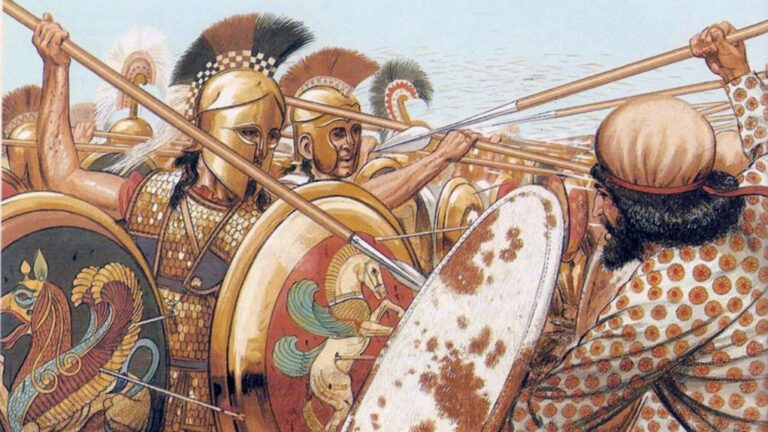
One of the most significant factors contributing to the decline of the Achaemenid Empire was a series of military defeats, most notably against the Greek states. The Greco-Persian Wars (499-449 BCE) were a major setback. Despite initial successes, the Persians were ultimately defeated at key battles such as Marathon (490 BCE), Salamis (480 BCE), and Plataea (479 BCE). These defeats not only weakened Persian military might but also tarnished their image of invincibility.
The decisive blow came with the conquests of Alexander the Great. Beginning in 334 BCE, Alexander launched a campaign against the Persian Empire, defeating Darius III at battles such as Issus (333 BCE) and Gaugamela (331 BCE). These defeats led to the rapid collapse of Achaemenid control and the eventual fall of their empire.
2. Internal Strife and Succession Issues
The Achaemenid Empire struggled with internal strife and succession issues, which weakened its stability. After the death of a strong ruler, internal conflicts often arose over who would take the throne. The assassination of Xerxes I in 465 BCE and the subsequent power struggles are prime examples. Xerxes I was murdered by Artabanus, the commander of the royal bodyguard, leading to a period of instability and power struggles. Artabanus initially seized power but was soon overthrown by Artaxerxes I, Xerxes’ son.
These internal conflicts distracted from governing and defending the empire, making it more vulnerable to external threats. Furthermore, the vastness of the empire made it difficult to maintain centralized control. Satraps (provincial governors) often wielded significant autonomy, sometimes leading to rebellion and corruption, further weakening the central authority.

3. Economic Strain
The vast size of the Achaemenid Empire required substantial resources to manage and defend. Continuous military campaigns, including those in Greece and Egypt, drained the empire’s treasury. Additionally, the maintenance of the Royal Road and other infrastructure projects, while beneficial for trade and communication, placed a significant financial burden on the empire.
The heavy taxation imposed on the subjects to fund these endeavors often led to economic discontent and rebellion. The burden of taxation without adequate economic reforms contributed to internal instability and weakened the empire’s economic foundation.
4. Cultural and Administrative Challenges
The Achaemenid Empire was a multicultural and multiethnic state, which, while a strength in terms of diversity and cultural richness, also posed significant administrative challenges. The empire’s policy of relative autonomy for different regions sometimes resulted in a lack of cohesion. Local customs, laws, and languages varied greatly, complicating governance.
Efforts to centralize authority often met with resistance. The empire’s attempts to impose uniform policies and practices sometimes clashed with local traditions, leading to unrest. The difficulty in managing such a diverse empire contributed to its eventual decline.
5. Decline in Leadership Quality
The decline in the quality of leadership after Darius I and Xerxes I also played a crucial role. Later Achaemenid rulers, such as Artaxerxes II and Artaxerxes III, faced significant challenges and internal strife, but lacked the strategic and administrative capabilities of their predecessors. The last Achaemenid king, Darius III, was unable to effectively organize resistance against Alexander the Great, leading to his defeat and the empire’s downfall.
6. Alexander the Great’s Conquests
Alexander the Great’s military genius and relentless campaign against Persia were pivotal in the empire’s decline. His ability to exploit Persian weaknesses and his strategic brilliance in battles like Issus and Gaugamela led to rapid Persian defeats. Alexander’s policy of integrating Persian nobility and customs into his administration further solidified his control over the former Achaemenid territories.

Rapid Succession and the End of the Dynasty
Following the death of Xerxes I, the Achaemenid Empire experienced rapid changes in rulers, contributing to its decline. Here is a brief overview of the key rulers and events leading to the end of the dynasty:
- Artaxerxes I (465-424 BCE):
- Seized power after the assassination of Xerxes I.
- His reign saw the continuation of internal strife and challenges in maintaining control over the vast empire.
- Died of natural causes, leading to further succession struggles.
- Xerxes II (424 BCE):
- Son of Artaxerxes I, ruled for only 45 days before being assassinated by his brother Sogdianus.
- Sogdianus (424-423 BCE):
- Ruled briefly after assassinating Xerxes II, but was overthrown and killed by Darius II.
- Darius II (423-404 BCE):
- Known for his attempts to stabilize the empire, but his reign was marked by corruption and further internal conflicts.
- Died of natural causes, succeeded by his son Artaxerxes II.
- Artaxerxes II (404-358 BCE):
- Faced numerous revolts and external threats, including the revolt of his brother Cyrus the Younger.
- His long reign was plagued by ongoing internal and external challenges.
- Artaxerxes III (358-338 BCE):
- Sought to reassert central authority and conducted military campaigns to regain control over rebellious regions.
- Poisoned, possibly due to court intrigues.
- Artaxerxes IV (Arses) (338-336 BCE):
- Short reign marked by further instability and assassinations.
- Killed by Bagoas, a powerful court eunuch.
- Darius III (336-330 BCE):
- Last Achaemenid ruler, faced the full force of Alexander the Great’s invasion.
- Defeated in key battles and eventually betrayed by his own satraps.
- Murdered in 330 BCE, marking the end of the Achaemenid dynasty.
Conclusion
The decline of the Achaemenid Persian Empire was a multifaceted process influenced by military defeats, internal strife, economic strain, cultural challenges, leadership issues, and the conquests of Alexander the Great. The rapid succession of rulers and the resulting instability further weakened the empire, leading to its eventual fall. Understanding these factors provides insight into the complexities of maintaining a vast and diverse empire and highlights the challenges faced by even the most powerful states in history.

 Kam Austine
Leave a comment