

Introduction: The Ingenious Legacy of the Achaemenid Empire
The Achaemenid Persian Empire, which flourished from the 6th century BCE until its conquest by Alexander the Great in 330 BCE, was not only vast in size but also in intellect and innovation. Known for its efficient administration, architectural wonders, and technological advancements, the Persian Empire laid the foundation for systems still in use today. From the qanat water management systems to their advancements in governance and infrastructure, ancient Persian innovations were instrumental in shaping both their empire and the broader world.
1. The Qanat System: Revolutionary Water Management
Water is the lifeblood of any civilisation, and in the dry, arid regions of Persia, managing water resources was both a challenge and a necessity. One of the most remarkable contributions from ancient Persia was the qanat system, an underground channeling technique used to bring water from distant underground aquifers to arid regions without significant evaporation loss.
- How It Worked: The qanats consisted of a series of vertical shafts connected by gently sloping tunnels. These tunnels allowed water to flow naturally from a higher water source to lower land areas for agriculture and drinking.
- Global Impact: The qanat system spread from Persia to regions like Egypt, North Africa, Spain, and even parts of China. Its impact can be seen in the irrigation systems still in use today in various arid regions around the world.
- Read more The Persian Aqueducts: How the Qanat System Revolutionised Agriculture and Cities

2. The Royal Road: Connecting an Empire through Infrastructure
The vast size of the Persian Empire necessitated a reliable way to communicate and manage distant regions. To address this, the Achaemenid rulers, particularly Darius I, created an extensive road system known as the Royal Road, which became a backbone for governance, military mobilisation, and commerce.
- Design: The Royal Road stretched over 2,500 kilometers (1,600 miles), connecting key cities such as Susa and Sardis. Along the road, relay stations and rest stops were built, allowing couriers to exchange horses and rest, ensuring messages could travel quickly across the empire.
- Pioneering Postal System: The couriers who traveled the Royal Road were part of an early postal system, described by Herodotus as a system where “neither snow, nor rain, nor heat, nor gloom of night” could prevent its function—a precursor to the modern postal service.
- Global Influence: This road system allowed Persia to efficiently govern its empire, and its concept later inspired the infrastructure of both the Roman Empire and modern transportation systems.
- Read more The Persian Royal Road: Connecting an Empire through Infrastructure and Architectural Marvels and The Nisean Horse: Persia’s Divine Breed and the Stallions of Achaemenid Glory
3. Standardised Currency: The Daric Gold Coin
To unify the diverse regions of the Persian Empire economically, Darius I introduced the daric, a standardized gold coin, and the siglos, its silver counterpart.
- Economic Revolution: By minting standardized coins, Darius facilitated trade and taxation across the empire’s vast territory, which spanned from the Indus River to Egypt. The use of gold and silver coins allowed for more efficient trade and simplified the collection of taxes.
- Impact on Trade: The introduction of these coins promoted international trade, particularly along the Royal Road and the Silk Road, contributing to the economic prosperity of the empire and the exchange of goods, culture, and ideas with neighboring civilizations.
- Legacy: The Persian system of standardized currency laid the groundwork for the concept of a unified economy, a model adopted by later empires such as the Greeks and Romans, and it resonates in modern monetary systems.
- read more about Achaemenid Economy.

4. Bureaucratic and Administrative Innovations: The Satrap System
The Persian Empire was the first empire to develop a sophisticated administrative system that allowed it to govern its vast and culturally diverse territories efficiently. Darius I is credited with creating the satrap system, which divided the empire into various provinces called satrapies, each governed by a satrap (provincial governor).
- How It Worked: Satraps were appointed by the king to govern specific regions, but they had autonomy in local matters while remaining loyal to the central authority. A system of checks and balances was established through royal inspectors, who ensured that satraps remained accountable to the king.
- Effective Governance: This decentralized administrative model allowed the Persian Empire to control its vast territories, making it possible to manage local affairs while still maintaining overall imperial unity. It also enabled a degree of cultural and religious autonomy in various regions.
- Global Influence: The satrap system influenced later empires, such as the Roman and Byzantine empires, and even modern federal systems of governance, where local leaders administer regions under the overarching control of a central government.
- Read more Bureaucratic and Administrative Innovations of the Achaemenid Empire: The Satrap System also Part 1: The Role of Satraps in the Achaemenid Empire: Balancing Power and Authority and Part 2: The Role of Satraps in the Achaemenid Empire: Balancing Power and Authority
5. Persian Engineering Marvels: Bridges, Canals, and Roads
The Achaemenids were master engineers who constructed monumental infrastructure projects that reflected both their practical needs and their imperial ambition. These projects not only facilitated commerce and communication but also underscored the might of the empire.
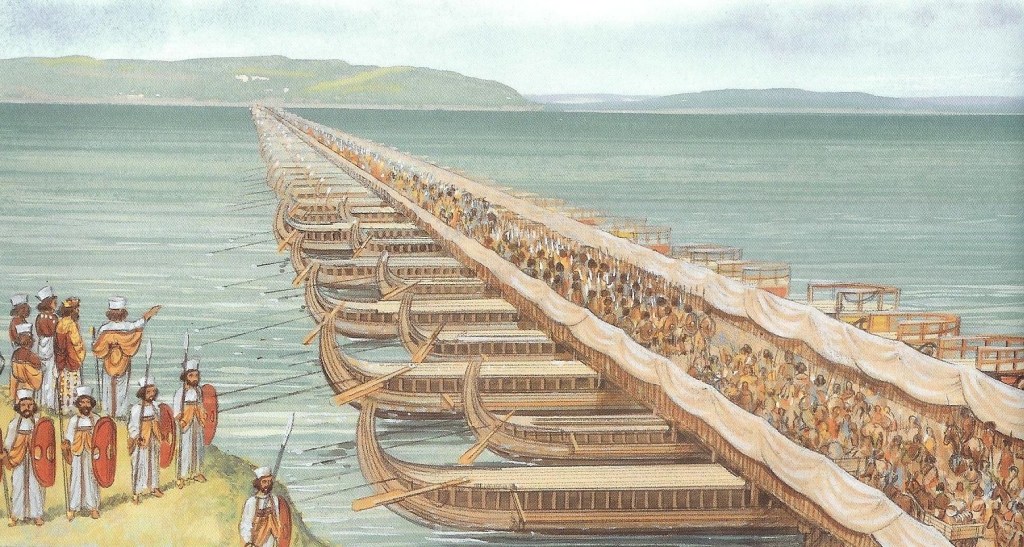
- Bridges: One of the most famous Persian engineering feats was the Pontoon Bridge constructed by Xerxes I during his invasion of Greece. It was made by lashing together boats to create a floating bridge across the Hellespont, allowing the Persian army to cross into Europe.
- Canals: Darius I initiated the construction of the Darius Canal, which connected the Red Sea to the Nile River. This canal allowed for easier trade between the Mediterranean and the Indian Ocean, centuries before the Suez Canal was created.
- Innovative Road Construction: Persian roads were not only extensive but also built with techniques that made them highly durable. In some areas, stone-paved roads were laid, which allowed for quicker and smoother travel compared to dirt roads. Their roads facilitated the rapid movement of armies, administrators, and traders.
6. Medicine and Healing: The Contributions of Ancient Persian Physicians
Ancient Persia also made contributions to the field of medicine. Persian physicians, many of whom worked in royal courts, made advances in surgery, herbal remedies, and holistic approaches to health. Persian scholars translated and preserved medical knowledge from earlier civilizations, contributing to its dissemination across the empire and beyond.
- Achaemenid Medical Practices: Persian doctors developed advanced techniques for treating wounds, performing surgical procedures, and creating herbal medicines. They are known to have used opium for pain relief and various plants for antiseptics.
- Global Influence: Much of this knowledge was passed on to Greek and later Roman doctors, with Persian medical texts playing a crucial role in the development of Islamic medicine. This body of knowledge eventually found its way into European medical practice during the Middle Ages and Renaissance.
- read more on Atossa’s Breast Cancer: The First Recorded Case in History
7. Astronomy and Timekeeping
The Persian Empire was also known for its advances in astronomy and timekeeping. Persian scholars developed sophisticated systems to track the stars and measure time, which played an important role in both agriculture and religious ceremonies.
- Astronomy in Ancient Persia: Persian astronomers built observatories and created star charts that helped them predict celestial events. Their understanding of the lunar and solar cycles was integral to the Zoroastrian calendar.
- Influence on Later Cultures: Persian advancements in astronomy were passed on to later Islamic astronomers, who would go on to make further contributions to the field during the Islamic Golden Age. These early observations laid the foundation for the astronomical innovations of the Renaissance in Europe.
- read more Celestial Innovations: How Achaemenid Persia Advanced Astronomy and Science
Conclusion: Persia’s Lasting Legacy
The innovations of the Achaemenid Persian Empire not only contributed to its own prosperity but also laid the groundwork for future empires and modern society. From infrastructure to governance, their advancements in areas like water management, roads, currency, and medicine created a model for future civilizations. The impact of ancient Persia’s innovations is still felt today, reminding us of the empire’s ingenuity and its lasting influence on the world.


 Kam Austine
Leave a comment