
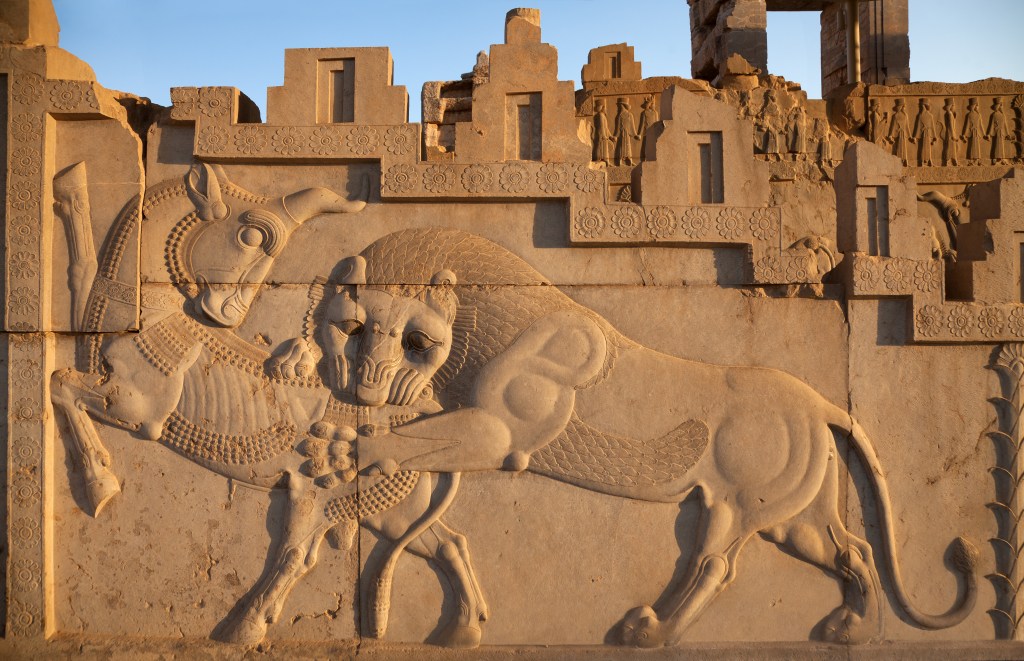
Picture above: Apadana Entrance in Persepolis – The lion-bull iconography during the Achaemenian period of ancient Persia has generated different theories of astronomical and seasonal events
The Achaemenid Empire, known for its military prowess and expansive governance, also became a thriving center for intellectual advancements. Science, particularly astronomy, played a crucial role in the empire’s daily life—from agriculture to religious ceremonies. Drawing from the vast knowledge of the cultures they absorbed, particularly Babylon, the Persians laid the foundations for future discoveries in astronomy, timekeeping, and scientific observation.
By combining Persian practicality with the wisdom of Babylonian, Egyptian, and Indian cultures, the Achaemenids created a fertile environment for the development of science, most notably astronomy. The Achaemenids are remembered for their curiosity about the heavens, the integration of celestial knowledge into their calendar, and the profound influence they exerted on later Islamic and Greek science.
The Role of Astronomy in the Persian Empire
Astronomy had a significant role in agriculture and timekeeping. In the arid lands of Persia, managing the seasons and crop cycles was crucial for survival. Persian astronomers used the stars to predict the best times for planting and harvesting, creating a system that synchronised nature’s rhythms with human needs.
The importance of astronomy extended beyond agriculture. Zoroastrianism, the dominant religion of Persia, emphasised the relationship between the cosmos and the divine. Persians believed that the heavens reflected the battle between good (Ahura Mazda) and evil (Angra Mainyu), and understanding the stars was a way to comprehend cosmic order. This philosophical and religious approach to astronomy meant that Persians were not just interested in the movements of the stars for practical reasons but also for their spiritual significance.
- The Zoroastrian Calendar: The Persian calendar, rooted in astronomical observation, divided the year into 12 months, each named after a different Zoroastrian deity. It was based on the solar year, making it one of the most accurate timekeeping systems of its era. This calendar was essential for coordinating religious festivals and state ceremonies. It also demonstrated how astronomy was interwoven with the daily and spiritual life of the empire.
- Celestial Worship: The Persians also worshiped celestial bodies, with fire temples and rituals often aligning with the stars. This practice later influenced both Islamic and Christian traditions of cosmic symbolism.

Babylonian Influence on Persian Astronomy
When Cyrus the Great conquered Babylon in 539 BCE, he inherited a vast wealth of astronomical knowledge. Babylon had one of the most advanced systems of star charts and calendars in the ancient world, dating back centuries. Babylonian astronomers were masters at predicting eclipses, tracking planetary movements, and documenting the cycles of the moon. This knowledge quickly integrated into Persian culture, and the Achaemenid court sponsored Babylonian astronomers to continue their work under Persian rule.
- The Enuma Anu Enlil: This Babylonian text, containing detailed records of celestial events, became a reference for Persian astronomers. The Babylonians were the first to create a systematic record of lunar and solar eclipses, and these records were passed on to the Persians. Their system of dividing the heavens into constellations and their methodology for interpreting celestial phenomena were both absorbed and expanded by Persian scholars.
- Use of Star Charts: Persians used these star charts to guide their agricultural, political, and religious decisions. The positions of the stars were seen as omens, signaling favorable or unfavorable times for state decisions. This practice later influenced Persian kings like Darius I, who used astrology to plan military campaigns.

K8538 is held in the British Museum collection
Development of Persian Observatories and Tools
One of the legacies of the Achaemenid Empire is the establishment of observatories for the systematic study of the stars. Persian astronomers developed tools for tracking celestial movements more precisely, and these observatories laid the groundwork for later advancements during the Islamic Golden Age.
- Observatories in Persia: These observatories, such as the one believed to have been established near Persepolis, allowed astronomers to map the stars with greater precision. Although these early observatories were rudimentary, they set the stage for the more sophisticated instruments and observatories that would come under later Persian dynasties and Islamic scholars.
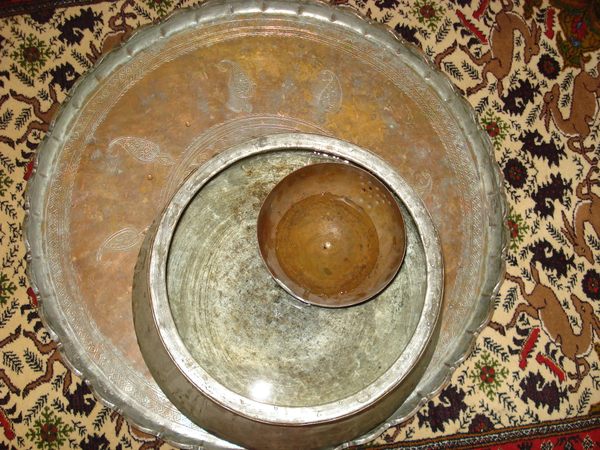
- Early Timekeeping Devices: In addition to observatories, the Achaemenids likely used water clocks and sundials for timekeeping. These devices were essential for both religious rituals and practical needs like trade and navigation. The water clock, in particular, was significant in measuring the passage of time at night, when the stars were most visible for tracking celestial bodies.
Zoroastrian Cosmology and Its Impact on Science
Zoroastrianism’s influence on Persian thought cannot be overstated. As a religion based on cosmic dualism—light versus darkness, truth versus lies—it encouraged a structured understanding of the universe. The sun, moon, and stars were central symbols in Zoroastrian cosmology, representing the forces of good that illuminated the world and kept chaos at bay.
- The Role of Light: Light, particularly the sun, was venerated as a symbol of Ahura Mazda’s divine presence. This veneration of light and cosmic order aligned with the Persians’ desire to understand and predict celestial movements. Persian philosophers saw the cosmos as an orderly structure where humans played an essential role in maintaining balance, an idea that would later resonate with early Greek philosophers influenced by Persian thought.
- Persian Influence on Greek Science: When Alexander the Great conquered Persia, he was exposed to this blend of science and religion. Greek philosophers like Heraclitus and Anaxagoras are believed to have been influenced by Persian dualism, particularly the notion of cosmic order and its reflection in human ethics. The flow of knowledge was not one-way, as Persian scholars also interacted with the Greek world, creating a cross-cultural exchange that enriched both civilisations.
Mathematics and Astronomy: The Foundation for Later Advancements
Persian interest in mathematics was also closely linked to their astronomical studies. Babylonian mathematical systems—especially their base-60 (sexagesimal) number system—became integral to Persian timekeeping and celestial mapping. The Babylonians were skilled in using mathematics to predict the movement of planets and lunar cycles, a practice adopted by Persian astronomers.
- Sexagesimal System: The Babylonians developed the sexagesimal system, which divides circles into 360 degrees, a method still in use today. This system was crucial for their understanding of the cosmos, and Persian astronomers used it to track planetary motions with precision. The division of time into 60 minutes and 60 seconds can also be traced back to this system.
- Geometric Calculations for Astronomy: Persian astronomers used geometric models to map the movements of celestial bodies. These geometric methods were essential for creating star charts and predicting eclipses. Their knowledge of geometry and algebra later became foundational for Islamic scholars like Al-Khwarizmi, who is often called the father of algebra.

Persian Science and the Islamic Golden Age
The collapse of the Achaemenid Empire did not mark the end of Persian contributions to science. Instead, many of the advancements in astronomy and mathematics were preserved and expanded during the Islamic Golden Age. Persian scholars, working under Islamic rule, continued to explore the heavens, building on the knowledge of their Achaemenid ancestors.
- Al-Khwarizmi and Astronomy: One of the greatest astronomers of the Islamic Golden Age, Al-Khwarizmi, was of Persian descent. His work on algorithms and the development of the astrolabe was deeply influenced by earlier Persian knowledge. He refined the sexagesimal system and introduced the use of zero in calculations, which revolutionized both astronomy and mathematics.
- Omar Khayyam: Another famous Persian polymath, Omar Khayyam, made significant contributions to astronomy and calendar reform. His work on the Persian calendar, building on the astronomical traditions of the Achaemenid era, resulted in a calendar that was more accurate than the Julian calendar and closer to the Gregorian calendar used today.
The Global Influence of Persian Astronomy
Persian advancements in astronomy left an enduring legacy on the wider world. From India to the Mediterranean, the knowledge passed down from the Achaemenid Empire influenced scholars across cultures. Persian observatories became models for later Islamic observatories, where the movement of celestial bodies was mapped with increasing precision.
- Influence on the Islamic World: Persian knowledge of astronomy and mathematics was preserved and expanded during the Abbasid Caliphate in Baghdad, where scholars like Ibn al-Haytham and Nasir al-Din al-Tusi built on Achaemenid ideas. The Islamic Golden Age saw the synthesis of Persian, Greek, and Indian astronomical knowledge, leading to breakthroughs in planetary motion, optics, and geometry.
- Transmission to Europe: The advancements in astronomy made by Persian scholars eventually reached Europe through translations of Arabic texts. Works by Al-Khwarizmi and other Persian scholars were translated into Latin, influencing European astronomers like Copernicus and Galileo. The mathematical and astronomical techniques developed during the Achaemenid and Islamic periods laid the groundwork for the scientific revolution in Europe.
Conclusion: Persia’s Celestial Legacy
The Achaemenid Empire’s advancements in science and astronomy laid a crucial foundation for the intellectual progress of future civilizations. Through their integration of Babylonian astronomical knowledge, establishment of observatories, and innovative timekeeping systems, the Persians expanded humanity’s understanding of the cosmos. These contributions were not only essential for the empire’s own governance and religious practices but also influenced later scholars in the Islamic Golden Age and Renaissance Europe. Persian science, particularly in astronomy, became a bridge between the ancient world and the modern scientific revolution, continuing to inspire generations of scholars.


 Kam Austine
Leave a comment