
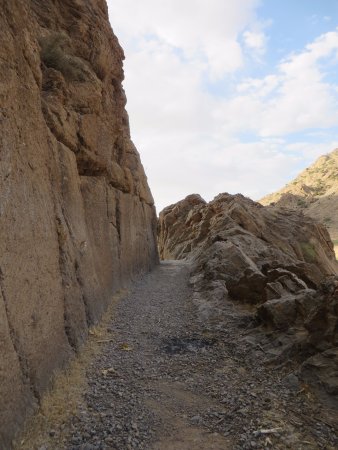
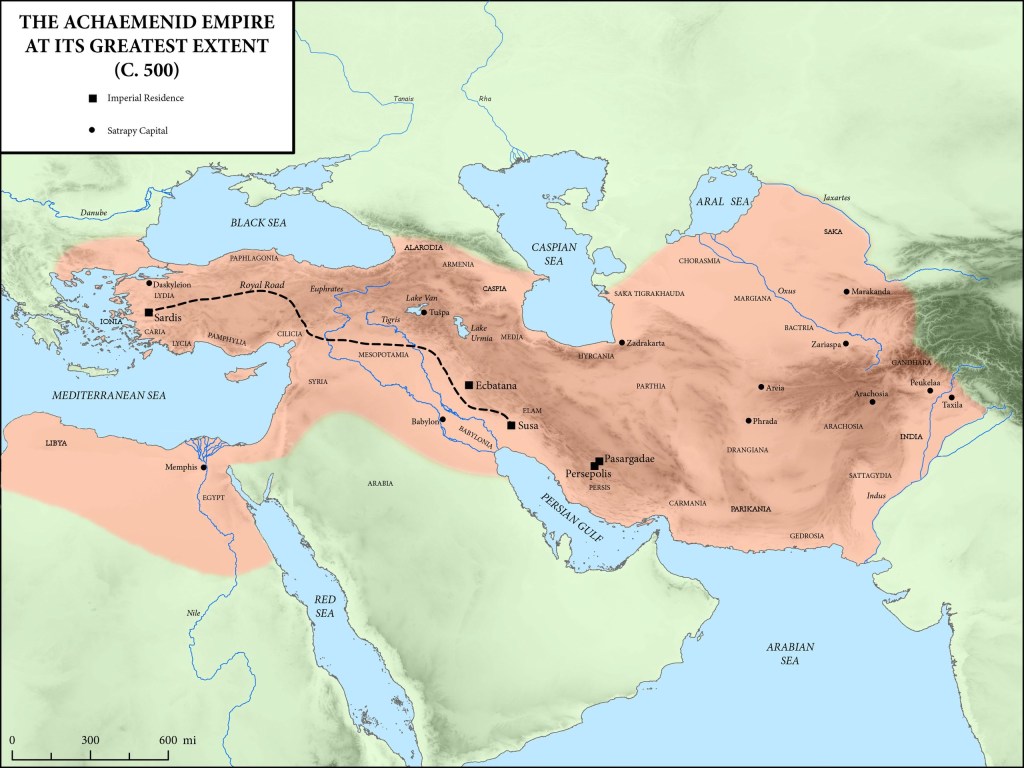
The Achaemenid Empire (550–330 BCE) is celebrated for its advanced infrastructure, which allowed it to manage vast territories stretching from the Mediterranean to the Indus Valley. While the Royal Road is often highlighted as the empire’s main artery, a complex network of lesser-known trade routes supported commerce, communication, and cultural exchange across remote regions. These minor routes connected local economies, linked the empire to distant regions, and played a critical role in integrating the empire’s diverse populations.
This article explores these overlooked roads and waterways, highlighting their origins, destinations, importance, and the critical roles they played in shaping the Achaemenid Empire.
1. Expanding the Network: Minor Roads of the Achaemenid Empire
1.1 Babylon to Ecbatana Route
This route was a key link between Babylon, the administrative heart of Mesopotamia, and Ecbatana (modern Hamadan, Iran), one of the empire’s prominent summer capitals. Stretching through the rugged Zagros Mountains, it served as a conduit for grain, textiles, and metal goods.
- Significance: This route facilitated communication between the empire’s western and central regions, enabling rapid troop movements and efficient tax collection.
- Branches: Smaller branches extended toward Susa, connecting the road to the Royal Road and allowing travelers to continue toward Sardis or Persepolis.
1.2 Persia to the Indus Valley
One of the most critical trade routes extended southeastward from Persia to the Indus Valley (modern-day Pakistan). This route passed through the arid Makran region, a challenging landscape requiring significant logistical expertise.
- Goods Traded: Spices, textiles, and gemstones flowed westward, while Persian silver and handicrafts made their way eastward.
- Importance: This road was vital for connecting the Achaemenid Empire to the rich cultures of the Indian subcontinent, laying the groundwork for future trade along the early Silk Road.
1.3 Routes to the Northeast: Sogdia and Bactria
In the northeast, minor roads connected Parthia, Sogdia, and Bactria (modern Uzbekistan, Turkmenistan, and Afghanistan). These regions were known for their agricultural wealth, horses, and silk production.
- Significance: These routes served as early precursors to the Silk Road, linking Persia to Central Asia and facilitating exchanges of luxury goods such as silk, lapis lazuli, and horses.
- Cultural Impact: The interaction between Persian and Central Asian cultures along these roads enriched the Achaemenid Empire, introducing new artistic and architectural styles.
1.4 Egypt to Persia
After the conquest of Egypt by Cambyses II, the empire developed overland routes connecting Egypt to Persia. These routes passed through the Levant (modern Israel, Lebanon, and Syria), ensuring the flow of Egyptian goods such as papyrus, linen, and grain.
- Connections: From the Levant, roads linked with the Royal Road near Babylon, allowing goods from Egypt to reach all corners of the empire.
1.5 The Western Branches: Anatolia and the Aegean
Minor roads in Anatolia (modern Turkey) served as vital links between Sardis (the terminus of the Royal Road) and various coastal cities along the Aegean Sea. These roads connected to ports that facilitated maritime trade with Greece and the wider Mediterranean.
- Goods Traded: Timber, wine, olive oil, and luxury goods flowed through these routes, strengthening ties between the Achaemenid Empire and its western territories.
1.6 Other prehistoric roads maintained and used by Persian
Please read the following articles:
Nomads, Traders, and Tribal Roots; Pre-Imperial Persia
The Elamite Empire – The Forgotten Architects of Persia
Part I – The Highland Kingdom — Anshan Before Persia
Part II – The Birth of Persia — From Anshan to Empire
2. Riverways and Seaways: The Hidden Lifelines of the Empire
While roads were critical for overland trade, rivers and seas provided natural highways for transporting heavy goods and connecting distant regions.
2.1 Mesopotamian Rivers: The Tigris and Euphrates
The Tigris and Euphrates Rivers in Mesopotamia were vital waterways for the Achaemenid Empire. These rivers allowed for the efficient transport of goods such as grain, dates, and textiles.
- Port Cities: Cities like Babylon and Uruk served as key riverine trade hubs, linking the Mesopotamian heartland to Persia and the Arabian Gulf.
- River Transport: Barges and small ships navigated these rivers, moving goods far more efficiently than overland routes in the region’s challenging terrain.
2.2 The Persian Gulf
The Persian Gulf was a crucial maritime corridor, connecting the Achaemenid Empire to the Arabian Peninsula, the Indus Valley, and beyond.
- Trade with the Arabian Peninsula: Goods such as incense, spices, and exotic animals flowed into Persia via ports along the Persian Gulf.
- Indus Valley Links: The Persian gulf also connected the empire to the Indus Valley, complementing the overland route through the Makran region.
2.3 The Red Sea
The Red Sea became increasingly important after Persia’s conquest of Egypt. It served as a vital link between Egypt and the southern Arabian Peninsula, facilitating the transport of goods such as myrrh, frankincense, and precious metals.
- Innovative Navigation: Persian mariners, influenced by Egyptian techniques, utilised seasonal winds to navigate the Red Sea efficiently, connecting the Nile to the Arabian Sea.
2.4 Caspian Sea and Northern Waterways
The Caspian Sea, though less prominent, provided a northern maritime link for the Achaemenid Empire.
- Connection to Central Asia: River systems like the Oxus (Amu Darya) linked the Caspian Sea to Bactria and Sogdia, facilitating the movement of goods such as silk and horses.
- Strategic Importance: These waterways allowed Persia to maintain control over its northeastern provinces and monitor potential threats from nomadic tribes.
3. The Canal of the Pharaohs: An Engineering Marvel
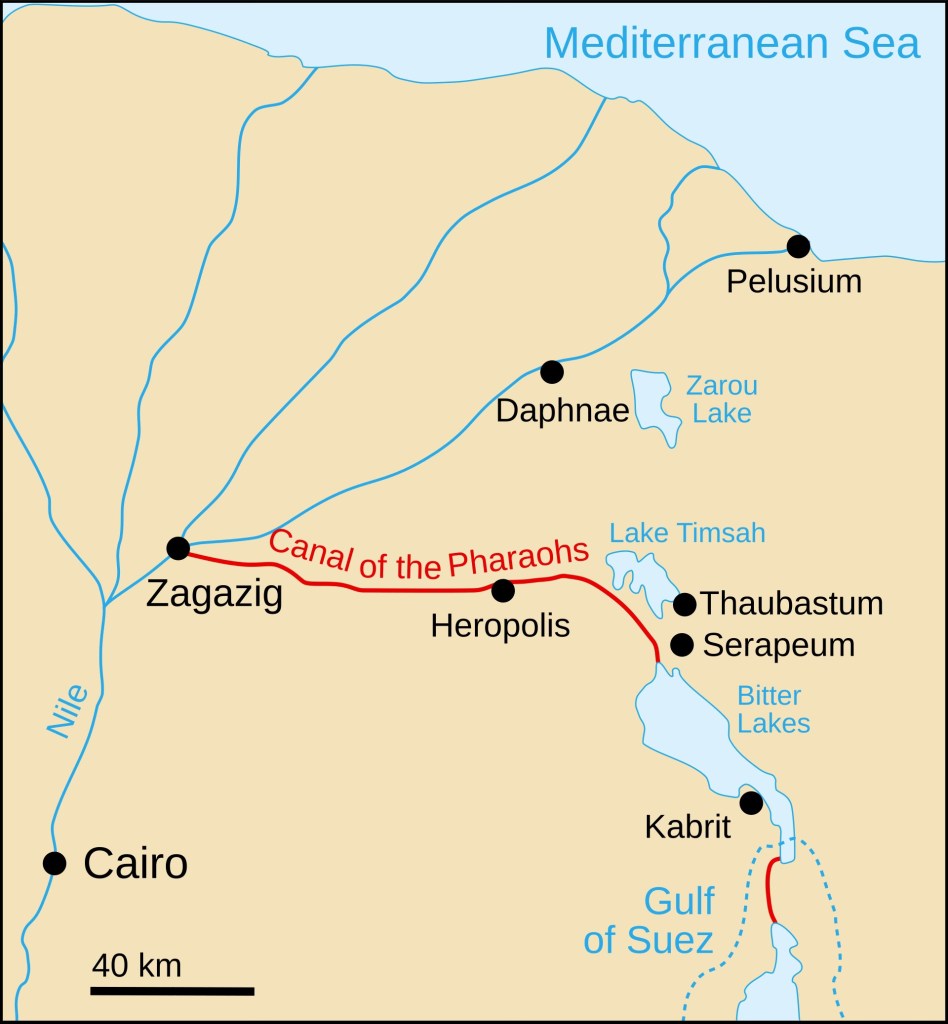
The Achaemenid Empire’s control of Egypt and its strategic vision led to the development of a canal connecting the Red Sea to the Nile River, an extraordinary feat of engineering that anticipated the modern Suez Canal. This canal, often referred to as the Canal of the Pharaohs, played a significant role in linking the Mediterranean Sea with the Arabian Sea via the Red Sea.
3.1 Origins and Construction
The canal’s construction was not a purely Achaemenid innovation; its origins date back to earlier Egyptian dynasties. However, it was during the reign of Darius I that the canal was completed and became a functional maritime route. Historical records, including Herodotus and later classical writers, suggest that Darius expanded and completed a canal that linked the Nile River near Bubastis to the Red Sea.
- Purpose: The canal served as a trade and military route, facilitating the movement of goods, troops, and resources between the Mediterranean, the Red Sea, and beyond.
- Route: The canal began at the eastern branch of the Nile in the Delta region and extended southeastward to the northern tip of the Red Sea (modern Suez).
Engineering Techniques
The canal’s construction required significant expertise in engineering and hydraulic management. Workers had to dig trenches through the desert, manage water levels, and prevent the accumulation of silt.
- Locks and Basins: To address the elevation differences between the Nile and the Red Sea, engineers constructed locks or basins to regulate water flow, ensuring smooth passage for ships.
- Width and Depth: The canal was designed to accommodate the seafaring vessels of the time, likely making it wide enough for cargo ships carrying goods like spices, timber, and textiles.
Completion by Darius I
An inscription attributed to Darius I celebrates the canal’s completion. According to Darius, “I ordered this canal to be dug from the Nile that flows in Egypt to the sea which begins in Persia. This canal was dug as I commanded, and ships went from Egypt through this canal to Persia, as I willed.” This statement underscores the canal’s significance in connecting Egypt to the broader Achaemenid Empire.
3.2 Economic and Strategic Significance
Trade Expansion
The canal transformed Egypt into a critical hub for trade between the Mediterranean, Red Sea, and Indian Ocean regions. Goods from Africa, Arabia, and the Indian subcontinent could now reach the Mediterranean more efficiently, while Persian exports flowed outward.
- Commodities Traded: Incense, spices, textiles, ivory, and precious stones from Arabia and India passed through the canal en route to the Mediterranean markets.
- Cultural Exchange: The canal also facilitated cultural exchanges, introducing Persian and Greek influences to regions in Africa and Arabia.
Military Mobility
The canal enhanced the Persian Empire’s ability to deploy naval forces across regions. Ships could be moved from the Mediterranean to the Red Sea and beyond without the need for long overland transport or treacherous maritime detours around the Arabian Peninsula.
Integration of Territories
By connecting the Nile to the Red Sea, Darius strengthened the integration of Egypt into the Achaemenid Empire. The canal demonstrated the empire’s capacity for large-scale infrastructure projects that benefited commerce and governance alike.
3.3 The Canal’s Later History
The Canal of the Pharaohs fell into disuse after the Achaemenid Empire’s decline, likely due to neglect and the accumulation of silt. However, the idea of a canal linking the Mediterranean to the Red Sea persisted, inspiring later rulers such as the Ptolemies and Romans. These subsequent efforts culminated in the construction of the Suez Canal in the 19th century, which follows a similar concept but on a modern scale.
3.4 Legacy of the Red Sea-Nile Connection
The canal was more than just an engineering achievement; it symbolised the Achaemenid Empire’s vision of connectivity. By linking waterways across vast regions, the empire demonstrated its commitment to fostering trade, cultural exchange, and political cohesion. The Canal of the Pharaohs stands as a testament to the ingenuity and ambition of the Achaemenid rulers, who understood the power of infrastructure in shaping their empire’s destiny.
4. Legacy of the Forgotten Roads
The lesser-known trade routes of the Achaemenid Empire were not mere extensions of the Royal Road—they were vital arteries that kept the empire alive. These routes connected local economies, integrated diverse cultures, and laid the groundwork for the future Silk Road. Their contributions to commerce, cultural exchange, and administrative efficiency were as significant as the grander infrastructure projects of the empire.
The integration of riverways and seaways into this network highlights the Achaemenid Empire’s ability to adapt to geography and utilise all available resources to maintain its vast domain. From the fertile plains of Mesopotamia to the deserts of the Makran, these forgotten roads and waterways tell the story of an empire built on connectivity and innovation.


 Kam Austine
Leave a comment