
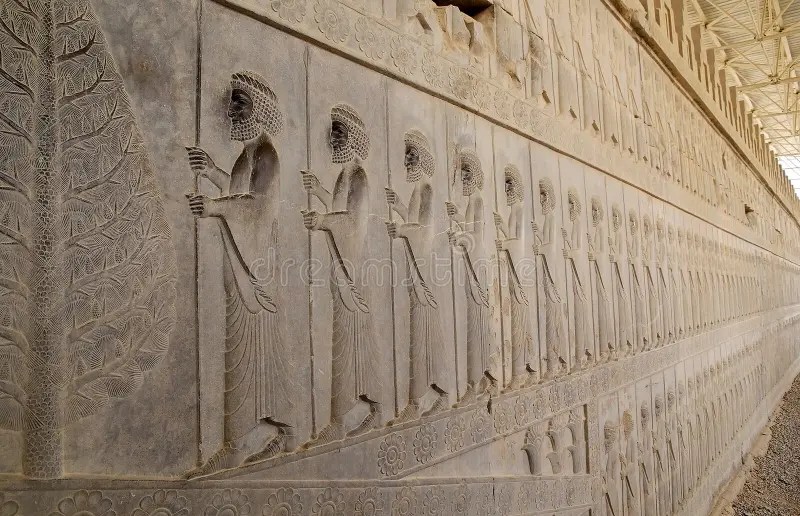
The Immortals were not just soldiers—they were a symbol of power, unity, and the might of the Achaemenid Empire. This elite force, celebrated in ancient texts and modern imaginations, formed the backbone of the Persian military and represented the empire’s strength and stability. Known for their discipline, impeccable organization, and unyielding loyalty, the Immortals were a vital part of Persian military dominance.
This article delves into the origins, structure, and legacy of the Immortals, peeling back the layers of myth to reveal the reality of one of history’s most enigmatic military units.
The Origins of the Immortals
The Immortals, known in Old Persian as the Anûšiya (meaning “companions” or “followers”), were first organized during the reign of Cyrus the Great (r. 550–530 BCE) and played a crucial role in the formation and expansion of the Achaemenid Empire. By the time of Darius I (r. 522–486 BCE), their structure and prestige were firmly established.
The Immortals earned their legendary name from Herodotus, the Greek historian, who described them as an elite unit of exactly 10,000 soldiers. According to Herodotus, any casualty—whether by death, injury, or illness—was immediately replaced, ensuring that their numbers never diminished. This continuity gave rise to their reputation as an “immortal” force, always ready and unwavering.
Structure and Composition
The Immortals were not just ordinary soldiers; they were the crème de la crème of the Achaemenid military. Their organization and equipment reflected their elite status:
1. Recruitment and Identity
- Ethnic Composition: While the Achaemenid Empire was vast and multicultural, the Immortals were predominantly Persian, ensuring loyalty to the royal court. Some scholars suggest that Medes and Elamites might also have been included.
- Selection: Only the most skilled and disciplined soldiers were chosen. Physical strength, combat ability, and unwavering loyalty to the king were paramount criteria.
2. Equipment
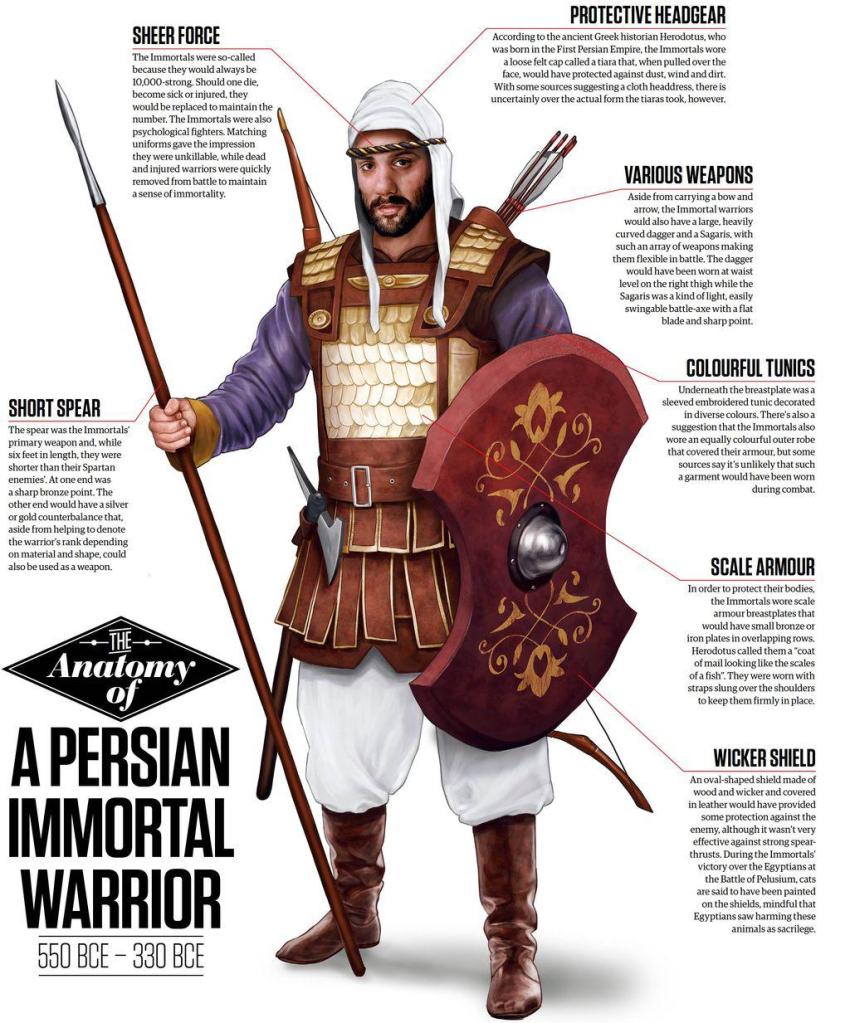
- Uniform: The Immortals were distinguished by their ornate uniforms and golden jewelry, which emphasized their elite status. Herodotus describes them as being “armed like the rest of the Persians, but with gold adornments that set them apart.”
- Weapons: Their armament included:
- Short spears with decorated shafts.
- Bows and quivers filled with arrows, reflecting their proficiency in ranged combat.
- Daggers for close-quarters combat.
- Large wicker shields, providing mobility while offering protection.
- Pack Animals: Each Immortal was accompanied by a servant and pack animals (camels or mules) to carry provisions and additional equipment, ensuring that the unit could sustain itself during long campaigns.
3. Command Hierarchy
The Immortals operated under a rigid command structure:
- A single commander, often a close confidant of the king, led the unit.
- The hierarchy ensured that orders flowed seamlessly, reflecting the discipline and efficiency for which they were famed.
Role in the Achaemenid Military Machine
The Immortals were more than just a fighting force; they were a versatile unit that performed multiple roles critical to the empire’s military strategy:
1. Guardians of the King
- The Immortals often acted as the king’s personal bodyguards, ensuring his safety during peacetime and war. Their constant presence around the monarch reinforced the image of unassailable royal power.
2. Shock Troops
- On the battlefield, the Immortals served as shock troops, delivering decisive blows to enemy forces. Their combination of archery and close-combat skills made them adaptable to various terrains and opponents.
3. Psychological Warfare
- The Immortals’ appearance, with their gleaming weapons and elaborate attire, was designed to intimidate. The sight of 10,000 disciplined soldiers advancing in unison struck fear into the hearts of their enemies.
4. Strategic Mobility
- Equipped with their own logistical support, the Immortals could be deployed quickly to any part of the empire, reinforcing their reputation as the empire’s most reliable military unit.
The Immortals in Battle
The Immortals participated in some of the most significant battles of the Achaemenid Empire:
1. The Conquests of Cyrus the Great
- The Immortals were instrumental in Cyrus’ campaigns, including the capture of Babylon in 539 BCE, a moment that solidified Persian dominance in the ancient Near East.
2. Darius I’s Scythian Campaign
- During Darius I’s expedition against the Scythians, the Immortals demonstrated their endurance and adaptability, navigating the challenging terrain of the Eurasian steppes.
3. The Greco-Persian Wars
- In the Battle of Thermopylae (480 BCE), the Immortals famously clashed with the 300 Spartans. Despite being unable to break the Spartans’ defense initially, their involvement showcased their importance in Xerxes I’s military strategy.
The Legacy of the Immortals
The Immortals left an enduring legacy that transcended the Achaemenid Empire:
1. Symbol of Persian Power
- To both friends and foes, the Immortals symbolized the might and unity of the Persian Empire. Their discipline and organization became a model for future military forces.
2. Influence on Later Armies
- The concept of an elite, ever-ready military unit inspired later empires, including the Romans and Byzantines. Even in modern times, the name “Immortals” evokes a sense of invincibility.
3. Cultural Representation
- The Immortals continue to captivate popular imagination, appearing in films, books, and historical reenactments. Their mystique, rooted in Herodotus’ writings, ensures their place in history as one of antiquity’s most iconic military units.
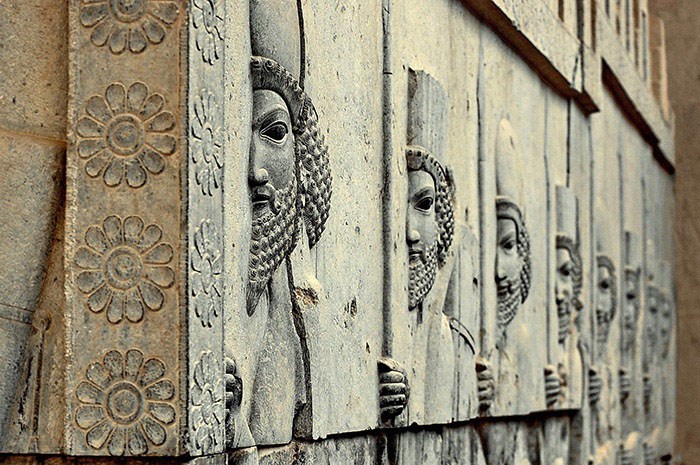
Conclusion: The Immortals as a Reflection of Achaemenid Strength
The Immortals were more than an elite guard; they embodied the ideals of the Achaemenid Empire, discipline, loyalty, and power. Through their unwavering dedication to the throne, they helped Persia maintain its dominance over a vast and diverse empire. Yet, their mystique also serves as a reminder of the fragile nature of power, as even the greatest military forces can falter when the empire they serve begins to crumble.
The Immortals’ legacy lives on, a sign of the grandeur and complexity of the Achaemenid Empire and the military innovations that helped it endure as one of history’s greatest civilisations.
Read more about Persian Achaemenid Military
The Nisean Horse: Persia’s Divine Breed and the Stallions of Achaemenid Glory
Egypt and Persia: Battles, Governance, and Cultural Exchange in Antiquity
The Greco-Persian Cultural Exchange: From Conflict to Cooperation
Why Did the Achaemenid Persian Empire Decline?
The Deaths of the Achaemenid Kings: Power and Peril from Cyrus to Darius III
Part 1: The Role of Satraps in the Achaemenid Empire: Balancing Power and Authority
Part 2: The Role of Satraps in the Achaemenid Empire: Balancing Power and Authority
The Assyrian Model of Imperial Control: Lessons the Persians Embraced and Rejected
The Persian Royal Road: Connecting an Empire through Infrastructure and Architectural Marvels


 Kam Austine
Leave a comment