

Water is the lifeblood of civilization, and few ancient societies understood this better than the Persians of the Achaemenid Empire. In an arid and unforgiving environment where rainfall was scarce and rivers unpredictable, the ancient Persians developed an ingenious solution: the qanat system. This underground aqueduct network allowed them to transport water over long distances, transforming deserts into fertile lands and enabling cities to thrive.
This article explores the origins, engineering marvels, and far-reaching impact of the qanat system, a technological innovation that revolutionised agriculture, urban development, and water management in the ancient world.
1. The Birth of the Qanat System
The qanat system originated in ancient Persia, with its development likely beginning as early as the first millennium BCE. The need for such a system arose due to the geography of the region. Persia (modern Iran) is characterised by vast deserts and rugged mountains, with limited surface water to support agriculture and settlements.
- Why Qanats Were Necessary: Traditional irrigation techniques, such as surface canals, were impractical due to high evaporation rates and the seasonal nature of rivers. To address these challenges, the Persians developed a method to access underground water supplies from aquifers and transport it to the surface without significant water loss.
- Early Evidence: Archaeological evidence points to early qanat systems in the region of Zagros Mountains and Khorasan. By the time of the Achaemenid Empire (550–330 BCE), the technology had spread across the empire, from Persia to Mesopotamia, North Africa, and even as far as Spain through later Islamic expansion.
2. Engineering the Qanat: A Masterpiece of Precision
The construction of a qanat required remarkable skill, precision, and labor, often involving teams of engineers, surveyors, and diggers. The process was complex and could take years to complete.
2.1 How Qanats Were Built
- Locating the Water Source: Engineers first identified a suitable underground aquifer, often located at the base of a mountain. These aquifers were typically formed by rainfall seeping through permeable rock layers.
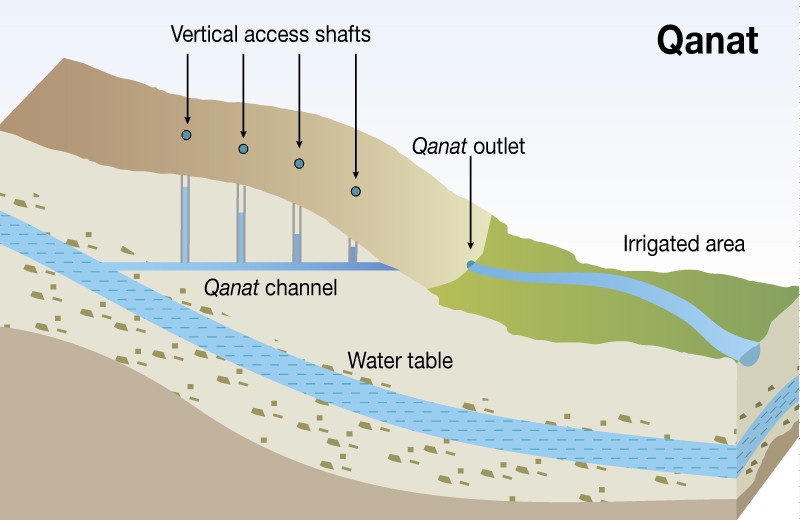
- Sinking Vertical Shafts: Vertical shafts were dug at regular intervals along the planned route of the qanat. These shafts provided access points for workers and helped ventilate the tunnel.
- Constructing the Main Tunnel: Workers then dug a gently sloping tunnel from the aquifer to the surface, ensuring that the gradient was precise enough to allow the natural flow of water without flooding or stagnation.
- Calculating the Gradient: The slope of the qanat, typically less than 0.5%, was crucial to its success. Too steep a gradient would cause erosion, while too shallow a gradient could result in insufficient water flow.
Read similar engineering of Persians for Nile Canal knows as canal of Pharaohs.
2.2 Architectural Features
- Vertical Shafts: The shafts, which could be as deep as 100 meters in some cases, were essential for maintenance and allowed workers to clear blockages and repair the system when necessary.
- Tunnels and Galleries: The main tunnel was typically 1 to 2 meters high, allowing workers to move freely during construction and maintenance.
- Water Distribution Channels: Once the water reached the surface, it was directed into canals or reservoirs for agricultural and urban use.

3. Qanats in Agriculture: Turning Deserts Green
The primary purpose of the qanat system was to provide a reliable water supply for agriculture, enabling farmers to cultivate crops in otherwise arid regions.
- Expanding Farmland: Qanats allowed for the expansion of farmland beyond river valleys, making it possible to grow crops like wheat, barley, dates, and pomegranates in desert regions.
- Stable Water Supply: Unlike rivers that could dry up during droughts, qanats provided a year-round source of water. This stability supported the growth of permanent settlements and large agricultural estates.
- Terraced Farming: In mountainous regions, qanat water was used to irrigate terraced fields, maximizing arable land in hilly terrain.
- Crop Rotation and Sustainability: The consistent water supply allowed for sustainable farming practices, including crop rotation, which preserved soil fertility and prevented overexhaustion of the land.

4. The Role of Qanats in Urban Development
Beyond agriculture, qanats were integral to the development of cities and towns, particularly in the arid heartland of the Achaemenid Empire.
- Urban Centers: Cities such as Persepolis, Pasargadae, and later Yazd thrived thanks to qanat-fed water supplies. Public baths, fountains, and gardens were made possible even in desert cities, showcasing Persian advancements in water management.
- Gardens and Royal Complexes: The concept of Persian gardens (pardis), known for their lush greenery and flowing water, would not have been possible without qanats. These gardens symbolized paradise in Persian culture and reflected the empire’s mastery of irrigation.
- Cooling and Ventilation: In addition to providing drinking water, qanats helped cool buildings through a system of wind towers (badgirs). Cool air was drawn over qanat water and circulated through buildings, offering relief from the scorching desert heat.
5. The Spread and Legacy of the Qanat System
The success of the qanat system did not end with the Achaemenid Empire. As Persian influence spread, so did its engineering marvels.
- Export to Other Civilizations: The qanat system spread to Mesopotamia, North Africa, Arabia, and eventually Spain during the Islamic period. The Spanish version, known as the galería, contributed to the development of irrigation in the Iberian Peninsula.
- Influence on Islamic Engineering: During the Islamic Golden Age, Persian engineers refined and expanded qanat technology, incorporating it into cities like Damascus and Córdoba.
- Modern-Day Use: Today, qanats are still in use in parts of Iran, Oman, and Afghanistan, providing water to remote villages and preserving a tradition that has lasted for over two millennia.

6. Challenges and Modern Adaptations
Despite their longevity, qanats face several challenges in the modern era:
- Maintenance and Depletion: Many qanats have fallen into disrepair due to a lack of maintenance or overuse of groundwater, leading to the drying up of aquifers.
- Urbanization and Modern Wells: The rise of modern wells and pumping technology has made qanats less essential in some regions, although they remain vital in rural areas where modern infrastructure is unavailable.
- Conservation Efforts: Recognizing their historical and cultural significance, organizations in Iran and UNESCO have worked to preserve remaining qanats. The Gonabad Qanat in Iran is a UNESCO World Heritage Site, celebrated for its engineering and historical value.
Conclusion: A Witness to Persian Ingenuity
The qanat system stands as one of the greatest engineering achievements of the ancient world. By harnessing underground water and transporting it across vast distances, the Persians turned deserts into fertile farmland and created thriving cities in the harshest environments. Their innovations in water management influenced civilisations far beyond their borders and laid the foundation for sustainable irrigation systems still in use today.
As we marvel at modern irrigation and water distribution networks, it is worth remembering that much of this progress was built on the ingenuity of ancient Persian engineers and their remarkable qanat system—a technology that continues to provide life and sustenance thousands of years after its invention.


 Kam Austine
Leave a comment