
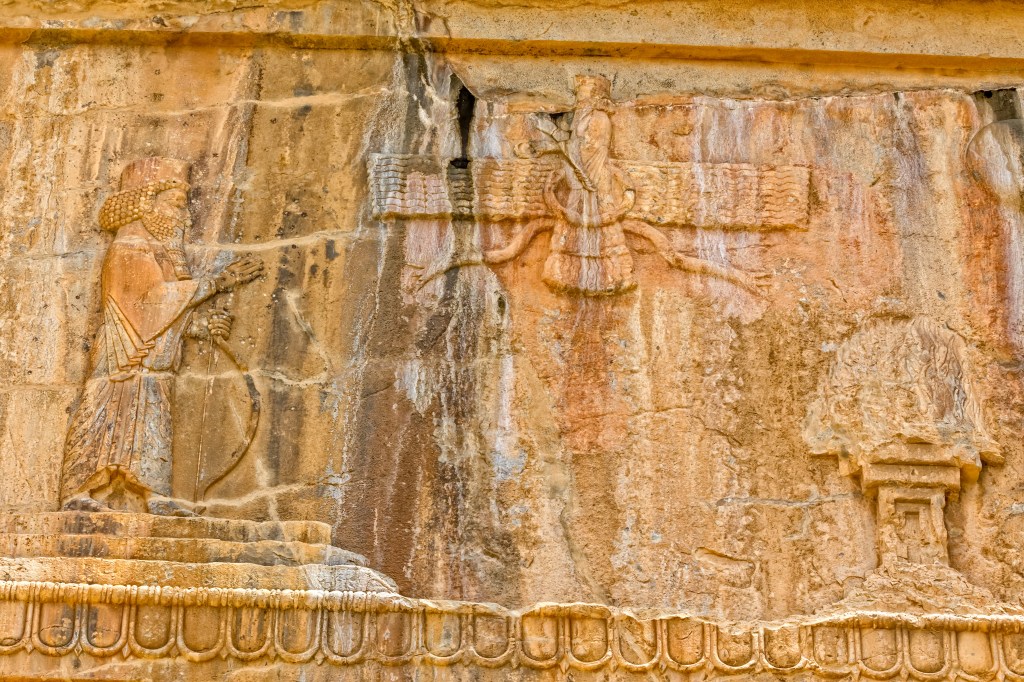
When the Persian Empire emerged under Cyrus the Great and later flourished under Darius I, it presented itself not only as a political dominion, but as a moral order. Achaemenid kings ruled not simply by conquest, but by truth — by asha, the cosmic principle of order, justice, and righteousness. This concept, foundational to Zoroastrianism, was no imperial afterthought. It had deep roots in the tribal and spiritual traditions of the Iranian plateau — a legacy that predated empire and infused it with a distinct ethical identity.
In this article, we explore how pre-imperial Zoroastrian ideas helped shape the ideological infrastructure of the Achaemenid state. From fire rituals and ethical dualism to the sacred responsibilities of kingship, Zoroastrianism provided the Achaemenids not just with a religion, but with a framework for legitimacy, governance, and moral authority.
The Iranian Plateau Before Empire: A Sacred Landscape
Long before the rise of the Achaemenids, the Iranian plateau was home to Indo-Iranian tribes who practised a polytheistic, nature-oriented belief system. These early Iranians revered fire, water, the sun, and the forces of fertility and renewal. Their religious life was mobile, oral, and ritualistic — performed in open landscapes rather than formal temples.
Out of this milieu, a set of spiritual principles emerged. Among them, one concept stood out: asha — a word encompassing truth, order, cosmic harmony, and right conduct. Opposed to it was druj, or the lie — the force of deception, chaos, and evil. This moral dualism, in its early form, was not yet rigid theology, but an ethical compassguiding individual behaviour and communal expectations.
Zoroaster (Zarathustra), the prophet of Zoroastrianism, likely lived and preached sometime between 1200 and 600 BCE, though scholars disagree on the precise date. What is clear is that by the time of Darius I, Zoroastrian thought — especially its veneration of asha and fire — had become embedded in royal ideology.
Fire, Truth, and Ritual: The Sacred in Daily Life
Among early Iranian tribes, fire was not worshipped as a god, but revered as the visible presence of truth, energy, and purification. Fire was central to domestic rituals, seasonal ceremonies, and oaths of loyalty. In the absence of written scripture or established clergy, ritual truthfulness and right action were the highest religious obligations.
This was not an abstract theology but a lived practice. Speaking truthfully, tending fire, caring for the land, and showing hospitality were acts of alignment with asha. Inversely, lying, hoarding, cruelty, and disrespecting sacred elements aligned one with druj — the force of disorder.
Such a system was inherently moral and politically resonant: leaders who governed justly were considered aligned with asha. Those who ruled with cruelty or deceit, even if victorious, were spiritually illegitimate.
Zoroaster’s Revolution: Ethics Over Ritual
Zoroaster’s innovation was to elevate this pre-existing worldview into a monotheistic ethical religion. He taught that the supreme deity, Ahura Mazda (the Wise Lord), created asha and governed the world through it. Human beings had free will, and their actions in this life contributed to the cosmic struggle between truth and the lie.
Zoroaster rejected the empty ritualism of older Indo-Iranian sacrifices, placing emphasis instead on intent, truthfulness, and good deeds. His message resonated with tribal elites who saw in it a justification for righteous leadership and spiritual legitimacy.
By the time of the Achaemenid kings, Zoroastrian principles had spread through large parts of eastern Iran and into Pars. Whether Cyrus himself was a formal Zoroastrian remains debated — but by the reign of Darius I, Zoroastrian concepts were firmly embedded in the ideology of empire.
Read more on The Blossoming of Science, Philosophy, and Mathematics During the Achaemenid Era
Darius I and the Moral Kingship of Asha
The clearest evidence of Zoroastrian influence on imperial ideology comes from the Behistun Inscription, carved by order of Darius I around 520 BCE. Written in Old Persian, Elamite, and Babylonian, it is both a royal proclamation and a spiritual testament.
Throughout the inscription, Darius declares that he rules by the grace of Ahura Mazda and that his authority is based not only on lineage or conquest, but on truthfulness, order, and justice. He portrays his victory over usurpers not as mere political success, but as a moral victory over the lie.
“It was by the will of Ahura Mazda that I became king. Ahura Mazda gave me the kingdom because I was not deceitful, I was not wicked… I governed them according to asha.”
Here, we see a clear fusion of Zoroastrian ethics with imperial power. Kingship is conditional upon moral conduct, and the king is accountable to a higher cosmic order. This sharply contrasts with earlier models (like the Assyrians), where kings ruled by sheer power or divine wrath.
Institutions of Sacred Governance
Under the Achaemenids, fire temples began to take on a more formalised role. While we have little archaeological evidence from the early empire, later Zoroastrian tradition places the establishment of sacred fires and temple infrastructure in this era. It’s likely that the Persians standardised some ritual forms and elevated the priesthood (magi) as part of imperial administration.
Yet the Persian Empire never enforced a religious orthodoxy. Instead, it built a spiritual umbrella under which multiple traditions could coexist — with Zoroastrian ethics at the ideological core. Ahura Mazda was often portrayed as the high god, but the empire did not demand conversion. Instead, it used religious concepts to legitimise imperial unity.
This flexibility, grounded in a unifying moral framework rather than a rigid theology, helped the Achaemenid Empire sustain diversity without fragmentation.
Legacy and Continuity
Zoroastrian thought did not vanish with the fall of the Achaemenids. It continued through the Parthian and Sasanian periods, eventually becoming the state religion of the latter. But it was under the Achaemenids that Zoroastrian principles first shaped an empire.
The emphasis on truth in governance, the sacredness of fire and earth, the expectation that rulers must act justly — these ideas outlasted temples and dynasties. They influenced not only Iranian tradition, but left traces in Hellenistic philosophy, early Islamic administrative theory, and Western interpretations of the “philosopher-king.”
Conclusion: The Spiritual Architecture Beneath Empire
The Persian Empire was not built by conquest alone. It stood upon a spiritual architecture centuries in the making. The tribes of Pars, and the broader Iranian world, carried with them a moral vision — one that valued truth, purity, and just rule. Zoroastrianism gave this vision clarity and direction.
By the time Darius spoke of Ahura Mazda and the lie of the usurper, he was not inventing a religion — he was articulating a legacy of ethical kingship rooted in generations of belief.
Zoroastrianism was never merely about fire temples or rituals. It was about the sacred responsibility to act with wisdom, truth, and justice — a responsibility that, in the Achaemenid mind, made empire not only possible, but righteous.


 Kam Austine
Leave a comment