
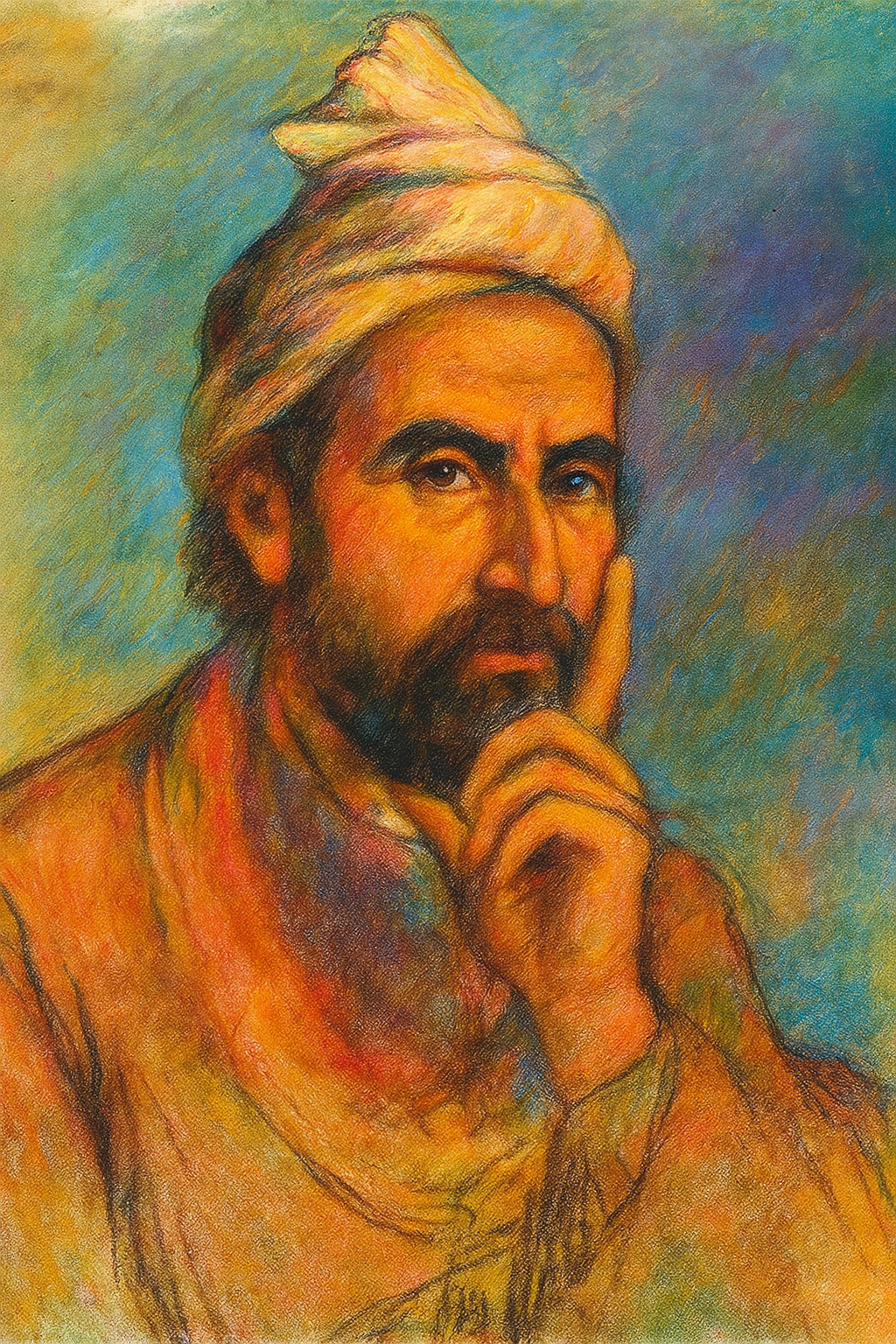
No. 30
The secrets of eternity, neither you know nor I;
And this enigmatic discourse, neither you read nor I.
Behind the veil lies the conversation of you and I,
But when the veil lifts, neither you remain nor I. *
Philosophical Reflection
Few quatrains in Khayyam’s corpus express epistemic humility with such grace and finality. The opening line establishes the central claim: the ultimate truths of existence — its origins, its destiny, and the nature of eternity — are concealed from all. No person, however learned or devout, possesses the final answer. Khayyam makes no exceptions, offering an equal negation: “neither you know nor I.” This shared unknowing becomes a human bond, a leveling of all pretensions.
The second line intensifies the point. The “enigmatic discourse” — the puzzle of existence itself — is a text no one can read. Life appears to speak in symbols, causes, and signs, yet none of it resolves into a decipherable message. The world’s meaning, if it has one, remains hidden behind a veil we cannot penetrate. Khayyam’s tone is not one of frustration but of acceptance. The mystery is not a flaw but a condition.
The third line introduces a subtle shift. There is, he suggests, a “conversation” behind the veil — a truth, a logic, a pattern, a dialogue between existence and consciousness. But it lies entirely out of reach. We intuit that something is happening beyond our sight, but we cannot hear its words. This is perhaps one of Khayyam’s most elegant descriptions of metaphysical distance: an awareness of meaning’s presence without the ability to grasp it.
The final line closes the quatrain with existential clarity. When the veil finally lifts — at death — the ones seeking understanding no longer remain to receive the answer. Whatever truth exists does not reveal itself within the bounds of personal existence. Khayyam therefore negates both revelation and the self simultaneously. The point is sharp: if truth is unveiled only after consciousness dissolves, then one must live without the comfort of knowing.
This quatrain echoes Khayyam’s stance in Doubts Concerning the Bases of Knowledge, where he dismantles claims to certainty, and in Treatise on Being, where he explores the limits of metaphysical understanding. The verse invites readers not to despair at ignorance but to recognise the humility, equality, and even beauty that arise from living within an unfinished mystery.
Footnote
* Source: Trabkhaneh, Homaei, no. 30, translated by Kam Austine for the book Philosophy in Verse
اسرار ازل را نه تو دانی و نه من
وین حرف معما نه تو خوانی و نه من
هست از پس پرده گفتگوی من و تو
چون پرده بر افتد نه تو مانی و نه من
Related Khayyam’s Treatises:
Doubts Concerning the Bases of Knowledge
Treatise on Being
The Light of the Intellect on the Subject of Universal Knowledge
Internal Themes: #Meaning #Doubt #Epistemology #Ontological Mystery
Published as part of the Philosophy in Verse Series — under “Meaning & Doubt.”

 Kam Austine
Leave a comment