
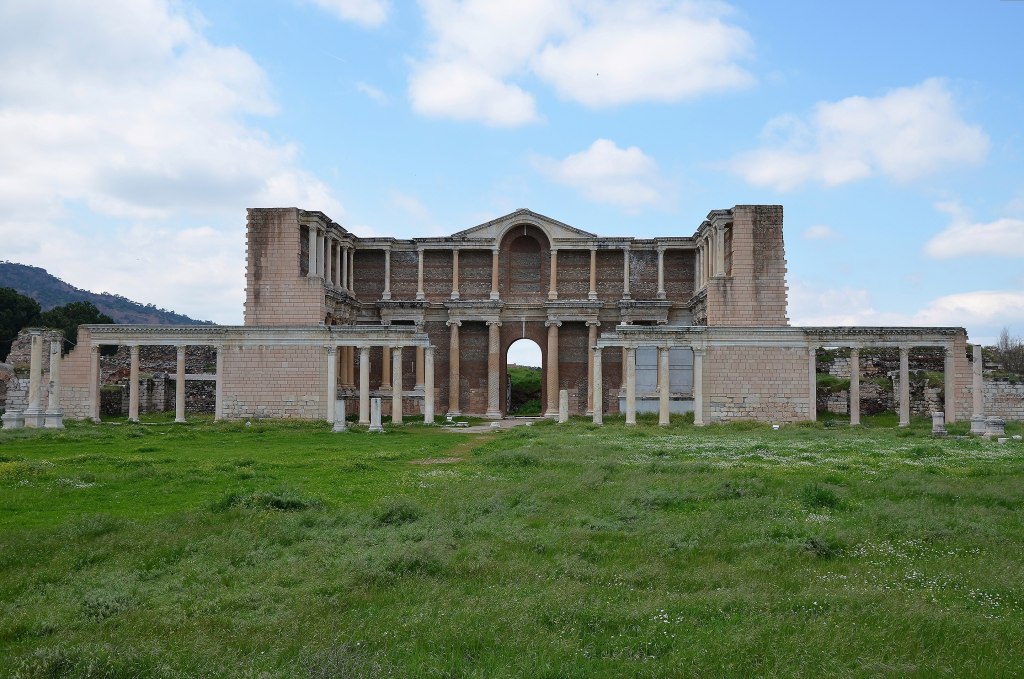
Picture above: The Bath-Gymnasium complex at Sardis, late 2nd – early 3rd century AD, Sardis, Turkey (wikipedia)
The rise of the Persian Empire is often seen through the lens of eastern conquests — Median submission, Babylonian succession, and Elamite inheritance. But to understand how Persia became a truly world-spanning power, we must turn west — to Lydia, a kingdom of immense wealth, strategic geography, and cultural sophistication.
The fall of Croesus, Lydia’s legendary king, was not merely a conquest; it was a transformative acquisition. With Lydia, the Achaemenids inherited not just land, but systems — of money, governance, metallurgy, and diplomacy — that would reshape the economic and geopolitical face of their empire. This article traces how Persian ambition met Lydian innovation, and how the echoes of that encounter helped shape the foundations of imperial finance, Anatolian administration, and cross-cultural exchange.
The Kingdom of Lydia: A Western Powerhouse
By the 6th century BCE, Lydia had emerged as the dominant power in western Anatolia. Its capital, Sardis, nestled at the foot of Mount Tmolus and near the fertile Hermus River, was a centre of commerce, metallurgy, and political influence.
Lydia was a bridge kingdom — positioned between the Greek world and the great empires of the east. Its rulers controlled trade routes that passed through the Aegean, Phrygia, and the Iranian plateau. Its wealth derived from both natural resources — especially gold from the Pactolus River — and its control over Ionian city-states, including Ephesus, Smyrna, and Miletus.
At the helm of this flourishing state was Croesus, the last king of Lydia, whose name would become synonymous with opulence. His court dazzled with splendour. His alliances reached as far as Egypt and Babylon. And his empire appeared, briefly, indomitable.
Croesus and the Clash with Persia
When Cyrus the Great toppled the Median king Astyages in 550 BCE, Croesus misread the regional balance. Bound by familial ties to the Medes and emboldened by the Delphic Oracle, he launched a pre-emptive campaign against the young Persian kingdom.
Initially, Croesus’s forces met Cyrus’s army near the Halys River, resulting in an inconclusive battle. Believing winter would halt further fighting, Croesus returned to Sardis — only for Cyrus to pursue and besiege him in a rapid counteroffensive. Within weeks, Lydia fell. Sardis was captured. And Croesus, the richest man in the known world, became a subject — or adviser, depending on the version — to the Persian king.
This was not just a military victory. It was the acquisition of a fully operational state apparatus — with systems of finance, taxation, diplomacy, and manufacturing that the Persians could now harness on a grander scale.
The Invention of Coinage: A Lydian Legacy
One of Lydia’s most enduring contributions was its invention of coinage. Long before silver drachmas circulated in Athens or gold darics bore the image of Persian kings, Lydia had pioneered the use of stamped electrum coins — a naturally occurring alloy of gold and silver — under King Alyattes and perfected under Croesus.
These coins were not merely tokens of exchange. They were state-backed instruments of value, bearing royal emblems (often lions or bulls) and guaranteed by the king’s treasury. They facilitated trade, standardised tribute, and allowed for the accumulation of capital in a way that barter or weighed metals could not.
The Achaemenids, though initially slow to adopt coinage, eventually issued their own gold darics and silver sigloi — unmistakably modelled on Lydian prototypes. These coins became the economic backbone of the Persian Empire, used to pay soldiers, fund infrastructure, and circulate across its vast territories.
Thus, Lydian monetary innovation became Persian financial infrastructure — allowing the empire to function at a scale previously impossible.
Persian Control of Anatolia: Governance After Conquest
With Lydia came not only coinage but a tested system of provincial administration. The Lydians had governed a diverse and often rebellious population of Greeks, Carians, and Phrygians — groups that the Persians now had to absorb.
Cyrus retained much of the existing bureaucratic framework. Sardis remained the regional capital, and local elites — including Greek tyrants and Lydian aristocrats — were co-opted into the new imperial order. The Persians established one of their earliest satrapies in Lydia, and appointed governors to collect tribute, maintain order, and defend the Aegean frontier.
In doing so, they inherited Lydia’s foreign policy problem: the fractious Greek city-states. These would remain both valuable and volatile subjects, eventually sparking the Ionian Revolt and the Persian Wars. But even in conflict, the infrastructure of empire — roads, garrisons, tax networks — was already laid atop Lydian precedent.
Lydian Economic Models: Gold, Tribute, and Industry
Beyond coinage, Lydia offered the Persians a model of resource-based economic centralisation. The Lydians had perfected the extraction and refinement of precious metals — especially gold dust from the Pactolus River, filtered and minted under state supervision.
Tribute from Ionian cities came in both coin and kind — a dual structure of taxation that the Persians would adopt across their empire. Croesus had established central treasuries, skilled metallurgical workshops, and craft guilds — all of which were absorbed into the Persian imperial economy.
Moreover, Lydia’s emphasis on artisan production — textiles, pottery, armaments — created a manufacturing base that fed into Persian logistics and palace construction. Lydian techniques and aesthetics even left their mark on Achaemenid decorative arts, blending eastern and western motifs.
In essence, Lydia functioned as Persia’s first economic province — not just a conquest, but an operational model.
Cultural Exchange and the Aegean Horizon
The conquest of Lydia also brought Persia face-to-face with the Greek world. The Ionian cities, once vassals of Croesus, were now part of the Persian sphere. This contact zone became a crucible of cross-cultural exchange — and future conflict.
Persians adopted and adapted aspects of Greek architecture, sculpture, and city planning. Greek artisans worked in Persepolis. Ionian mercenaries served in the Persian military. And Persian officials learned the value — and the danger — of Greek political autonomy.
The Lydian bridge between east and west thus remained active — only now under Persian control. This contact would culminate in the Ionian Revolt (499 BCE) and eventually the Greco-Persian Wars, setting the stage for an empire that was not only multi-ethnic, but truly intercontinental.
Conclusion: Lydia’s Role in Building Persia
Cyrus’s conquest of Lydia was one of the most consequential moments in Persian imperial history. It was not simply the fall of a rich kingdom — it was the absorption of an economic, administrative, and cultural powerhouse.
From coinage and gold refinement to systems of taxation and regional governance, Lydia gave Persia the tools to manage wealth at scale and integrate the complex western edges of its empire. It offered models of rule, symbols of legitimacy, and a platform for engagement with the Greek world — for better and worse.
The ambition of Persia was vast. But the wealth of Lydia gave that ambition form, finance, and frontier. In Croesus, Cyrus did not merely defeat a king. He acquired a blueprint for ruling the western world.


 Kam Austine
Leave a comment