
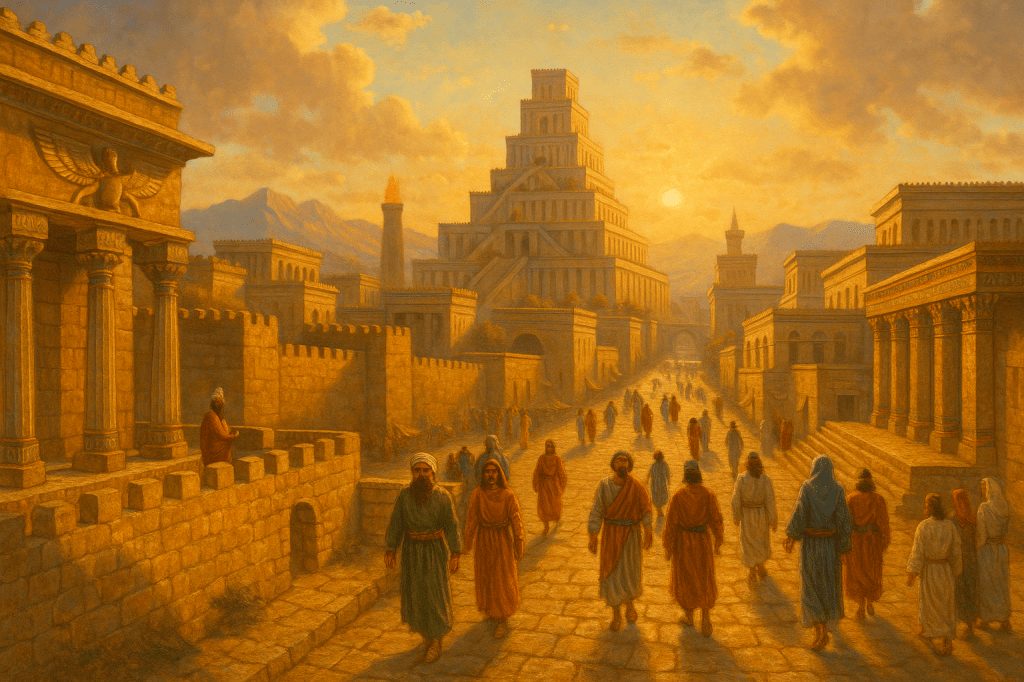
In the highlands of ancient Anshan, the foundations of Persia were laid. From its Elamite heritage emerged a dynasty that would redefine kingship and reshape the political geography of the ancient world. Here, amid the mountain passes and fertile valleys of Tal-i Malyan, a small kingdom inherited the administrative wisdom of Elam, the spiritual legacy of its gods, and the cultural resilience of the plateau. When Cyrus the Great arose from this soil, he did not invent empire — he inherited it.
The story of Persia’s birth begins not in the grand palaces of Persepolis, but in the ancestral courts of Anshan, where the House of Achaemenes transformed regional tradition into imperial destiny.
The House of Achaemenes and the Anshan Lineage
The earliest known ancestor of the Persian kings is Achaemenes (Haxāmaniš), from whom the dynasty takes its name. While little is known of his reign, later inscriptions — particularly those of Darius I — credit him as the patriarch of a noble line rooted in Anshan [1]. His descendant Teispes (Čišpiš) likely ruled in the early seventh century BCE, and it was under him that the Persian chieftains of Anshan began to consolidate their territory amid the waning influence of Elam [2].
Teispes’s sons, Cyrus I and Ariaramnes, divided their domains — Cyrus continuing the Anshanite line, Ariaramnes ruling over Persis. This division marks the beginning of a dynastic duality that would later merge into the unified rule of Cyrus II the Great [3].
Cambyses I, son of Cyrus I, was the last ruler to bear the ancient title “King of Anshan.” During his reign, Persia was under the shadow of Median hegemony, with Astyages of Media holding nominal supremacy over the highlands. Yet Cambyses retained autonomy and governed a structured highland domain that still reflected the administrative patterns of Elam [4].
His marriage to Mandana, daughter of Astyages of Media, was both political and prophetic. Through this union, two Iranian traditions — Median and Persian — were joined, and their child, Cyrus II, would become the first to merge them into an empire. Herodotus recounts that Astyages dreamt his daughter would give birth to a ruler who would overthrow him, a vision that symbolised the inevitable rise of Persia from Median tutelage [5].
Thus, in the generation of Cambyses and Mandana, Anshan ceased to be a provincial polity and became the womb of empire.
The Political Legacy of Elam: Administration and Capitals
Elamite statecraft had long relied on a dual-capital model — Susa in the lowlands and Anshan in the highlands. The early Persians, inheriting this geographic division, replicated it on a grander scale. When Cyrus and later Darius expanded the empire, they preserved this duality in the form of Susa (administrative capital) and Persepolis(ceremonial heart), while Ecbatana served as the Median summer capital [6].
This tri-capital system was not innovation but continuation — an evolution of the Elamite principle of distributed sovereignty. Even the bureaucratic frameworks of Achaemenid governance owed much to Elamite prototypes. The use of the Elamite language in royal inscriptions and archives of Persepolis and Susa illustrates how the scribal class of Anshan became the linguistic backbone of the early empire [7].
The Persepolis Fortification Tablets (dating c. 509–494 BCE) reveal extensive use of Elamite administrative vocabulary — a striking testament to the endurance of Anshan’s traditions within the Achaemenid bureaucracy [8]. These records detail rations, land management, and economic transactions, preserving a direct link between Elamite documentation and Persian imperial administration.
Religious and Cultural Continuities
Anshan’s cultural memory was steeped in Elamite spirituality, which revered deities such as Inshushinak, Kiririsha, and Napirisha. Over time, these divine archetypes blended with emerging Zoroastrian principles, particularly the worship of Ahura Mazda as the supreme creator. The Persian kings reframed the old Elamite idea of divine stewardship — the ruler as protector of cosmic balance — into a moral theology of truth (asha) and justice [9].
This transformation is visible in the Behistun Inscription of Darius I, which echoes the ethical dualism of earlier Iranian faiths while retaining the ritual language of Elamite royal declarations. Where Elamite kings invoked Inshushinak, Darius invoked Ahura Mazda; both stood as guarantors of order against chaos.
The sacred geography of Persis — with its fire sanctuaries, altars, and mountain tombs — also preserves Elamite spatial logic. Religious sites such as Pasargadae and Naqsh-e Rustam were carefully aligned with ancient routes between Susa and Anshan, embodying continuity of sacred landscapes [10].
Anshan in Imperial Ideology
For Cyrus the Great, the title “King of Anshan” was more than a dynastic formality; it was a statement of legitimacy. His inscriptions refer to him as the “descendant of Teispes, King of Anshan,” anchoring his authority in a lineage older than the empire itself [11]. In the Cyrus Cylinder, composed after his conquest of Babylon in 539 BCE, Cyrus introduces himself through his ancestry, not his conquests — a rhetorical gesture rooted in Anshanite identity.
When Darius I later ascended the throne, he too referenced Achaemenes and Teispes as forebears, reinforcing the notion that Persian kingship was inherited through Anshan’s noble house, not seized by ambition. In this way, Anshan became both a historical and ideological foundation for the empire’s self-conception — a mythic homeland of rightful rulers.
Just as Susa embodied administration and Persepolis ceremony, Anshan represented origin — a sacred link to the past. It was invoked in texts and remembered in ritual, though its political significance had faded.
Archaeology and Modern Scholarship
Modern archaeology continues to illuminate the blurred line between Elamite and Persian Anshan. Excavations at Tal-i Malyan led by Kamyar Abdi (1999–2004) and subsequent regional surveys have revealed evidence of continuous occupation from the third millennium BCE into the early Achaemenid period [12]. Yet the exact transition from Neo-Elamite to Persian rule remains debated.
Abdi argues that early Achaemenid Anshan likely served as a ceremonial and ancestral centre rather than an active political capital, a view supported by the absence of large administrative complexes from Cyrus’s time [13]. D. T. Potts notes that while the archaeological record thins during this phase, textual continuity — particularly in royal titulature — confirms its enduring symbolic authority [14].
Recent work has used geophysical mapping and sediment analysis to reconstruct Malyan’s urban sprawl, indicating that the Achaemenids may have continued to revere certain sections of the site, even if governance had shifted to Pasargadae and later Persepolis [15].
The Legacy of Cambyses I and Mandana
The union of Cambyses and Mandana embodied a fusion of traditions — Elamite-Persian administration and Median aristocracy. This marriage, though described mythically by Herodotus, had profound historical consequences. It represented the first consolidation of Iran’s tribal and dynastic powers under one lineage.
Cambyses I, ruling from Anshan, bridged the last phase of Elamite-influenced kingship and the dawn of Persian sovereignty. Mandana’s Median heritage lent legitimacy to the new order in the eyes of both eastern and western Iranians. Through their son, Cyrus, the political vision of Anshan found its world stage.
Herodotus’s prophecy — that Mandana’s offspring would “overflow Asia as a great river” — reads today as allegory for the diffusion of highland civilisation into empire [16]. It is the story of a small kingdom’s inheritance of Elam’s legacy, Media’s power, and Persia’s destiny.
Conclusion: From Highland Roots to World Empire
Anshan was the matrix of Persia — its first city, its ancestral soil, its unseen capital. The Achaemenids inherited from it not only a place but a principle: that kingship was stewardship, and empire continuity, not rupture.
From Achaemenes to Cyrus, the highland lords of Anshan transformed the Elamite idea of dual rule into a cosmopolitan vision of empire. Their memory remained inscribed not on tablets alone but in the architecture, theology, and administrative systems of a realm that stretched from the Indus to the Aegean.
In rediscovering Anshan, we glimpse the ancestral horizon of Persian identity — the moment when a forgotten kingdom became the foundation of one of history’s most enduring empires.
Read part one of this article on Part I – The Highland Kingdom — Anshan Before Persia.
If you are interested on pre-historic period of Persia, Nomads, Traders, and Tribal Roots: Pre-Imperial Persia article is recommended.
Later Cyrus the great moved the capital from Anshan to Pasargadae. Pasargadae: The Heart of the Persian Empire is recommended for more reading.
Footnotes
- Briant, P. From Cyrus to Alexander: A History of the Persian Empire, Eisenbrauns, 2002.
- Potts, D. T. The Archaeology of Elam, Cambridge University Press, 1999, pp. 180–186.
- Henkelman, W. F. M. “Anshan and the Origins of Achaemenid Power,” Iranica Antiqua, vol. 45 (2010).
- Abdi, K. “Political Landscape of Early Achaemenid Anshan,” Iranian Archaeology Review vol. 8 (2004).
- Herodotus, Histories, Book I.107–130 (trans. Godley, 1920).
- Briant, P. op. cit., pp. 124–131.
- Stolper, M. W. “Elamite as an Administrative Language,” Achaemenid Research Newsletter, 2003.
- Hallock, R. T. Persepolis Fortification Tablets, University of Chicago Press, 1969.
- Henkelman, W. “Religion and State in Achaemenid Iran,” World Archaeology vol. 36 (2005).
- Stronach, D. “Pasargadae: A Report on the Excavations Conducted by the British Institute of Persian Studies,” Iran vol. 2 (1964).
- Kuhrt, A. “The Cyrus Cylinder and Achaemenid Ideology,” Journal for the Study of the Old Testament, 1983.
- Abdi, K. Excavations at Tal-i Malyan: Anshan Revisited, Tehran University Press, 2004.
- Abdi, K. ibid., pp. 93–99.
- Potts, D. T. op. cit., pp. 192–197.
- Goff, C. and Abdi, K. “Remote Sensing and Settlement Reconstruction at Tal-i Malyan,” Iranica Antiqua vol. 41 (2006).
- Herodotus, op. cit., Book I.108.


 Kam Austine
Leave a comment