

“Before Persepolis, before Pasargadae — there was Elam, the mother of Persian thought.”
1. Before Persia, There Was Elam
Long before the rise of Cyrus, Darius, and Xerxes, the plains of Khuzestan and the highlands of Anshan were home to a civilisation whose brilliance laid the first stones of what would later become Persia. This was Elam — Hal-tam-ti in its own language, meaning “The Land of the Gods.”
From roughly 2700 to 539 BCE, Elam flourished as one of the earliest states in recorded history, older than Assyria and Babylon, and contemporary with Egypt and Sumer. To the west it looked upon Mesopotamia; to the east it climbed the Iranian plateau. This in-between position made Elam a hinge between worlds — agricultural and mountainous, Semitic and Aryan, urban and tribal.
When later Persian kings called themselves “Kings of Anshan and Persia,” they were invoking an Elamite heritage that reached back five millennia. Elam was not merely Persia’s ancestor in geography — it was her intellectual and spiritual progenitor.
2. The Land Between Rivers and Mountains
Elam’s heartland stretched from the Zagros foothills east of the Tigris to the fertile lowlands of Susiana (modern Khuzestan). Its two poles were the cities of Susa, vibrant with trade and temple ritual, and Anshan (Tali Malyan), the highland stronghold guarding the passes to the plateau.
Here, rain-fed rivers carved through green valleys, nurturing barley, dates, and livestock. From the Persian Gulf ports, copper and lapis travelled north; from the mountains came timber, silver, and stone. Elam thus became the corridor of exchange linking Mesopotamia and the Iranian plateau — a geography that naturally bred diplomacy, multilingualism, and cosmopolitanism.
3. The Birth of a Civilisation
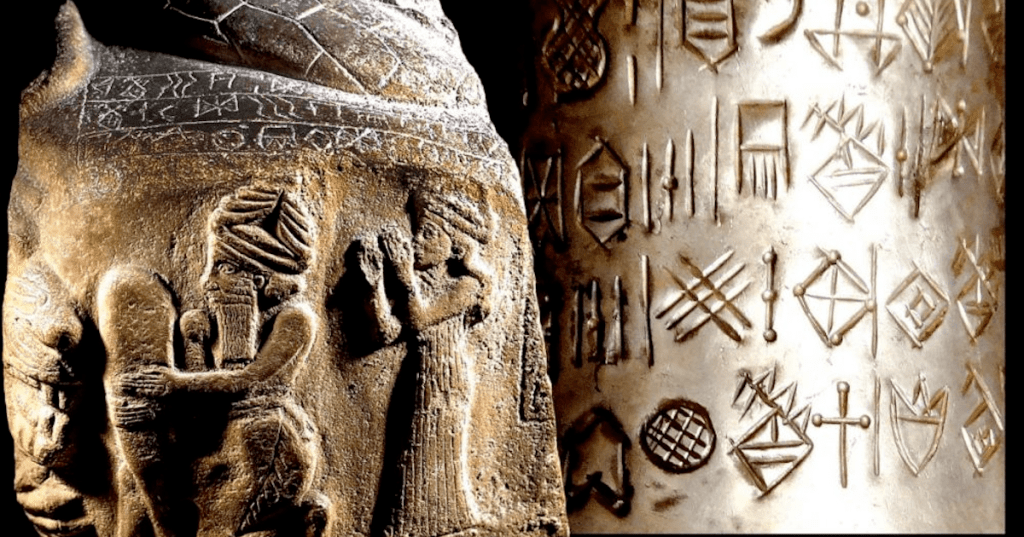
Archaeological evidence places the earliest village culture in Susiana around 7000 BCE, evolving into an urban civilisation by 3100 BCE. The so-called Proto-Elamite tablets — incised clay records of grain and herds — represent one of the world’s earliest writing systems.
Elam’s rise coincided with the dawn of metallurgy: bronze weapons, tools, and ornaments circulated between Susa, Uruk, and the Gulf islands. Temples dedicated to local deities appeared beside administrative granaries. Already, a pattern was emerging that would define Iranian civilisation — the fusion of the sacred and the bureaucratic.
4. Divine Kingship and the Gods of Elam
At the summit of Elamite belief stood Inshushinak, the guardian of Susa, whose horned temples dominated the skyline. Alongside him were Kiririsha, the Great Mother; Humban, later associated with royal fortune; and Pinikir, the goddess of heaven and stars.
Unlike the anthropomorphic gods of Mesopotamia, the Elamite pantheon retained a sense of abstraction and mystery. Inshushinak was less a warrior than a judge and protector of truth, presiding over the afterlife. The Elamite king ruled by divine appointment but remained a servant of the gods — a theology that prefigured the Achaemenid formula “By the will of Ahura Mazda.”
This notion of cosmic legitimacy — that the ruler governs not by conquest alone but by alignment with divine order — would echo through Persia’s imperial ideology for centuries.

5. Society, Language, and Power
Elamite society was hierarchical yet surprisingly inclusive. Its administration employed both the Elamite and Akkadian languages, and women held visible positions of influence. The bronze statue of Queen Napir-Asu, wife of Untash-Napirisha (c. 1250 BCE), bears an inscription invoking blessings from all major deities, suggesting a role beyond consort — perhaps co-ruler or high priestess.
Elamite law recognised property rights for women and temple priestesses. Its scribal schools trained generations of record-keepers, whose titles — sukkal, sukkal-mah — would later appear in Achaemenid administrative vocabulary and even influence the Persian satrapal system.
6. War and Wisdom — Elam and Mesopotamia
For nearly two millennia, Elam contended and conversed with its western neighbours. The Akkadian king Naram-Sin invaded Elam around 2250 BCE; centuries later, Hammurabi of Babylon signed alliances with its kings. Trade, diplomacy, and war alternated like the seasons.
When Babylon was plundered in 1155 BCE by the Elamite king Shutruk-Nahhunte, the spoils he carried to Susa included the Stele of the Code of Hammurabi — an act both of conquest and of cultural preservation. That single monument, recovered millennia later, reminds us that Elam was not merely a destroyer but a curator of civilisation.
7. The Ziggurat of Chogha Zanbil — Architecture of Faith

The greatest architectural testament to Elam’s piety and artistry is the Ziggurat of Chogha Zanbil, near Susa. Built by King Untash-Napirisha, it was dedicated to Inshushinak and rose in five terraces of baked brick. Each level represented a step toward the divine realm; each gate bore inscriptions in cuneiform prayers.
Unlike Mesopotamian ziggurats, Chogha Zanbil formed part of a vast sacred precinct with shrines to multiple deities — a pantheon rendered in architecture. The site reveals urban planning, water engineering, and artistic finesse that would later inspire Persian temple design from Pasargadae to Persepolis.
8. The Fall and the Phoenix
By the 7th century BCE, Elam’s independence was eroded by Assyrian power. In 647 BCE, Ashurbanipal’s armies razed Susa, claiming to have “destroyed the gods and their temples.” Yet even amid destruction, Elam’s culture endured.
Many Elamites migrated eastward into the highlands of Anshan, intermarrying with Indo-Iranian tribes. Out of this synthesis emerged a new identity — the Persians. When Cyrus I and later Cyrus II (the Great) styled themselves “Kings of Anshan,” they were asserting legitimacy through their Elamite inheritance. The administrative pragmatism, artistic vocabulary, and theological subtlety of Elam thus re-emerged in Persian form.
9. Echoes in the Achaemenid Age
In the Achaemenid Empire, the Elamite language remained one of the three official tongues (alongside Old Persian and Babylonian) used in royal inscriptions. Darius’s Behistun Inscription includes a complete Elamite version — a deliberate nod to continuity.
Elamite craftsmen decorated the palaces of Susa and Persepolis with motifs first seen in Chogha Zanbil. Even the concept of a king chosen by divine wisdom — xvarnah or “royal glory” — can be traced to Humban’s sacred favour.
Thus, Elam lived on within the empire that had supplanted it. Persia did not erase her mother culture; she absorbed it, refined it, and carried it forward.
10. Rediscovery of the First Persians
Modern knowledge of Elam began with the excavations of Jacques de Morgan, Roman Ghirshman, and Ezzat Negahban at Susa, Haft Tepe, and Tali Malyan. Their discoveries — cylinder seals, inscriptions, jewellery, and administrative tablets — revealed a civilisation of astonishing depth.
UNESCO’s designation of Chogha Zanbil as a World Heritage Site in 1979 acknowledged Elam as the earliest expression of urban and spiritual life in Iran. Each brick inscribed with the name of Inshushinak is a syllable in the long sentence of Persian history.
11. Legacy — The Forgotten Architects of Persia
Elam’s story is one of endurance through transformation. From its cities rose Persia’s capitals; from its language came the bureaucratic idioms of empire; from its theology flowed the Persian idea of righteous rule.
When Darius proclaimed, “By the favour of Ahura Mazda, I built the palace of Susa,” he spoke in the shadow of Inshushinak’s ziggurat. The line between Elamite and Persian is not a boundary but a continuum — an ancient melody re-orchestrated by time.
To walk among the ruins of Susa or Anshan today is to feel the pulse of a civilisation that never truly died, only changed its name.
Footnotes
- Potts, D. T. The Archaeology of Elam: Formation and Transformation of an Ancient Iranian State. Cambridge University Press, 2016.
- Ghirshman, R. Iran: From the Earliest Times to the Islamic Conquest. Penguin, 1954.
- Hinz, W. The Lost World of Elam: Re-creation of a Vanished Civilization. Methuen, 1972.
- Curtis, J. E. Ancient Persia. British Museum Press, 2010.
- De Morgan, J. Mission Scientifique en Perse. Paris, 1905.


 Kam Austine

Leave a comment