

“To rule an empire, one must first teach the world how to see.”
— Achaemenid Principle of Royal Imagery (implied in multiple inscriptions)
The Achaemenid Empire did not rely on monumental texts to explain its vision of kingship. Instead, it spoke through images—precise, ordered, and endlessly repeated. The reliefs of Persepolis, Susa, and Pasargadae form a visual language, a deliberate grammar of power crafted to communicate legitimacy, justice, and cosmic order to a multi-ethnic world.
Unlike Assyrian art, which glorified brutality and conquest, Achaemenid iconography reveals a fundamentally different imperial philosophy: the king as harmoniser, not destroyer; the empire as a garden, not a battlefield; rule as order, not domination. To understand Achaemenid imagery is to understand how Persia imagined itself, and how it wanted to be remembered.
The Purity of Order — Why Persian Art Looks “Calm”
Visitors to Persepolis often remark on the serene, almost mathematical precision of its reliefs. Everyone stands upright. No one is slain. No one bleeds. No one screams. The empire that ruled the known world does not depict conquest, only representation, procession, balance.
This was intentional.
The Persians believed that order (asha, truth, cosmic harmony) must be reflected in art. Disorder (druj—chaos, violence, lies) was banished from the king’s visual space. Once one understand this cosmological principle, the entire artistic programme makes sense:
- symmetry = cosmic balance
- repetition = eternal rule
- calm faces = mastery of self
- processions = unity of nations
- lack of violence = moral superiority
Every figure becomes a visual argument for the righteousness of Achaemenid kingship.

The Lotus and the Lily — The Flower of Eternal Rule
Lotus (Nelumbo nucifera) — Symbol of Rebirth
The lotus appears under thrones, in hands, on robes, and in borders. Its meaning reaches deep into Elamite and Mesopotamian symbolism, but the Achaemenids refined it into one core message: The king renews the world.
Lotus petals radiating outward also mimic the shape of the Iranian faravahar wings—another symbol of order and protection.
Blue Water Lily — Symbol of Royal Tranquillity
Glazed tiles from Susa show fields of blue water lilies. Blue symbolises:
- the heavens
- divine protection
- coolness, calm, truth
The flowers are not decorative—they declare the emotional climate of the empire: composure, purity, serenity.
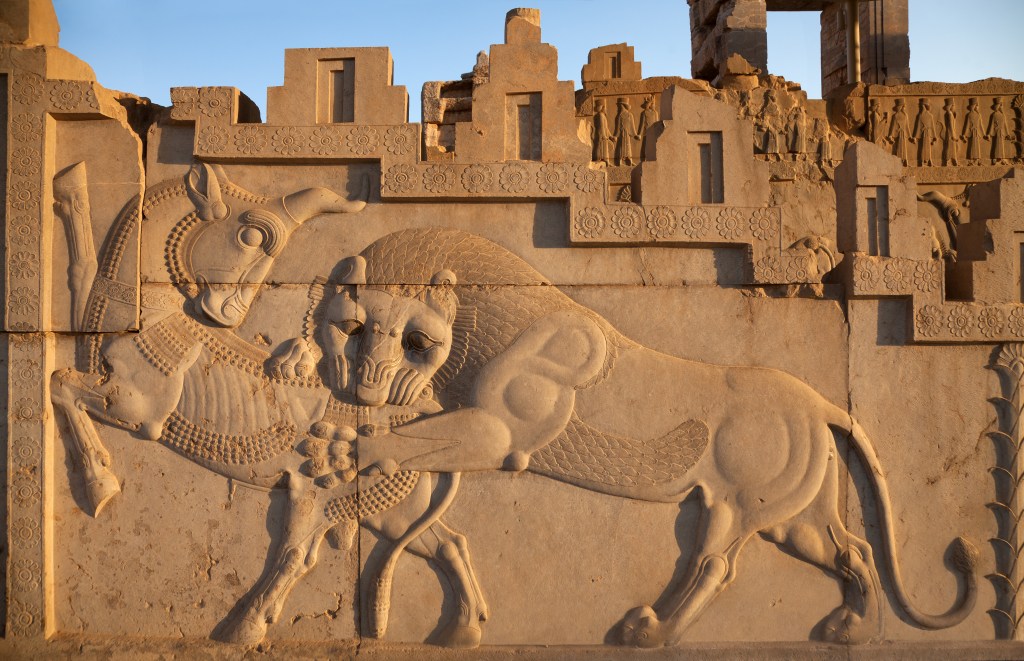
The Lion and the Bull — Cosmic Drama on Stone
No Achaemenid motif is more dramatic than the lion attacking the bull. Found in Persepolis staircases, capitals, and textiles, it appears dynamic and violent—yet in Persian thought, it conveys balance, not aggression.
Interpretations
- Astronomical: Leo (lion) overpowering Taurus (bull) → the vernal equinox, symbolising renewal.
- Moral: Light over darkness; order over chaos.
- Imperial: The king’s eternal victory over forces threatening the cosmic order.
This was a cosmic reassurance: the world is safe because the king keeps the heavens in harmony.
The Immortals — Uniformity, Diversity, and the Theatre of Power
Reliefs of the Immortals, the elite royal guard—are among the most iconic images of Persia. At first, they seem repetitive, almost identical. But close study reveals:
- slightly different patterns in robes
- different hairstyles
- subtle variations in weaponry
- minute shifts in ornament geometry
What does this mean?
Unity without erasing individuality.
A perfect metaphor for the empire itself.
Their disciplined stance, forward stride, and composed expressions symbolise:
- loyalty
- controlled strength
- readiness without aggression
In contrast with Assyrian “violence-as-propaganda,” the Persian soldier communicates responsibility, not terror.

The Winged Figure — Guardian of Kingship
The winged figure, often called the “Ahuramazda figure,” (faravahar) appears above the king in several places, most famously at Persepolis. Scholars debate whether it represents:
- Ahura Mazda
- royal xvarnah (divine glory)
- a protective spirit
- ancestral majesty (King’s fravashi)
Regardless of identity, its message is clear: The king rules with divine sanction.
The outstretched wings often mirror the symmetry of the palace architecture itself—another sign that architecture, symbolism, and kingship form a single theological system.

Robes, Patterns, and Ethnic Identities — The Art of Inclusion
The Achaemenid Empire was the most ethnically diverse state of antiquity. Its art proudly displays this diversity.
How do we know?
- Egyptians with short kilts
- Lydians with patterned tunics
- Scythians with trousers and pointed hats
- Ethiopians with animal skins
- Indians carrying ivory and gold
- Ionians with Greek chitons
Every delegation is identifiable by clothing, hairstyle, objects, or posture.
This is not ethnographic curiosity, it is political messaging:
“Every nation belongs here. Every people contributes to harmony.”
The king is shown not as conqueror, but as the centre of a world that willingly approaches him.
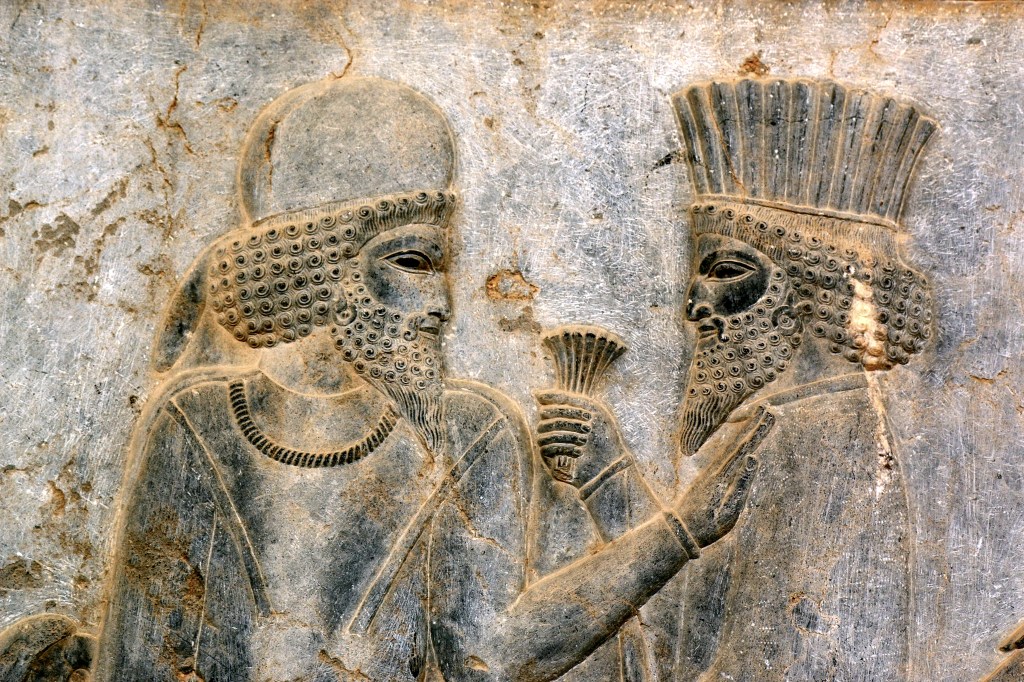
Gesture and Posture — A Syntax of Respect
Bodies in Achaemenid art follow strict rules:
Raised hand (the king): Blessing, greeting, command, and truth-speaking.
Joined hands (envoys): Respect, calmness, acknowledgement of royal authority.
Slight forward lean (delegates): Movement into the king’s presence, ritualised approach.
Level gaze: Equality between nations, but hierarchy in direction: they look toward the king, never above or beyond him.
This visual grammar encoded the distribution of power.
Animals as Moral Qualities — Bulls, Lions, Griffins
Achaemenid capitals famously use animal forms:
- Bull: strength, stability, cosmic endurance.
- Lion: courage, royal authority.
- Griffin: vigilance, protection, guardianship of sacred spaces.
- Horse: nobility and imperial speed.
Columns literally rest on the backs of sacred animals—a statement that the palace rests on eternal virtues.

Repetition as Eternity — Why Persian Art Rarely Changes
To a modern eye, Achaemenid reliefs appear repetitive. But this is intentional.
Repetition = timelessness
Timelessness = legitimacy
Legitimacy = trust
Empires of the ancient world often advertised power with innovation; Persia advertised durability through consistency. Reliefs at Persepolis and Susa were not updated with each king’s reign because the kingship was institutional, not personal.
This was the visual equivalent of the phrase:
“By the favour of Ahura Mazda, I am king.”
Not I, Darius—
but I, the king, eternal.
Multicultural Artisans — The Makers Behind the Majesty
Cuneiform inscriptions list the peoples who built these monuments:
- Elamites
- Babylonians
- Ionians
- Sardians
- Egyptians
- Cappadocians
- Lydians
Archaeology confirms it: the hands that shaped the empire were as diverse as the nations depicted on its walls.
This makes Achaemenid art not only a Persian achievement, but also the world’s first truly international artistic collaboration.

Why Persian Art Avoids Depicting Failure
Interestingly, Achaemenid art avoids:
- battlefields
- executions
- internal conflict
- slavery
- humiliation of enemies
Even the king’s victories appear symbolically, not literally. Why?
Because art was not a record. It was a declaration.
The empire wished to show not what happened, but what ought to happen according to cosmic order. This ethical restraint is unique in the ancient Near East, where other empires proudly displayed cruelty. Persian art preferred aspiration over intimidation.
Legacy — How Achaemenid Iconography Shaped Iranian Identity
The visual language of Achaemenid Persia survived long after Persepolis burned:
- Parthian coinage adopted the lotus.
- Sasanian rock reliefs preserved the royal calm posture.
- Iranian carpet motifs still echo bull-lion patterns and rosettes.
- Modern Iranian identity often evokes Persepolitan imagery.
This continuity is not accidental. Persia’s early kings created a symbolic lexicon that became an identity, not mere decoration.
Conclusion — Teaching the World How to See
Achaemenid art is not passive ornament—it is visual philosophy. Every choice in line, colour, motif, posture, and symmetry expresses:
- cosmic order
- moral clarity
- royal legitimacy
- unity in diversity
- eternal stability
In a world of competing empires, Persia alone perfected a visual language that replaced terror with law, brutality with balance, and propaganda with dignity.
What remains on the stones of Persepolis and Susa is not a story of domination, but a statement of how to rule without cruelty, how to lead without chaos, and how to express power without shouting.


 Kam Austine
Leave a comment