

“Among all the horses beneath the sun, none equals the Nisean.”
— Ancient Greek Proverb (reported by Strabo)
Few animals are as deeply woven into the identity of ancient Persia as the Nisean horse, the legendary warhorse bred in the rich plains of Media, revered by kings, sought by empires, immortalised in art, and celebrated across the ancient world.
Standing taller, prouder, and more radiant than any horse known in the Near East, the Nisean was not merely an animal: it was a symbol of kingship, a companion of empire, and one of the most coveted breeds in human history.
This article explores the origins of the Nisean horse, its role in the early Persian world, its sacred association with Achaemenid kingship, its connection to Persepolis motifs, and the mysterious afterlife of the breed — including its surprising presence in Chinese imperial annals.
Homeland of Kings — The Nisean Plains of Media
The original homeland of the breed was the Nisean Plain (also Nisaea or Nesaean), a fertile region near modern-day Hamedan–Kermanshah in western Iran, once part of ancient Media. This land, with its lush grasses and abundant water, produced a horse that ancient writers considered the finest in the world.
Greek, Roman, Babylonian, and Persian sources all agree: the Nisean was the “royal horse.”
Herodotus claims that the Medes developed the original stock and that the Persians adopted it as the imperial standard. Xenophon writes that kings maintained vast royal studs — some numbering tens of thousands of mares — to preserve this sacred bloodline.
What Made the Nisean Horse Unique?
Descriptions across antiquity consistently highlight the same traits:
- Large stature: often 15–16 hands, exceptionally tall for the time
- Powerful, muscular build: ideal for chariots and cavalry
- High neck carriage: associated with noble bearing
- Arched profile: giving the horse a proud, “regal” silhouette
- Thick, flowing manes and tails: noted even in early depictions
- Strong, fast, and enduring: capable of long campaigns
Persians considered the Nisean a gift of the gods, and only royalty or elite cavalry were permitted to ride them.
They were also sacred.
In spring ceremonies, Nisean horses were offered to the sun in rituals symbolising purity, power, and renewal, an ancient tradition that probably later influenced Zoroastrian solar associations.

The Nisean and the Achaemenid Court — Horses of Empire
Under the Achaemenids, the Nisean horse became inseparable from imperial identity.
Royal Cavalry and Elite Guards
The elite units of the Persian cavalry — Immortals, nobility, and royal bodyguards — were mounted on these horses.
Their speed and bravery made them central to Persian military doctrine, which relied on:
- shock cavalry
- mounted archers
- highly mobile flanking manoeuvres
Achaemenid Processions
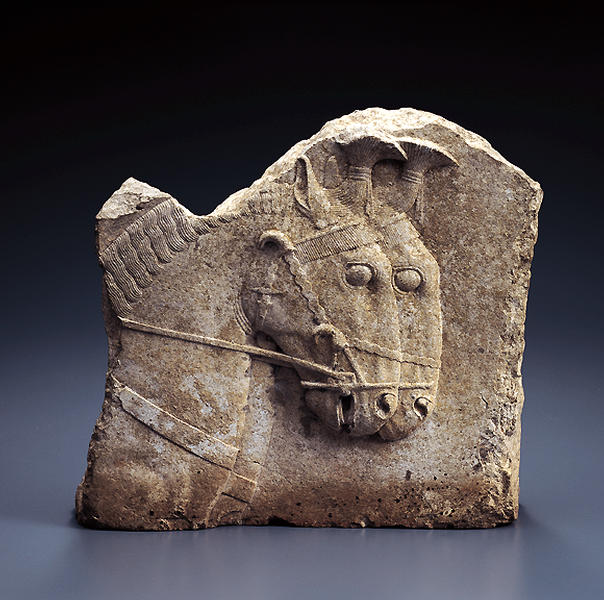
The perpetual processions carved at Persepolis include horses in several panels.
Although stylised, the horses are shown:
- tall
- powerful
- with upright manes
- adorned with decorated harnesses
These are almost certainly Nisean horses, rendered with the same reverence as delegations and kings.
Their presence symbolised:
- imperial majesty
- the legitimacy of the king
- the unity of the nations he commanded
- the celestial favour of Ahura Mazda
Chariots of Kings
Cyrus, Darius, and Xerxes all used Niseans to pull royal chariots, a tradition inherited from both Median and Elamite courts.
Nisean Horses in Persepolis and Other Achaemenid Motifs
The Achaemenid visual language preserves the Nisean in several ways:
A. Reliefs of Delegations
In the Apadana staircase, horses appear with:
- long, flowing manes
- strong forequarters
- decorated halters
- attendants holding reins with respect
These are not ordinary horses — they are royal animals.
B. Bull–Horse and Lion–Horse Symbolism
Some capitals and reliefs indirectly reference horse qualities:
- the strength of the bull
- the courage of the lion
- the nobility of the horse
Because Niseans symbolised the king’s physical and celestial authority, they were part of the larger grammar of order carved into palace walls.
C. Royal Hunting Imagery
Fragments from Susa and Pasargadae show horses used in royal hunts, often mounted by nobles or attended by grooms. These were likely Nisean-blood horses, as hunting was a royal-only activity and no lesser animal would be used.
“Heavenly Horses” — How China Sought the Nisean Breed
One of the most fascinating cross-cultural episodes involving the Nisean horse appears in Chinese chronicles.
During the Han dynasty, the Chinese sought a breed they called the “Heavenly Horses of the West.” These are widely believed to be descendants or relatives of the Nisean stock.
Records describe:
- emissaries sent westward
- costly exchanges
- the acquisition of ten stallions of exceptional stature
These horses were prized for military cavalry and believed to possess divine vitality.
Given the distance, these horses were likely transported via:
- Bactria
- Parthia
- Sogdia
- possibly the Median Plateau
This suggests that while the pure Nisean breed declined after the Achaemenids, its descendants survived eastward, influencing Central Asian and Chinese cavalry traditions.
Decline and Survival — The Fate of the Breed
The fall of the Achaemenids (330 BCE), followed by Seleucid and Parthian shifts in power, disrupted royal stables. By the Sasanian era, Persian cavalry was dominated by Asiatic, Turkic, and Steppe-derived horses.
However, evidence suggests:
- the Nisean may have mixed into Karabakh, Turkmen, and Akhal-Teke lines
- certain traits (high neck, long legs, proud stance) survive
- some Iranian researchers trace warm-blooded breeds in Hamedan to ancient lineage pockets
In short: the pure Nisean is gone, but its blood runs strongly across Eurasia.
Why the Nisean Matters — More Than a Horse
The Nisean horse occupies a special space in Persian cultural memory because it embodies:
- Persian kingship
- Median heritage
- military innovation
- artistic symbolism
- cosmic legitimacy from Ahura Mazda
To the Achaemenids, the horse was not an animal but a mythic companion of the king, a creature whose speed, courage, and beauty mirrored the divine favour that sustained the empire.
To study the Nisean horse is therefore to study:
- the philosophy of Persian rule
- the aesthetics of Achaemenid art
- the rituals of ancient kingship
- the shared heritage of Media and Persia
- the transmission of Iranian culture across Asia
It is one of the few living threads that still ties Iran to its deepest past.


 Kam Austine
Leave a comment