
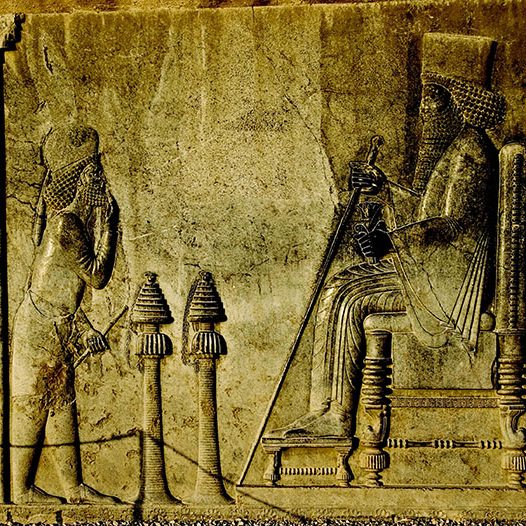
When the Achaemenid Empire expanded eastward, it encountered a world profoundly different from the Mediterranean and Near Eastern regions it already governed. The Indus frontier was not a landscape of city-states, monumental temples, or centralised kingship comparable to Egypt or Babylonia. Instead, it was a mosaic of riverine communities, post-Harappan cultural continuities, regional elites, and long-standing trade routes that connected South Asia to Central Asia, Iran, and the Persian Gulf. Persia’s success in this region did not lie in dramatic conquest narratives but in diplomacy, accommodation, and administrative restraint [1].
Unlike the western frontiers—where Greek sources preserve vivid accounts of war —the eastern frontier entered Persian history largely through silence. That silence, however, is revealing. It suggests a model of imperial integration that relied less on spectacle and coercion and more on negotiated authority, tribute relationships, and strategic inclusion within a broader imperial system [2].
The Indus World Before Persian Rule
By the late second and early first millennium BCE, the Indus Valley had already experienced the rise and decline of one of the world’s earliest urban civilisations. Although the mature Harappan cities had disappeared centuries earlier, their legacy endured in settlement patterns, agricultural practices, craft traditions, and trade networks [3]. The Indus was not politically unified; instead, it consisted of regional polities and tribal groupings whose power rested on land control, river access, and commercial exchange.
Crucially, the Indus region was already outward-looking. Long before Persian rule, goods, ideas, and peoples considered part of a broader Indo-Iranian cultural sphere moved across the Iranian plateau and into South Asia. This connectivity made the region particularly receptive to incorporation into an empire that valued continuity over disruption [4].
Cyrus, the East, and the Limits of Evidence
The eastern reach of Cyrus the Great remains one of the most debated questions in Achaemenid history. While later tradition occasionally attributes vast eastern conquests to him, contemporary Persian inscriptions remain silent on any direct annexation of the Indus during his reign [1]. This silence is significant. Persian royal inscriptions were not shy about proclaiming conquest; their restraint here suggests either indirect influence or deliberate non-intervention.
What can be said with confidence is that Cyrus secured the eastern Iranian world—regions such as Arachosia and Drangiana—creating the political and logistical conditions that made later incorporation of the Indus possible [2]. The frontier Cyrus shaped was one of influence rather than domination.
Darius I and the Formal Incorporation of the Indus
The first explicit Persian reference to the Indus appears under Darius I. In his inscriptions, Darius lists the land of _Hindush_among the territories under his authority, marking the formal integration of the Indus region into the Achaemenid imperial framework [5]. This inclusion was not symbolic. Administrative evidence, Greek testimony, and archaeological traces all confirm that the Indus functioned as a satrapy or semi-satrapal region within the empire.
Herodotus notes that the Indus province provided one of the highest tribute contributions in the empire, largely in the form of gold dust [6]. While Greek authors frame this as taxation, Persian administrative practice suggests a more nuanced system: tribute was embedded within diplomatic relationships, seasonal exchanges, and obligations that balanced extraction with royal generosity [7].

Administration Without Erasure
Persian rule in the Indus stands out for its relative lightness. There is little evidence of large-scale Persian settlement, monumental architecture, or aggressive cultural replacement. Instead, local elites appear to have retained authority under Persian suzerainty, functioning as intermediaries between imperial administration and regional populations [2].
This approach was consistent with broader Achaemenid governance. Rather than imposing uniform systems, Persian rulers adapted to existing structures, intervening only where stability, revenue, or security required it. In the Indus, this meant preserving local customs while integrating the region into imperial trade, military recruitment, and tribute networks [8].
Tribute, Exchange, and Eastern Wealth
The Indus was valuable not merely for its gold but for its strategic position within long-distance trade networks. Goods from South Asia—textiles, spices, timber, ivory, and animals—moved westward through Persian-controlled routes, while Persian silver, administrative practices, and military organisation flowed eastward [9].
Tribute should therefore be understood not as unilateral extraction but as part of a reciprocal system. In exchange for loyalty and resources, the empire offered protection, access to markets, and participation in a prestigious imperial order. This framework echoes the broader gift-economy model evident at Persepolis, where subject peoples are shown not as defeated enemies but as willing participants in a shared imperial ritual [10].
Military and Strategic Dimensions
The Indus frontier also played a role in Persian military strategy. Soldiers from eastern regions are attested in Persian armies, while elephants—rare in the western empire—became an important symbolic and practical asset [11]. Control of the Indus also secured Persia’s eastern flank, reducing threats from nomadic incursions and stabilizing trade routes linking Central Asia and the Indian subcontinent.
Yet the absence of fortification lines or large garrisons suggests that diplomacy remained the primary tool of control. The frontier was managed as a zone of cooperation rather than confrontation [4].
A Frontier of Integration, Not Conquest
Persia’s relationship with the Indus challenges modern assumptions about empire. Expansion here did not require cultural domination or military spectacle. Instead, it relied on shared economic interests, administrative pragmatism, and respect for local autonomy within an imperial framework [1].
This model helps explain why Persian rule in the Indus left comparatively few archaeological scars and why Alexander, when he later entered the region, encountered both the pathways Persia had opened and the limits of imperial accommodation.
Conclusion
The eastern frontier of the Achaemenid Empire reveals an imperial strategy grounded in diplomacy rather than force. By integrating the Indus through tribute, trade, and negotiated authority, Persia demonstrated that empire could be sustained through cooperation as much as conquest. This frontier was not a boundary but a bridge—one that connected Iran and South Asia in ways that would shape the political landscape long after Persian power receded.
Part II will explore how these connections endured, how cultural and economic exchange reshaped both worlds, and why Persia’s eastern policies made Alexander’s campaigns possible—yet ultimately fragile.
Footnotes
- Pierre Briant, From Cyrus to Alexander: A History of the Persian Empire, Harvard University Press, 2002.
- Amélie Kuhrt, The Persian Empire: A Corpus of Sources, Routledge, 2007.
- Gregory Possehl, The Indus Civilization: A Contemporary Perspective, AltaMira Press, 2002.
- Matt Waters, Ancient Persia, Cambridge University Press, 2014.
- Darius I, Royal Inscriptions (DB and related texts).
- Herodotus, Histories, Book III.
- Encyclopaedia Iranica, “Economy iii. Achaemenid.”
- Wiesehöfer, Josef, Ancient Persia, I.B. Tauris, 1996.
- Raymond Allchin, The Archaeology of Early Historic South Asia, Cambridge University Press, 1995.
- Margaret Cool Root, The King and Kingship in Achaemenid Art, Brill, 1979.
- Encyclopaedia Iranica, “India ii. Iranian Contacts.”

 Kam Austine
Leave a comment