
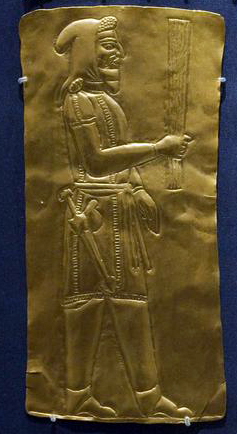
Empires are often remembered through their kings. Their names are carved into stone, their victories recorded, their monuments preserved. Yet behind every enduring system of power stands a quieter force — one that shapes belief, ritual, and legitimacy. In the Achaemenid Empire, that force may well have been the Magi.
They left no grand palaces. No royal inscriptions speak in their voice. And yet, their influence may be traced in one of the most striking transformations in Achaemenid history: the emergence of Ahura Mazda as the central divine authority in royal ideology.
Between Cyrus and Darius, something changed.
This article explores the possibility that the Magi — a Median priestly class — were not merely ritual specialists, but key agents in the formation of Achaemenid religious identity, bridging older Iranian traditions with the evolving ideological needs of empire.
I. The Invisible Architects of Empire
When Cyrus the Great established the Achaemenid Empire in the mid-6th century BCE, his rule was marked by remarkable flexibility. Conquered peoples were allowed to maintain their customs, religions, and institutions. Babylonian temples continued to function. Local priesthoods remained intact. Imperial authority did not demand theological uniformity.
Yet, within a few decades, under Darius I, a more defined religious language appears. In the Behistun Inscription and other royal texts, Darius repeatedly invokes Ahura Mazda as the source of his authority, the guarantor of truth, and the cosmic force that legitimises his rule.
This shift is subtle but profound.
It raises a question:
Who shaped this transition?
The answer may not lie solely with kings, but with those who stood behind them — the custodians of ritual and tradition.
II. Who Were the Magi?
The term Magi (Old Persian maguš) appears in classical sources, most notably in Herodotus, who describes them as one of the tribes of the Medes. According to him, they served as priests, interpreters of dreams, and custodians of ritual practice.
While Greek accounts must be treated cautiously, they align with broader evidence suggesting that the Magi were:
- A priestly class of Median origin
- Specialists in ritual, sacrifice, and sacred knowledge
- Mediators between human and divine realms
Their authority did not stem from political power, but from knowledge — of rites, of purity, of cosmic order.
Unlike later organised priesthoods, the Magi do not appear to have operated within temple-based institutions. Their power was portable — carried through oral tradition, ritual expertise, and proximity to authority.
III. The Magi at the Achaemenid Court
With the rise of the Achaemenids, the Medes were not displaced but integrated into imperial structure. It is likely that the Magi, as part of the Median elite, entered the Achaemenid court as ritual specialists.
Their roles may have included:
- Supervising royal rituals and sacrifices
- Interpreting omens and dreams
- Advising on matters of purity and cosmic order
- Participating in coronation and ceremonial practices
In an empire spanning diverse cultures and belief systems, such figures would have been essential. Kings required not only political legitimacy, but cosmic alignment.
The Magi may have provided precisely that.
IV. Cyrus and Darius: A Religious Turning Point
At Pasargadae, associated with Cyrus, we find:
- No clear inscriptions invoking Ahura Mazda
- Architectural simplicity
- A lack of overt theological articulation
By contrast, under Darius:
- Ahura Mazda is explicitly named in inscriptions
- The king is portrayed as chosen by a divine force
- The concept of truth (asha) versus lie (drauga) becomes central
This is not merely stylistic evolution. It suggests a shift in ideological framing.
Cyrus ruled through coalition and tolerance. Darius, inheriting rebellion and fragmentation, required systematisation — not only administratively, but ideologically.
Religion became part of that system.
V. Vishtaspa: Father or Patron?
At the heart of this transformation lies a fascinating question. Vishtaspa, the father of Darius, is historically attested. He appears in inscriptions and genealogies.
Separately, in Zoroastrian tradition, Kavi Vishtaspa is the king who supports the prophet Zarathustra.
Are they the same person?
The evidence is inconclusive.
Most scholars treat them as distinct figures. However, the convergence of names, roles, and timing invites speculation.
Rather than assert identity, we may consider a more nuanced possibility:
The Achaemenid court, particularly under Darius, operated within a cultural environment already shaped by traditions associated with Zarathustra — traditions possibly transmitted through Median priestly networks such as the Magi.
In this reading, the prominence of Ahura Mazda is not a sudden invention, but the formalisation of an existing current.
VI. The Magi and Early Mazdaean Religion
The religion reflected in Achaemenid inscriptions is often described as Mazdaean — centred on Ahura Mazda — rather than fully developed Zoroastrianism as known from later Sasanian texts.
Key features include:
- Emphasis on truth (asha)
- Opposition to falsehood (drauga)
- Moral responsibility of the king
- Divine sanction of rule
Notably absent are:
- Detailed cosmology of good vs evil
- Explicit reference to Angra Mainyu
- Canonical Avesta structure
This suggests a developing religious tradition, not yet fully systematised.
The Magi, as transmitters of ritual and belief, may have played a crucial role in preserving and shaping these ideas in practice, even before they were codified.
VII. Ritual Authority Without Temples
One of the most striking features of early Iranian religion is the absence of monumental temples.
Unlike Mesopotamia or Egypt:
- No large temple complexes dominate the landscape
- Worship appears to have occurred in open spaces
- Fire altars are simple, not monumental
This aligns with classical accounts describing Persian worship as taking place under the open sky.
In such a system:
Authority resides not in buildings, but in practitioners.
The Magi, therefore, were not temple priests in the conventional sense. They were carriers of ritual — mobile, adaptable, and embedded within court and society.
Read more at Fire, Purity, and Ritual: Everyday Religious Life in Achaemenid Persia
VIII. From Tribe to Empire: Religious Standardisation
As the empire expanded, diversity increased. Languages, customs, and local beliefs varied widely. Maintaining unity required more than administrative control.
It required a shared framework of meaning.
Under Darius, we see:
- Standardised inscriptions
- Repeated invocation of Ahura Mazda
- Moral framing of rebellion as “the Lie”
This suggests an attempt to establish:
A universal ideological language
The Magi, with their expertise in ritual and tradition, were well positioned to support this transformation.
They did not impose uniform belief. Instead, they helped create a coherent symbolic order that could operate across cultural boundaries.
IX. The Magi Beyond Persia
Greek sources portray the Magi with a mixture of fascination and suspicion. They are described as magicians, dream interpreters, and exotic priests. The very word “magic” in later Western languages derives from them.
This transformation of meaning reflects both:
- Their perceived ritual power
- Cultural misunderstanding
To the Greeks, the Magi were foreign and mysterious. To the Persians, they may have been essential custodians of order.
X. Legacy and Continuity
The influence of the Magi did not end with the Achaemenids. Elements of their role can be traced into later Iranian traditions, including the more structured Zoroastrian priesthood of the Sasanian period.
By then:
- Fire temples were established
- Texts were codified
- Ritual systems became formalised
But the roots of this system — portable, oral, ritual — likely reach back to earlier periods in which figures like the Magi played a central role.
Conclusion: Priests Behind the Throne
The history of the Achaemenid Empire is often told through kings: Cyrus, Darius, Xerxes. Their achievements are visible in stone and inscription.
But beneath this visible layer lies another history — one of ritual, belief, and transmission. The Magi stand at this intersection.
They did not build Persepolis. They did not command armies. But they may have shaped the very language through which kings understood their place in the world.
Between Cyrus’s silence and Darius’s declarations, there is a transition. Not abrupt. Not fully documented. But real.
And within that transition, the Magi emerge — not as rulers, but as architects of meaning, quietly aligning empire with cosmos.
Read more about Zoroastrianism and Achaemenid Theology
Zoroastrian Thought Before the Empire: Asha, Fire, and the Ethics of Kingship
The Role of Zoroastrianism in the Achaemenid Empire: Faith, Governance, and Legacy
Persepolis Reliefs as Political Theology
Post picture showing Zoroastrian priests (Magi) carrying barsoms. Statuettes from the Oxus Treasure of the Achaemenid Empire, 4th century BC, copyright Nickmard Khoey – https://www.flickr.com/photos/nickmard/2866382210/in/set-72157607303096557/

 Kam Austine
Leave a comment