
Empires are often understood through their institutions — armies, administrations, and monuments. Yet beneath these visible structures lies another layer, quieter but more enduring: the rhythms of belief.
In Achaemenid Persia, religion was not confined to temples or codified doctrine. It was lived — in the tending of fire, the care of water, the keeping of truth, and the observance of time. It was not a system imposed from above, but a framework woven into daily life.
If the Magi shaped the language of ritual, it was ordinary people who carried it forward.
I. Religion Without a Name
To speak of “Zoroastrianism” in the Achaemenid period is to use a later label for an earlier reality.
The inscriptions of Darius I and his successors invoke Ahura Mazda as the supreme divine authority. The king rules “by the will of Ahura Mazda,” and truth (asha) is upheld as the highest principle. Falsehood (drauga) is condemned not only politically, but morally.
Yet this religion is not presented as a formalised system:
- There is no canonical text referenced
- No structured priesthood hierarchy is described
- No explicit cosmological dualism appears
What we encounter instead is a Mazdaean worldview — ethical, ritual, and cosmic — not yet fully systematised. It is a religion in practice, not yet in doctrine.
II. Fire as Presence, Not Object
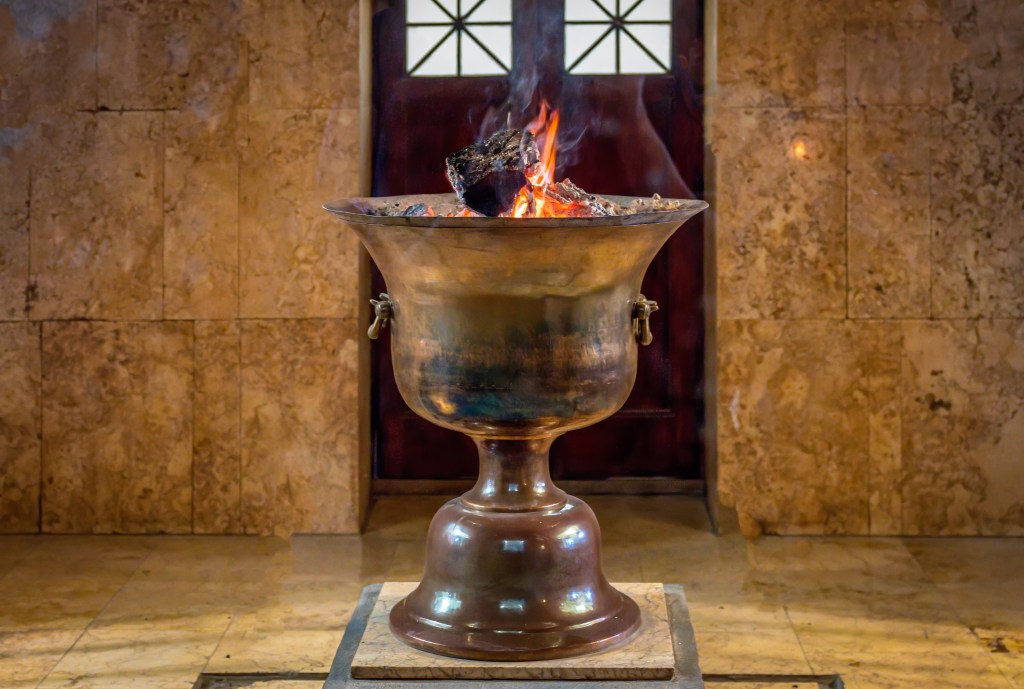
Among the most recognisable elements of ancient Iranian religion is fire. Yet fire was not worshipped as a god.
It functioned as:
- A symbol of truth and order
- A visible manifestation of purity
- A medium through which offerings were made
Fire’s importance lay in its qualities:
- It transforms without corruption
- It illuminates without deceit
- It consumes without becoming impure
In this sense, fire was not an object of devotion, but a presence — a reminder of the cosmic order aligned with asha. In domestic and communal contexts, tending fire was both practical and sacred.
Read more here: Zoroastrian Thought Before the Empire: Asha, Fire, and the Ethics of Kingship
III. Purity and the Structure of the World
If fire represented purity, then life itself required its protection.
Achaemenid religious practice placed strong emphasis on the purity of elements:
- Fire must not be polluted
- Water must remain clean
- Earth must not be defiled
This extended into everyday behaviour:
- Disposal of the dead required care (to avoid contaminating earth or fire)
- Waste and decay were treated as ritually dangerous
- Cleanliness was not merely hygienic, but cosmic responsibility
These practices reflect an underlying belief:
The world is ordered — and that order must be maintained through human action.
Religion, therefore, was not separate from daily conduct. It was embedded within it.
IV. Ritual in Daily Life
Unlike temple-based systems, Achaemenid religious life was decentralised.
Ritual occurred in:
- Households
- Open spaces
- Small communal gatherings
Offerings may have included:
- Libations
- Food
- Fragrant substances
But perhaps more important than formal offerings was ethical conduct. To Speak truth, Act justly, Keep one’s word was itself a religious act.
This alignment between ethics and ritual is one of the defining features of early Iranian religion.
Read more about the Persian lives here A Glimpse into the Lives of the Achaemenids: The Forgotten People
V. Time, Seasons, and Sacred Cycles
Religious life was not only spatial — it was temporal.
The passage of time was marked through festivals that aligned human life with cosmic cycles. While our evidence for specific Achaemenid observance is limited, several ancient Iranian festivals likely have roots in this period or earlier traditions.
Nowruz
Celebrated at the spring equinox, Nowruz marks renewal — the rebirth of nature and the restoration of balance.
Mehregan
Associated with Mithra, Mehregan reflects themes of covenant, justice, and gratitude.
Yalda Night
The longest night of the year, symbolising the triumph of light over darkness.
Sadeh
A celebration of fire and warmth in the depth of winter.
These festivals reflect a worldview in which:
Time itself participates in the moral and cosmic order.
Human life is aligned not only with divine principles, but with the rhythms of nature.
VI. Sacred Space Without Temples
One of the most distinctive features of Achaemenid religion is the absence of large temple complexes.
Classical sources suggest that Persians preferred:
- Open-air worship
- Elevated natural sites
- Simple altars
This does not indicate a lack of religiosity, but a different conception of sacred space. The divine was not confined to structures. It was encountered in:
- Fire
- Sky
- Landscape
In such a system, architecture plays a secondary role to ritual presence.
VII. The Role of the Magi in Everyday Life
As explored in the previous article, the Magi likely served as custodians of ritual knowledge.
In daily life, their role may have included:
- Guiding ritual practice
- Preserving oral traditions
- Ensuring correct performance of rites
- Advising on purity and conduct
They were not distant temple authorities, but embedded participants in social and courtly life. Their influence ensured continuity — not through institutions, but through practice.
VIII. Persepolis: Ritual Without Religion
At first glance, Persepolis appears religious. Processions. Offerings. Order. Symbolism. Yet, strictly speaking, it is not a temple complex.
Instead, it represents:
The ritualisation of kingship.
Delegations bring tribute not as worshippers, but as participants in a cosmic-political order. The king stands at the centre — not as a god, but as the guardian of order under Ahura Mazda.
Religion here is present — but transformed into imperial symbolism.
IX. The Question of Temples and the Cube of Zartosht
The structure known as Ka’ba-ye Zartosht remains one of the most intriguing monuments of the Achaemenid period.
Its function is uncertain:
- It may have served as a repository
- A ritual structure
- A symbolic monument
It is often associated with later Zoroastrian traditions, but there is no definitive evidence that it functioned as a fire temple in the Achaemenid era.
This ambiguity reflects a broader truth:
Institutional religion, as seen in later periods, had not yet fully emerged.
X. After Darius: Continuity and Transformation
Following Darius, rulers such as Xerxes continued to invoke Ahura Mazda. The religious language remained consistent, suggesting stability.
However, over time:
- Ritual practices became more formalised
- Priesthood structures evolved
- Fire temples emerged more clearly in later periods
What we see in the Achaemenid era is a transitional phase:
- Rooted in ancient Iranian tradition
- Moving toward later Zoroastrian formalisation
Read more on The Role of Zoroastrianism in the Achaemenid Empire: Faith, Governance, and Legacy
Conclusion: A Religion of Living Order
Achaemenid religion was not built in stone. It was carried in fire, spoken in truth, and measured in time. It required no temples, because it was already present in the world. It required no rigid doctrine, because it was expressed through action.
To live rightly was to participate in cosmic order. And in that participation — quiet, repeated, and shared — the empire found one of its deepest foundations.

 Kam Austine
Leave a comment