
“The city of Sais, where wisdom once dwelled, is now a whisper among the sands — yet her teachings shaped civilisations to come.”
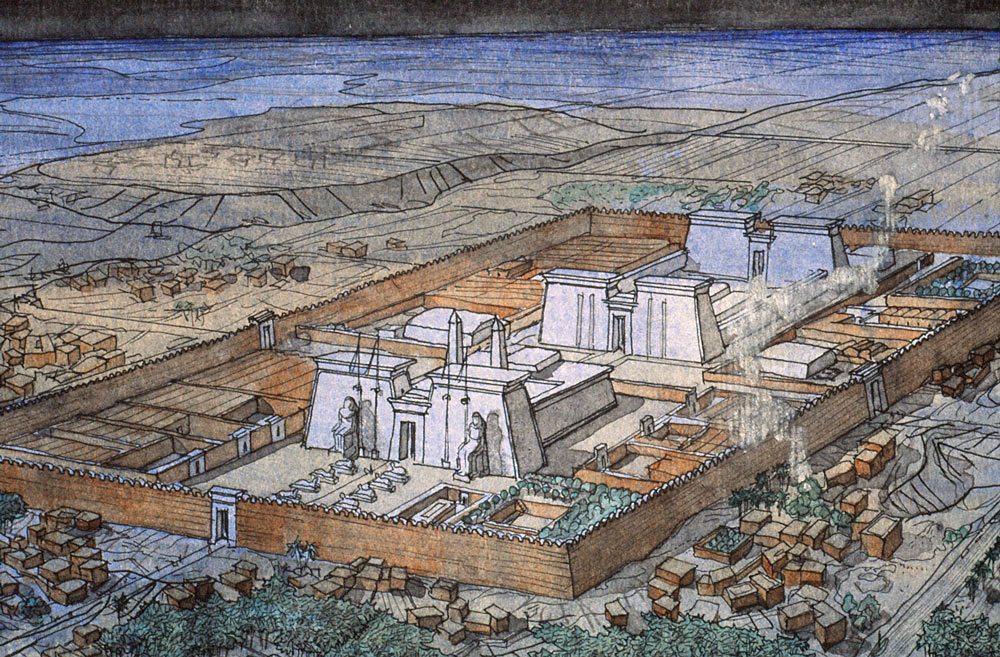
Picture: Reconstruction of the Temple of Sais by Jean-Claude Golvin — imagining the city as it might have appeared in the late Pharaonic era.
1. The City Where Wisdom Dwelled
On the western branch of the Nile Delta, where river and desert meet, lay the ancient and mysterious city of Sais — known to Egyptians as Sa and to the Greeks as Σάις. Modern Sa el-Hagar (“Stone Sais”) still marks its site, echoing the memory of a metropolis once radiant with temples, learning, and devotion.
As early as 3000 BCE, when the first pharaohs unified Egypt, Sais was already a sacred and strategic centre of Lower Egypt. Its limestone structures gleamed across the floodplain, serving as both royal residence and holy ground. Archaeological traces suggest a city built of monumental stonework, surrounded by gardens, shrines, and processional avenues — the first manifestations of an architectural tradition that would define Egyptian civilisation for millennia.
Sais was no ordinary provincial town; it was a city where knowledge and faith converged, where the divine was not distant but manifest in creation itself. At its heart stood the Temple of Neith, one of the oldest sanctuaries in Egypt and, according to ancient belief, the birthplace of wisdom.
2. Neith: The Goddess of Creation and Wisdom
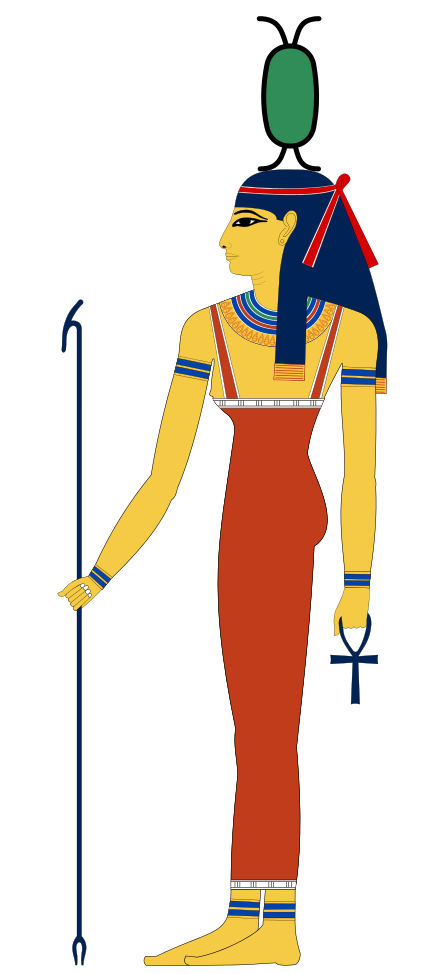
Neith was a paradox among gods — both a creator and a warrior, both mother and hunter. Her origins pre-date Egypt’s dynasties, reaching back to a Neolithic age when weaving, childbirth, and battle were understood as threads of the same cosmic fabric.
Her emblem, the Deshret (red crown of Lower Egypt) adorned with the cobra of Wadjet, symbolised her dominion over the Delta and her guardianship of divine order (ma’at). Uniquely, Neith was portrayed as self-generated, a being who “gave birth to Ra,” the sun god, yet was also invoked as the mediator between gods and humanity.
In her temple at Sais, priests taught that creation was an act of thought, not violence — a philosophical concept centuries ahead of its time. “What exists was born of Neith’s heart,” one inscription proclaimed. This notion — that mind precedes matter — would later echo in Greek philosophy and, through cultural transmission, even in Persian metaphysics.
The cult of Neith flourished particularly in periods when Egypt sought renewal. To the Saitic people, she was both the mother of the cosmos and the protector of soldiers, uniting wisdom with power — an archetype that would resonate in later goddesses such as Athena and Anahita.
3. Sais in Its Golden Age (664–525 BCE)
During Egypt’s 26th Dynasty, also known as the Saitic Renaissance, Sais became the political capital of a reunified kingdom. Under Psamtek I, Necho II, and Amasis II, Egypt rediscovered its ancient identity, reviving art, architecture, and science. The city’s monumental avenues, as described by Herodotus, dazzled visitors with colossal statues and immense sanctuaries.
The historian recounts the Sacred Lake of Sais — a man-made basin where priestly rituals were performed to honour Neith. During the Festival of the Lamps, the entire city glowed through the night, as thousands of saucers filled with oil and salt burned upon the water, their reflections merging with the stars above. To Herodotus, this illumination was more than a spectacle; it symbolised the light of divine understanding born from darkness.
Sais also housed royal tombs and administrative quarters, attesting to its dual function as both political and spiritual capital. The city’s prosperity attracted artisans, traders, and scholars from across the Mediterranean. Greek visitors brought ideas and goods; in turn, they carried Egyptian wisdom back to Ionia and beyond.
4. The Temple and the School of Medicine
Among the many disciplines practised in Sais, none reflected its spirit more profoundly than medicine. Attached to the Temple of Neith was one of the earliest known medical schools in human history — a centre that combined empirical observation with spiritual philosophy.
Remarkably, the school was distinguished by its female practitioners. In a civilisation often defined by patriarchal rule, Sais became a beacon for women in science.
The most famous among them was Pesehet (c. 2500 BCE), known as the “Lady Overseer of Female Physicians.”_Inscriptions indicate that she trained midwives and practitioners in obstetrics and gynaecology — fields regarded as sacred extensions of Neith’s creative power. Her title “King’s Associate”_ suggests that she served as royal physician, possibly to a monarch of the Old Kingdom.
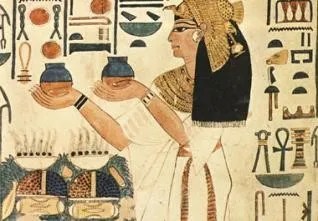
Pesehet’s example shows that Egyptian medicine was not merely pragmatic; it was deeply ethical and symbolic. Healing was an act of balance — restoring harmony between the body’s elements, mirroring the cosmic equilibrium maintained by the gods.
In this school, papyrus scrolls recorded treatments for childbirth, contraception, and reproductive health. Surgical instruments found in later periods — scalpels, forceps, and probes — reveal an astonishing sophistication. Sais thus stands as one of the first institutions in which science, spirituality, and gender equality coexisted.
5. Archaeological Rediscovery
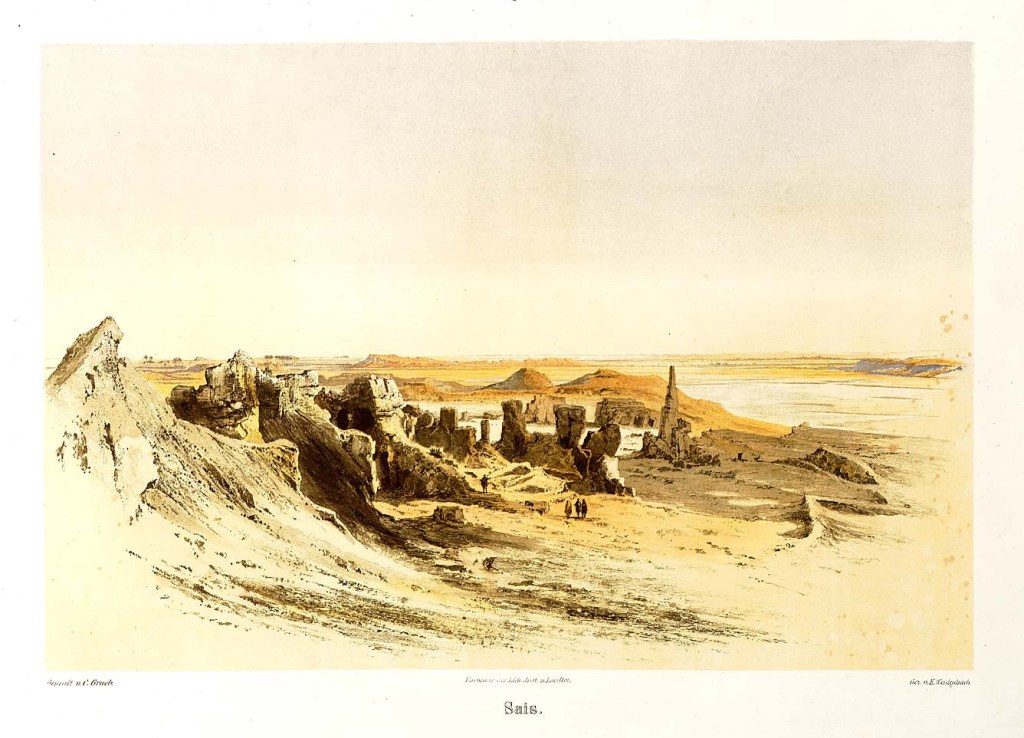
By the late 20th century, little remained of Sais beyond mounds of eroded brick and scattered stones. Yet beneath them lay traces of a vast metropolis. In 1993, Egyptian and British archaeologists uncovered sections of what they identified as the Saitic capital — including an industrial zone with kilns, workshops, and imported ceramics.
Among the findings were Greek amphorae, Syro-Palestinian wine jars, and local Egyptian vessels, revealing that Sais had been an international trading hub linking the Nile Delta with the Mediterranean and Levant. Domestic structures — ovens, storerooms, reception rooms — suggested a prosperous middle-class community.
Archaeologists also found amulets and iconography of Wadjet, the cobra goddess associated with Lower Egypt. Her presence reinforces the continuity between Neith’s ancient symbolism and the local protective deities that followed.
Despite extensive searches, the royal necropolis of the Saitic pharaohs remains undiscovered. Scholars believe the tombs of Psamtek I and his successors still lie hidden beneath the Delta clay, awaiting excavation. The Egypt Exploration Society continues to sponsor surveys, convinced that the city’s deepest secrets — perhaps even the archives of its medical school — still rest below ground.
6. Sais and the Persian Horizon
In 525 BCE, the armies of Cambyses II, son of Cyrus the Great, entered Egypt. The 26th Dynasty fell, and the Persian Empire extended its reach to the Nile. Yet unlike later conquerors, the Persians approached Egypt with respect and curiosity.
Read more about Egypt and Persia; Battles, Governance, and Cultural Exchange in Antiquity
Historical sources, including the autobiography of Udjahorresne, high priest of Neith, attest that Cambyses sought legitimacy through Neith’s temple at Sais. Udjahorresne records that the Persian king cleansed the shrines, restored offerings, and honoured Egyptian ritual. He even adopted an Egyptian throne name, Mesutire (“Born of Ra”) — perhaps bestowed in Neith’s sanctuary itself.
It is possible that Persian physicians and administrators encountered remnants of the Saitic medical school during this period. The Achaemenid court would later employ Egyptian doctors, engineers, and artisans, integrating their knowledge into the empire’s broader intellectual network.
In this sense, Sais became a bridge between civilisations — where Egyptian empirical science flowed eastward, influencing the medical traditions that would later flourish in Persia and, centuries after, in the Hellenistic world.
See more at The Blossoming of Science, Philosophy, and Mathematics During the Achaemenid Era
Thus, the story of Sais does not end with conquest. Its spirit of rationality and compassion endured, carried by the very empire that absorbed it.
Read connections with Susa (Shush) – The Eternal City of Kings
7. The Vanished City of Wisdom
Today, Sa el-Hagar appears as a quiet village surrounded by date palms and irrigation canals. The grandeur of Sais has long since faded; the colossal walls of Neith’s temple lie buried beneath centuries of silt. Yet the city’s legacy continues to resonate.
Sais symbolises a continuum of learning — from divine myth to human reason, from goddess to physician, from local shrine to global influence. Its ruins remind us that civilisation’s greatest monuments are not of stone alone, but of knowledge and care.
Future excavations may yet reveal the royal tombs or the archives of its temple school, but even now, the story of Sais endures as one of the earliest evidence to women’s leadership in science, cultural exchange, and the unity of mind and faith.
In every age, the pursuit of healing — whether physical or moral — returns to Sais, the city where wisdom first took form.
Footnotes
- Herodotus, Histories, Book II (Trans. A. D. Godley, Loeb Classical Library, 1920).
- Wilkinson, R. H. The Complete Gods and Goddesses of Ancient Egypt, Thames & Hudson, 2003.
- Lichtheim, M. Ancient Egyptian Literature, Vol. III (University of California Press, 1976).
- Bard, K. A. An Introduction to the Archaeology of Ancient Egypt, Wiley-Blackwell, 2015.
- Ray, J. D. “The Satrap and the Pharaoh: Udjahorresne and Cambyses,” Journal of Egyptian Archaeology 68 (1982).
- Brewer, D. J., and Teeter, E. Egypt and the Egyptians, Cambridge University Press, 2007.


Leave a Reply