
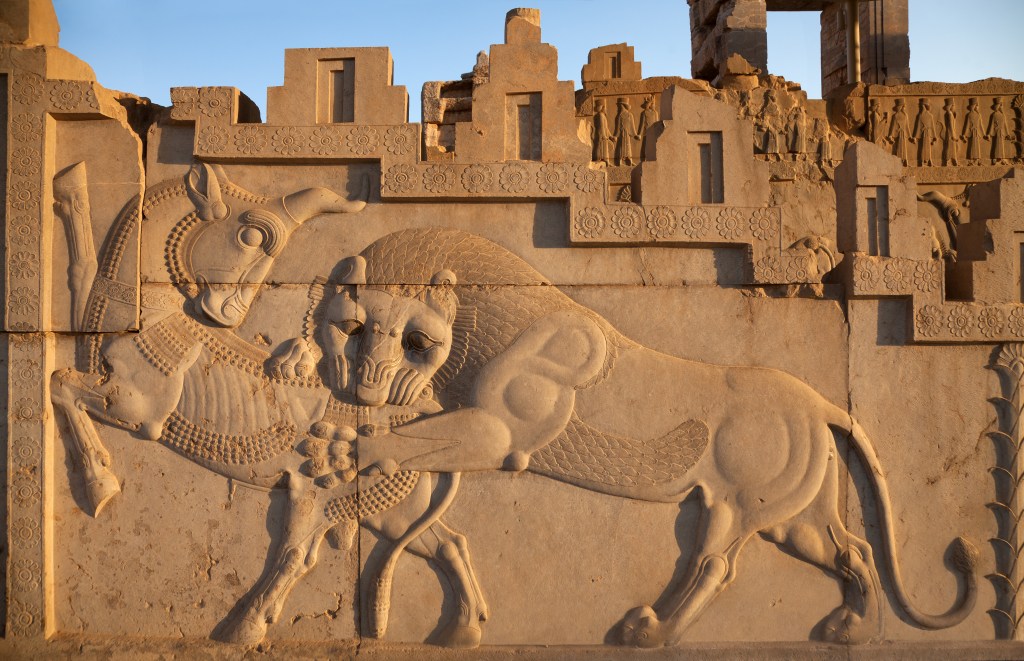
Among the many images carved into the stone terraces of Persepolis, one scene recurs with a quiet insistence: a lion sinking its teeth into the flank of a bull. The scene is neither chaotic nor brutal. The lion does not appear enraged, nor does the bull collapse in agony. Instead, the two animals are locked in a moment of perpetual tension, frozen in a struggle that never quite resolves. This image appears repeatedly on staircases, gateways, and architectural thresholds across Achaemenid ceremonial spaces, particularly at Persepolis and Susa. It is never accompanied by an inscription explaining its meaning. And yet, it is one of the most deliberate and carefully placed motifs in Persian imperial art.
This silence is not accidental. The lion and the bull were never meant to be explained; they were meant to be understood.
The Motif in Stone
At Persepolis, the lion-bull combat appears most famously on the eastern stairway of the Apadana. Carved in high relief, the scene shows a lion grasping the bull from behind, its jaws closing around the bull’s shoulder while the bull twists its head backward. The bodies are rendered with balance and dignity. There is no gore, no exaggeration of violence. The composition is symmetrical, controlled, and deeply intentional.
This motif is not isolated. Variations of the same struggle appear across Achaemenid monumental art, often positioned at transitional spaces: staircases, gateways, and points of ceremonial movement. These are liminal zones, where subjects approached the king, where time and space were symbolically reordered. The placement alone suggests that the image carried meaning beyond decoration [1].
What is equally striking is what the image does not show. The Persian king is absent. There is no human victor, no royal hero subduing chaos. The struggle unfolds independently of royal presence, as though the forces represented operate on a plane deeper than political authority.
Inherited Symbols: Elamite and Mesopotamian Roots
Persian imperial art did not emerge in a vacuum. The Achaemenids consciously positioned themselves as heirs to older civilisations of the Near East, particularly Elam and Mesopotamia. Animal combat scenes, especially involving lions and bulls, had appeared for millennia before Persia rose to power. In Mesopotamian art, the lion often symbolised solar power, kingship, and dominance, while the bull was associated with fertility, lunar cycles, and cosmic stability [2].
Yet the Persian version of the motif differs in tone. Earlier Mesopotamian representations often emphasised domination or divine triumph. In contrast, the Achaemenid lion and bull appear locked in a balanced confrontation, neither annihilated nor victorious. This transformation is revealing. Persia inherited the symbolic vocabulary of the ancient Near East but re-articulated it to express a distinct imperial philosophy [3].
The image is no longer about conquest alone; it is about continuity.
Seasonal Time and Cosmic Order
One of the most widely accepted interpretations of the lion-bull motif situates it within the seasonal and astronomical worldview of the ancient Iranian world. The bull is frequently associated with winter, earth, fertility, and the lunar cycle, while the lion corresponds to summer, the sun, heat, and renewal. Their struggle reflects the transition from winter to spring — a cosmic turning point rather than a final victory [4].
This reading aligns closely with the Nowruz festival, the Persian New Year, celebrated at the spring equinox . Persepolis itself is widely understood as a ceremonial complex deeply connected to Nowruz rituals. Delegations from across the empire arrived bearing gifts, renewing loyalty, and participating in a cyclical reaffirmation of order [5].
Seen through this lens, the lion does not destroy the bull; it overcomes it only temporarily, as spring overcomes winter. The bull will return. The struggle will repeat. Time, in this worldview, is cyclical rather than linear.
This is a profoundly unimperial idea by later standards. Empires often portray themselves as eternal triumphs. Persia, instead, carved impermanence into stone.
Kingship Without Domination
Perhaps the most revealing aspect of the lion-bull motif is its relationship to Persian kingship. The Achaemenid king does not appear as the agent of victory. Instead, he governs within a cosmic order that precedes and outlasts him. Royal inscriptions repeatedly emphasise that kings rule “by the will of Ahura Mazda,” not through personal force alone [6].
The absence of the king from the lion-bull struggle suggests a conception of power that is custodial rather than absolute. The king maintains balance; he does not end struggle. Order (aša) is preserved not by eliminating opposition but by keeping it in equilibrium.
This worldview helps explain why Persian imperial art avoids scenes of slaughter, humiliation, or annihilation of enemies. Even defeated peoples appear dignified in Persepolis reliefs, walking calmly toward the king with gifts rather than being dragged in chains. Power is expressed through harmony, not terror [1].
Indo-Iranian Resonances
The deeper one looks, the more the lion-bull motif resonates with Indo-Iranian cosmological ideas. In both Iranian and Vedic traditions, the universe is structured around opposing but interdependent forces. Order exists not in the absence of conflict but in its regulation.
The Avestan concept of aša and the Vedic ṛta both describe a cosmic order sustained through tension and balance rather than static perfection. Seasonal cycles, moral struggle, and the ongoing contest between constructive and destructive forces are fundamental to this worldview [7].
Within this framework, the lion and the bull are not moral symbols of good and evil. They are necessary counterparts. Their struggle is the mechanism through which time moves forward.
This may explain why the image held such power across cultural boundaries. It spoke in a symbolic language already intelligible from Anatolia to the Indus.
Psychology of Empire
Beyond cosmology, the lion and the bull reveal something subtle about Persian imperial psychology. The Achaemenid Empire ruled extraordinary diversity without attempting cultural homogenisation. Stability was achieved not by eliminating difference but by incorporating it.
The lion-bull struggle mirrors this political reality. The empire itself existed as a tension between centre and periphery, unity and diversity, authority and autonomy. The goal was not to erase opposition but to manage it within an ordered system.
This symbolism contrasts sharply with later imperial traditions that emphasised final victory, total domination, or apocalyptic endings. Persian imperial art suggests an acceptance of perpetual struggle as the condition of order.
In this sense, the lion and the bull may be read as an imperial self-portrait.
Why This Image, and Not Another?
The Achaemenids had many symbolic options. They could have depicted kings slaying enemies, gods defeating monsters, or empires crushing rivals. Instead, they returned repeatedly to an image without a clear victor.
This choice reflects extraordinary restraint. It acknowledges power while recognising its limits. It presents empire not as an endpoint of history but as a participant within it.
The lion and the bull do not represent Persia’s enemies. They represent the world itself.
After Persia: Survival of the Motif
The lion-bull struggle did not disappear with the fall of the Achaemenid Empire. Elements of the symbolism persisted into Sasanian art, Islamic motifs, Persian poetry, and even modern Iranian cultural memory. The idea that life unfolds through balance, renewal, and struggle remains deeply embedded in Persian thought.
That this image endured across religious and political transformations suggests that it articulated something more fundamental than imperial ideology. It expressed a worldview.
Conclusion: An Empire That Understood Time
The lion and the bull stand locked in eternal motion, carved into stone yet alive with meaning. They tell us that the Achaemenid Empire did not imagine itself as the end of history, but as its steward. Order was not static. Power was not absolute. Time was not linear.
In an age when empires shouted their dominance, Persia whispered its philosophy.
And the whisper still echoes.
Footnotes
- Margaret Cool Root, The King and Kingship in Achaemenid Art, Brill, 1979.
- Henri Frankfort, The Art and Architecture of the Ancient Orient, Yale University Press, 1954.
- Pierre Briant, From Cyrus to Alexander, Harvard University Press, 2002.
- Encyclopaedia Iranica, “Lion and Bull Motif.”
- Amélie Kuhrt, The Persian Empire, Routledge, 2007.
- Darius I, Royal Inscriptions (DB and related texts).
- Encyclopaedia Iranica, “Aša”; Encyclopaedia Britannica, “Ṛta.”


Leave a Reply