
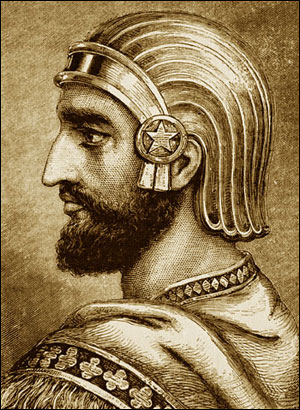
Introduction: The Many Faces of Cyrus
History remembers many conquerors. Some are admired for their military brilliance, others feared for their ruthlessness. Yet few rulers have been remembered favourably by as many different peoples as Cyrus the Great.
To the Persians, he was the founder of empire. To the Babylonians, he appeared as a restorer of order after a period of instability. To the Jewish people, he became the ruler who permitted the return from exile and the rebuilding of Jerusalem. Greek writers, even those whose descendants would later fight against Persia, often portrayed him as an exemplary king. More than two and a half millennia after his death, Cyrus remains one of the few ancient rulers claimed by multiple traditions and remembered across cultures.[1]
Such a reputation invites a question. Why did Cyrus succeed where so many conquerors before him failed? Why did his empire survive him, while the achievements of many earlier rulers collapsed within a generation? The answer lies not only in military victories but in a new approach to power, legitimacy, and imperial governance. Cyrus did not merely conquer territories; he transformed conquest into a durable political order.
The World Before Cyrus
When Cyrus emerged in the middle of the sixth century BCE, the ancient Near East was dominated by several powerful states. To the northwest stood the wealthy kingdom of Lydia under Croesus, whose name would become synonymous with riches. To the west and south lay the Neo-Babylonian Empire, heir to centuries of Mesopotamian civilisation and one of the most prestigious kingdoms of the ancient world. To the north, the Medes controlled much of the Iranian plateau, while Egypt remained an independent and influential power along the Nile.[2]
Against these established states, Persia appeared relatively modest. The Persians occupied the region of Pars in southwestern Iran and were generally viewed as subjects or junior partners within the wider Median political sphere. Few observers could have predicted that within a generation, this small kingdom would become the centre of the largest empire the world had yet seen.
Yet the foundations for that transformation had already been laid. As explored in the articles on Anshan and the Medes, the Persian rulers inherited a political environment shaped by centuries of interaction with Elamites, Medes, Babylonians, and Assyrians. Cyrus did not emerge from a vacuum. He emerged from a world already rich in administrative traditions, religious ideas, and political experiments. His achievement lay in combining these influences into something new.
Refer to Chapter 2 — Kingship, Rebellion, and the Struggle for Power of Achaemenid Empire Project for more details of these era.
From Anshan to Persia
The origins of Cyrus remain partly obscured by legend. Ancient sources preserve different and sometimes contradictory accounts of his ancestry and early life. The most famous narrative comes from Herodotus, who recounts a dramatic story involving dreams, prophecies, attempted infanticide, and eventual royal recognition.[3]
According to this tradition, the Median king Astyages dreamed that his grandson would one day overthrow him. Fearing the prophecy, he ordered the infant Cyrus to be killed. The child was secretly spared and raised among commoners before eventually discovering his royal identity and fulfilling the prediction. The story bears all the hallmarks of a heroic foundation myth and is difficult to verify historically.
Modern scholarship approaches such accounts with caution. What appears more certain is that Cyrus belonged to the Achaemenid ruling family of Anshan and was the son of Cambyses I. Through his lineage, he was connected to both Persian and Median elites, a fact that may later have helped him unite different groups under a single political framework.[4]
Whether or not the legends contain a kernel of truth, they reveal something important about how later generations understood Cyrus. He was not merely remembered as a successful king. He was remembered as a figure whose rise appeared almost inevitable, as though destiny itself had favoured him.
The Fall of Media
The decisive turning point in Cyrus’ career came with the collapse of Median power. Around 550 BCE, Cyrus rebelled against Astyages and defeated him, bringing the Median kingdom under Persian control.[5]
What followed is one of the most remarkable aspects of early Persian history. Unlike many conquerors who sought to erase the institutions of their predecessors, Cyrus largely preserved them. The Median elite were not systematically destroyed. Median administrators continued to serve within the new empire. Median traditions remained influential at court.
This approach would become a defining feature of Persian rule. Cyrus understood that conquest alone could create territory but not stability. By incorporating existing structures rather than dismantling them, he transformed former rivals into participants in a larger political project.
In many respects, the Persian Empire was not simply a replacement for Media; it was an expansion of the Median world under Persian leadership. This continuity helps explain how Cyrus was able to consolidate power so rapidly after his victory.
Cyrus the Conqueror
The conquest of Media was only the beginning. Within a relatively short period, Cyrus defeated Lydia in western Anatolia and later entered Babylon, bringing vast territories under his authority.[6]
Each of these victories altered the balance of power in the ancient world.
The conquest of Lydia brought enormous wealth and strategic control over western Anatolia. The defeat of Croesus eliminated one of the most powerful monarchies of the age and gave Persia access to important trade networks connecting Asia and the Mediterranean.
Babylon represented something different. It was not merely a wealthy city but a centre of immense cultural prestige. For centuries, Babylon had symbolised kingship, scholarship, religion, and imperial authority. To rule Babylon was to inherit one of the oldest political traditions in human history.
By the end of Cyrus’ reign, Persia had become the dominant power of the Near East. Yet the significance of these victories cannot be measured solely in territory. More important was the way Cyrus governed what he conquered.
Cyrus and the Problem of Sources
Before examining Cyrus’ reputation as liberator and founder, it is worth recognising the challenges historians face when reconstructing his life.
Our knowledge comes from a variety of sources, each with its own perspective and agenda. Babylonian chronicles provide contemporary administrative records. The Cyrus Cylinder offers an official statement of royal policy. Greek authors such as Herodotus and Xenophon wrote decades later and often blended history with moral instruction. Biblical texts present Cyrus through the lens of Jewish religious experience.[7]
These sources do not always agree. Some emphasise military conquest, others divine favour, and others ideal kingship. As a result, the historical Cyrus is not encountered directly. He emerges through a dialogue between multiple traditions.
This complexity is one reason why Cyrus continues to fascinate scholars. He exists simultaneously as a historical figure and as a symbol shaped by successive generations.
(To be continued in Part II with: Cyrus the Liberator, Cyrus Through Greek Eyes, The Founder of an Imperial Philosophy, Death and Legacy, and Conclusion.)
Footnotes
[1] Pierre Briant, From Cyrus to Alexander: A History of the Persian Empire (2002).
[2] Matt Waters, Ancient Persia: A Concise History of the Achaemenid Empire (2014).
[3] Herodotus, Histories, Book I.
[4] Amélie Kuhrt, The Persian Empire: A Corpus of Sources from the Achaemenid Period (2007).
[5] Nabonidus Chronicle; Briant, From Cyrus to Alexander.
[6] Herodotus, Histories, Book I; Waters, Ancient Persia.
[7] Kuhrt, The Persian Empire; Xenophon, Cyropaedia; Ezra; Isaiah 44–45.


Leave a Reply