

Omar Khayyam’s Bio
Omar Khayyam (1048–1131) was a Persian polymath — mathematician, astronomer, philosopher, and poet — whose genius resists easy classification. Born in Nishapur, in what is now northeastern Iran, he wrote a landmark treatise on algebra that solved cubic equations geometrically, centuries before comparable work appeared in Europe. As court astronomer to the Seljuk Sultan Malik-Shah, he led the reform of the Iranian solar calendar — the Jalālī calendar — whose calculation of the solar year remains more accurate than the Gregorian.
It is his Rubāʿīyyāt — collections of four-line poems — for which he is most widely known in the West, introduced through Edward FitzGerald’s celebrated 1859 free translation. Yet FitzGerald’s version shaped a Khayyam that is partly his own invention: lyrical, fatalist, pleasantly melancholic. The original is sharper. Behind the wine and the desert is a philosopher trained in formal logic, metaphysics, and natural science, working within — and against — the Islamic intellectual tradition of his time.
The Philosophy in Verse series reads each quatrain against Khayyam’s own treatises: a restoration, not merely a translation.
Omar Khayyam remains one of the most misunderstood figures of the medieval Persian world. Celebrated in the West as a poet of wine, fate, and fleeting pleasure, he was in truth a mathematician, astronomer, philosopher, and logician whose intellectual work stood at the crossroads of science, metaphysics, and existential reflection. Behind the famous quatrains lies a thinker deeply engaged with questions of necessity, knowledge, creation, mortality, and the limits of human certainty.
This project brings together essays, translations, and philosophical studies dedicated to Khayyam’s world of thought. At its centre is Philosophy in Verse — an ongoing thematic translation and interpretation of the quatrains read against Khayyam’s own treatises and the intellectual tradition of his time. Rather than treating the Rubāʿīyyāt merely as lyrical poetry, the project approaches them as fragments of a broader philosophical voice shaped by logic, scepticism, cosmology, and the tension between reason and revelation.
Alongside the quatrains, the project explores Khayyam’s writings on ontology, determinism, metaphysics, and the structure of existence, while also examining the historical environment of Seljuk Persia in which he lived and wrote. The aim is not only to translate Khayyam’s words, but to restore the intellectual atmosphere from which they emerged — where mathematics, astronomy, philosophy, and poetry still belonged to a single pursuit of truth.
Selective Khayyam’s Quatrains and their Philosophical Reflections
Meaning & Doubt
Time & Impermanence
The Challenge of Creation
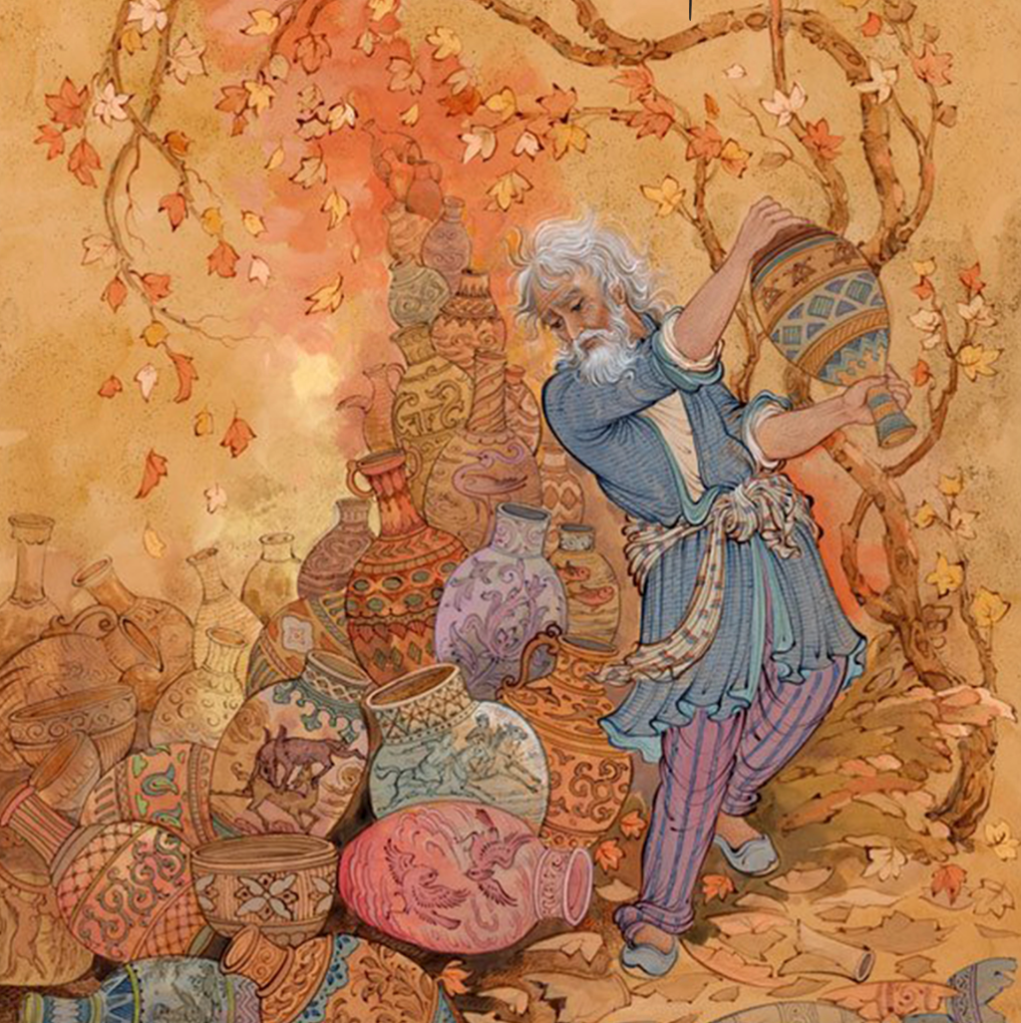
Khayyam’s Philosophy Series
Khayyam’s philosophical writings reveal a thinker far more systematic and rigorous than the image preserved through later poetic legend. Beyond the quatrains lies a scholar trained in logic, metaphysics, mathematics, and natural philosophy, working within the intellectual world shaped by Avicenna, Islamic theology, Greek philosophy, and Persian scientific tradition. His treatises confront enduring questions concerning existence, causality, determinism, knowledge, contradiction, and the structure of reality itself.
The Khayyam’s Philosophy Series gathers reflections, summaries, and studies based on Khayyam’s surviving philosophical works and related intellectual traditions. Rather than approaching the quatrains in isolation, the series attempts to place them back into the broader framework of Khayyam’s own metaphysical and scientific thought. Through this lens, the poetry becomes not merely lyrical meditation, but part of a deeper philosophical inquiry into being, mortality, uncertainty, and the limits of human understanding.
Many of these essays also explore the relationship between Khayyam’s formal philosophical arguments and the symbolic language of the Rubāʿīyyāt, tracing how themes such as determinism, existential doubt, the impermanence of existence, and the challenge of creation emerge across both his scholarly and poetic works. The aim is not to force certainty upon Khayyam’s worldview, but to reconstruct the intellectual atmosphere in which his philosophy and poetry continually intersect.


