
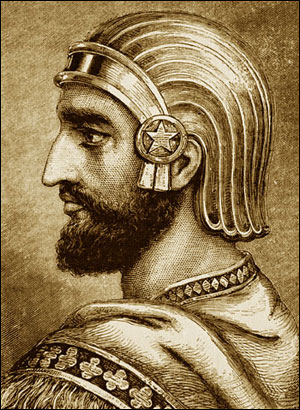
Cyrus the Liberator
The capture of Babylon in 539 BCE remains one of the defining moments of Cyrus’ career. Unlike many ancient conquests, the event appears to have occurred with relatively little destruction. Contemporary Babylonian records suggest that Cyrus entered the city as a welcomed ruler rather than a foreign devastator, presenting himself as the legitimate successor to Babylonian kingship rather than its destroyer.[8]
The most famous document associated with this event is the Cyrus Cylinder, discovered in Babylon in 1879. Written in Akkadian cuneiform, the inscription presents Cyrus as a ruler chosen by the Babylonian god Marduk to restore order after the perceived failures of Nabonidus. It describes the restoration of temples and the return of displaced religious communities to their homelands.[9]
Modern interpretations of the cylinder have often been shaped by contemporary political concerns. It is sometimes described as the world’s first declaration of human rights. While this interpretation has popular appeal, most historians regard it as an anachronistic reading of an ancient royal inscription. The cylinder belongs to a long Mesopotamian tradition of kings presenting themselves as restorers of order and divine favour rather than innovators of universal rights.[10]
Nevertheless, the inscription remains remarkable. It reveals a ruler who understood the political value of respecting local traditions. Cyrus did not attempt to impose a single culture upon his empire. Instead, he sought legitimacy by working through existing religious and social institutions.
Nowhere is this legacy more evident than in Jewish tradition. The biblical books of Ezra and Isaiah portray Cyrus as the ruler who permitted Jewish exiles to return to Jerusalem and rebuild the Temple.[11] Isaiah even refers to him as the Lord’s “anointed,” a unique honour for a non-Jewish king.
Whether viewed through Babylonian, Persian, or Jewish sources, a consistent pattern emerges. Cyrus gained support not simply through military victory but through a policy of accommodation that allowed conquered peoples to preserve important aspects of their identity.
Cyrus Through Greek Eyes
One of the most extraordinary aspects of Cyrus’ legacy is the admiration he received from Greek writers. This is particularly striking given that later generations of Greeks would become Persia’s principal rivals.
Herodotus portrays Cyrus as a charismatic founder whose courage and determination transformed Persia from a minor kingdom into a world power.[12] Although Herodotus includes legendary material, his account reflects genuine admiration for Cyrus’ leadership.
An even more influential portrait appears in Xenophon’s Cyropaedia. Written more than a century after Cyrus’ death, the work is not a conventional history but a philosophical exploration of ideal kingship. Xenophon uses Cyrus as a model ruler whose success stems from wisdom, discipline, justice, and the ability to inspire loyalty.[13]
The influence of Xenophon’s Cyrus extended far beyond antiquity. The Cyropaedia became one of the most widely read political works in the classical and early modern worlds. Alexander the Great reportedly admired Cyrus. Roman statesmen studied him. During the Renaissance and Enlightenment, political thinkers continued to debate Xenophon’s vision of kingship.
Few rulers of the ancient world enjoyed such a long intellectual afterlife. Cyrus was not only remembered; he was repeatedly reimagined as an example of how power ought to be exercised.
The Founder of an Imperial Philosophy
To understand Cyrus’ true significance, one must look beyond individual victories and ask a larger question: what kind of empire did he create?
Previous empires had often depended upon fear, tribute, and military dominance. Assyrian kings celebrated their victories through reliefs depicting conquest, punishment, and submission. Power was demonstrated through intimidation. While effective in the short term, such systems often proved fragile once central authority weakened.[14]
Cyrus pursued a different path. He recognised that an empire composed of diverse peoples could not be governed solely through force. Stability required legitimacy. Conquered populations needed reasons to cooperate beyond fear of punishment.
This principle can be seen repeatedly throughout Persian history. Local elites were frequently retained. Existing administrative structures were adapted rather than destroyed. Religious traditions were often respected. Instead of imposing uniformity, the empire sought integration.
The significance of this approach became clearer under Cyrus’ successors. The satrapal system, the Royal Road, imperial finance, and the vast ceremonial complexes of Susa and Persepolis all rested upon foundations laid during Cyrus’ reign. These institutions did not emerge in isolation. They grew from an imperial philosophy that viewed diversity as something to be organised rather than eliminated.
This philosophy should not be romanticised. The Achaemenid Empire remained an empire, sustained by military power and tribute. Yet compared with many of its predecessors, it displayed a remarkable capacity to incorporate different cultures into a common political framework.[15]
In this sense, Cyrus’ greatest achievement may not have been the territories he conquered, but the political model he created. The empire endured because it offered stability, continuity, and participation to many of the peoples it absorbed.
Cyrus and the Birth of Persian Identity
An often-overlooked consequence of Cyrus’ achievements was the emergence of a broader Persian identity. Before Cyrus, the Persians were one people among many within the Iranian world. After Cyrus, they became the leading force within a multinational empire.
This transformation affected both rulers and subjects. Persian kings increasingly saw themselves not merely as tribal leaders but as guardians of a universal political order. Subjects across the empire encountered Persian administration, Persian royal symbolism, and Persian concepts of kingship.
Yet the resulting identity remained surprisingly inclusive. The empire incorporated Median traditions, Elamite administrative practices, Babylonian scholarship, Egyptian customs, and countless local influences. Persian identity was therefore not created through isolation but through interaction.
The empire’s strength lay precisely in this ability to unite diversity under a shared political framework.
Death on the Frontier
Like many great conquerors, Cyrus spent his final years campaigning on the empire’s frontiers. Ancient sources disagree about the circumstances of his death. Herodotus reports that he died fighting the Massagetae, a nomadic people of Central Asia led by Queen Tomyris.[16] Other traditions present different accounts.
The exact details may never be known. What is clear is that Cyrus died not in a palace but while extending and securing the boundaries of his empire.
His body was returned to Pasargadae, the city he had founded in the Persian heartland. There, a remarkably simple stone tomb was constructed. Unlike the colossal monuments of Egypt or Mesopotamia, the tomb reflects a striking restraint.
Centuries later, when Alexander the Great visited Pasargadae, he reportedly paid his respects at Cyrus’ tomb.[17] Even the conqueror who ended the Achaemenid Empire recognised the stature of its founder.
Memory and Myth
Few ancient rulers have inspired as many different memories as Cyrus.
To Persians, he became the father of empire.
To Jews, the liberator from Babylonian captivity.
To Greeks, the model king.
To modern historians, a pivotal figure in the transition from regional kingdoms to global empires.
Each tradition emphasised different aspects of his life. Yet together they reveal something extraordinary. Cyrus transcended the boundaries of his own civilisation. He became a figure through whom different cultures articulated their own ideals of leadership, justice, and political order.
This process inevitably transformed the historical Cyrus into something larger than history. Legend and memory became intertwined with fact. Yet the persistence of these traditions is itself evidence of his significance.
Conclusion: Why Cyrus Endures
Many rulers conquered territory. Many kings accumulated wealth. Many generals won spectacular victories.
Cyrus achieved something rarer.
He transformed a regional kingdom into an imperial system capable of governing vast and diverse populations. He inherited traditions from Elam, Media, Babylon, and Persia, yet forged them into a new political order. He demonstrated that conquest could be followed by integration, and that power could be strengthened through legitimacy as well as force.
His successors would expand and refine the structures he created. Darius would build administrative systems, roads, and monumental capitals. Xerxes would command armies stretching across continents. Yet none of these achievements would have been possible without the foundations established by Cyrus.
More than two and a half millennia later, the empire he founded has long disappeared. The cities he ruled have risen and fallen. The roads have faded. The palaces have become ruins.
Yet Cyrus remains.
Not merely as a conqueror, nor solely as a liberator, but as a founder whose vision reshaped the ancient world and whose legacy continues to provoke admiration, debate, and reflection across cultures and centuries.
Refer to Chapter 2 — Kingship, Rebellion, and the Struggle for Power of Achaemenid Empire Project for more details of these era.
Additional Footnotes
[8] Nabonidus Chronicle.
[9] Cyrus Cylinder, British Museum Collection.
[10] Amélie Kuhrt, “The Cyrus Cylinder and Achaemenid Imperial Policy,” Journal for the Study of the Old Testament.
[11] Ezra 1:1–4; Isaiah 44:28–45:1.
[12] Herodotus, Histories, Book I.
[13] Xenophon, Cyropaedia.
[14] Mario Liverani, The Ancient Near East: History, Society and Economy.
[15] Pierre Briant, From Cyrus to Alexander; Maria Brosius, The Persians.
[16] Herodotus, Histories, Book I.
[17] Arrian, Anabasis of Alexander, Book VI.

 Kam Austine
Leave a comment