
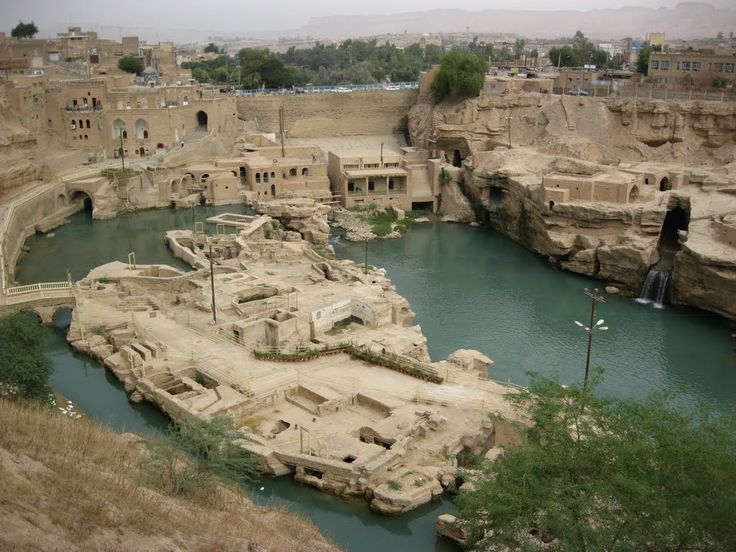
“In Susa, time never sleeps — only changes its crown.”
1. The Crossroads of Civilisations
In the fertile plains of Khuzestan, about 150 kilometres east of the Tigris River, lies Susa — known in Persian as Shush. This ancient city, founded as early as 7000 BCE, stands among the oldest continuously inhabited sites on Earth. Its deep cultural strata preserve the memory of empires that rose and fell like tides: Elamite, Achaemenid, Seleucid, Parthian, and Sasanian.
Susa’s story is not merely one of bricks and ruins, but of the encounter between worlds. Positioned between Mesopotamia and the Iranian Plateau, it became a living bridge linking the two greatest civilisations of the ancient Near East. To the west flowed the scribes and laws of Babylon; to the east, the mountains and metallurgists of Anshan. Here they met, exchanged, and blended into something greater than either alone — a culture that laid the groundwork for Persia itself.
2. The Elamite Legacy — Land of the Gods
Before Persia, there was Elam — the “Land of the Gods,” as the Assyrians called it, translating the Elamite name Hel-Tum-Ti. At its heart stood Susa, a city whose origins stretch back over nine millennia.
Archaeological layers reveal a society that mastered metallurgy, irrigation, and early writing systems, contemporaneous with Sumer. The Elamite tablets, written in proto-Elamite script, suggest one of the world’s earliest bureaucratic systems.
Susa’s wealth rested on three pillars:
- Intelligence and adaptability — the Elamites absorbed knowledge from their Mesopotamian neighbours without losing their identity.
- Fertility of the Khuzestan plain, ideal for agriculture and animal husbandry.
- Cultural rivalry with Assyria and Babylon, which spurred both innovation and resilience.
Among Susa’s treasures are the gold statuette of a deity and the Shush goblet, both housed in the Louvre. The goblet, decorated with stylised ibexes and geometric motifs, reveals not only aesthetic brilliance but also philosophical depth — the cyclical rhythm of nature rendered in form.
Elam was more than a kingdom; it was a cradle of continuity, transmitting its artistic and spiritual legacy to the later Persians who would claim descent from its soil.
3. The Fire of Ashurbanipal
Yet, greatness invites envy. In the 7th century BCE, Susa faced one of the darkest moments in its history.
Assyrian king Ashurbanipal launched a devastating campaign against Elam, seeking vengeance for generations of rivalry. His conquest of 647 BCE, recorded on Assyrian reliefs, depicts the Battle of Ulai — fire engulfing the city, soldiers looting temples, and captives dragged in chains.
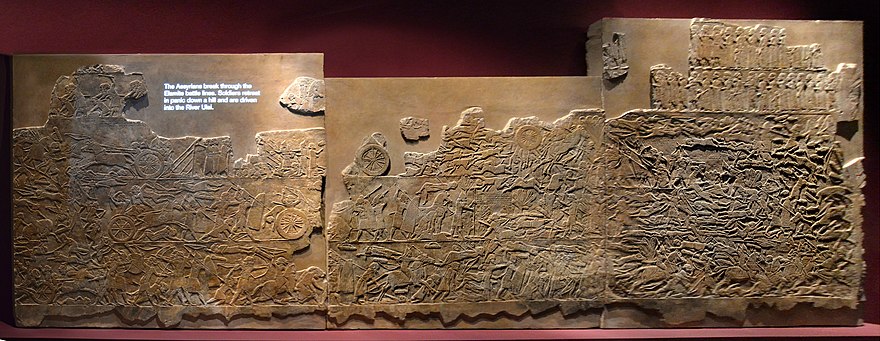
Ashurbanipal boasted that he “sowed salt into its earth so that nothing might grow again.” Yet, despite this annihilation, Susa rose once more — proof that civilisations can be razed but not erased.
The fall of Elam marked the twilight of an age, but the embers of its culture smouldered beneath the ashes, waiting for a new dawn: the rise of Persia.
4. The Achaemenid Renaissance — Susa, Jewel of the Empire
When Cyrus the Great founded the Achaemenid Empire, he inherited not only Elam’s geography but its spirit. His successors, especially Darius I the Great, would transform Susa into one of the most magnificent capitals of antiquity.
Darius declared in his foundation inscription:
“By the favour of Ahura Mazda, I built the palace of Susa.”
Under his reign, Susa became the empire’s administrative and ceremonial heart, sharing power with Persepolis and Pasargadae. The Royal Road, stretching over 2,700 km, linked Susa to Sardis in Lydia, allowing for swift communication, trade, and governance across an empire spanning three continents.
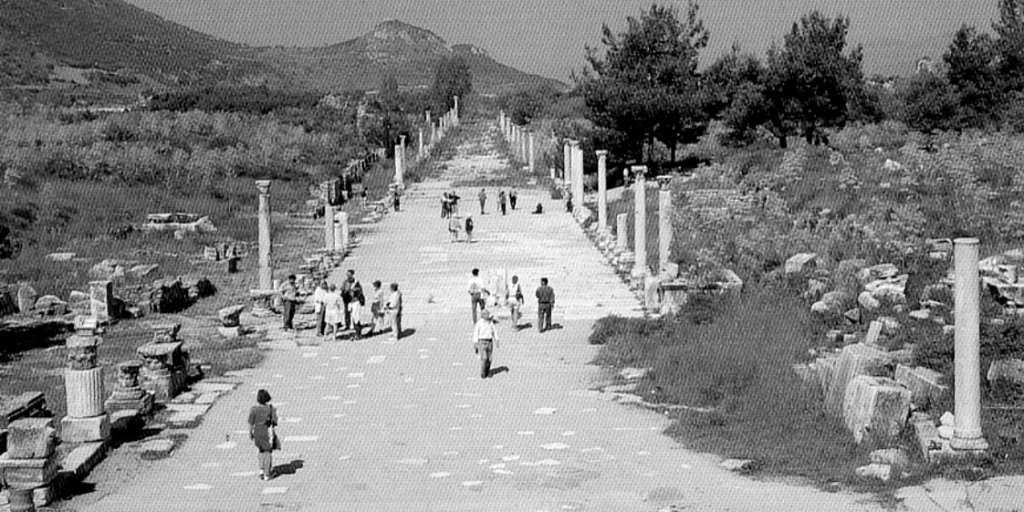
The construction of Susa’s palaces drew upon artisans from every corner of the empire: Babylonian brick-makers, Ionian sculptors, Egyptian goldsmiths, and Elamite masons. This multicultural collaboration symbolised the empire’s vision — unity without uniformity.
The Apadana Palace, Darius’s audience hall, stood as a witness to this harmony.
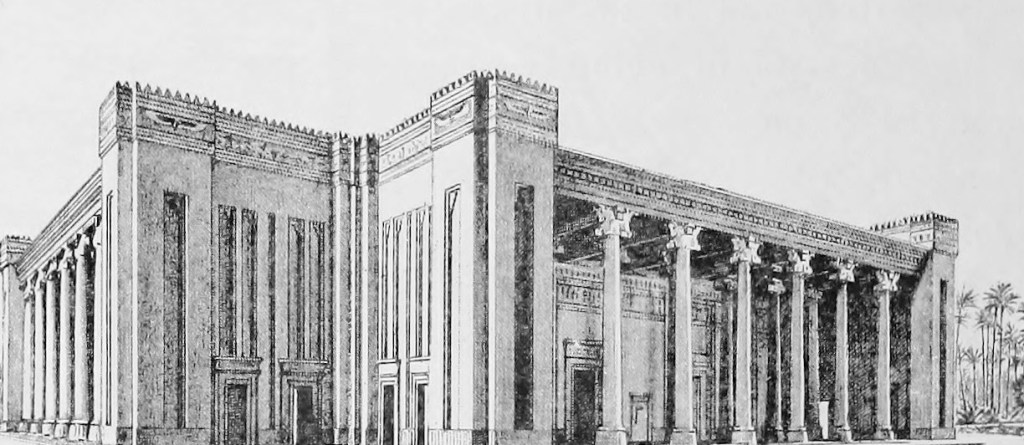
The Apadana’s walls once gleamed with glazed bricks depicting lotus motifs, lions, and the Immortals — symbols of eternal kingship. Here, Darius and Xerxes proclaimed edicts not of domination, but of administration, infrastructure, and tolerance, ideals that would echo through centuries.
Susa under the Achaemenids was more than a capital; it was a cosmos in miniature — where the empire’s diversity was carved into marble and clay.
5. Hellenistic and Parthian Transformations
Following Alexander’s conquest, Susa entered a new age under the Seleucids and later the Parthians. While its political prestige waned, it thrived as a commercial hub.
The Seleucids constructed a canal connecting Susa to the Karun (Eulaios) River, allowing goods from India and Arabia to flow into the city’s markets. Spices, silk, and gemstones arrived by sea and river, while Greek merchants established colonies nearby.
Coins minted in Susa reveal hybrid imagery — Greek deities inscribed with Aramaic and Middle Persian legends — reflecting the syncretic culture of the age. Despite shifting empires, Susa remained what it had always been: a meeting place of worlds and ideas.
6. Susa in the Sasanian Era — The Silk and the Sword
Under the Sasanian dynasty (224–651 CE), Susa flourished once again as an industrial and intellectual centre. Alongside Shushtar and Gundishapur, it became a node in the empire’s silk and textile network. Silk from Susa reached Byzantium and India, embodying Persia’s economic and artistic sophistication.
However, during the reign of Shapur II, rebellion erupted in Susa. The city resisted imperial taxation and authority. In response, Shapur marched with war elephants, besieging and razing the city. In the aftermath, he renamed it “Iran-Khurre Shapur”, meaning “Glory of Iran by Shapur.”
In northern Susa, the new settlement of Karkhadi Ladan (later Iran-Asan Karkuad, “Tranquillity of Iran”) rose, symbolising the empire’s attempt to rebuild order.
Meanwhile, the spread of Christianity and Manichaeism brought new religious dynamics. Susa became an episcopal seat; it also witnessed tragedy — Mani, the founder of Manichaeism, was executed nearby at Gundishapur, illustrating the complex interplay of faith and empire.
Thus, even under the Sasanians, Susa’s story was one of renewal — a city reborn through commerce, belief, and cultural fusion.
7. The Arab Conquest and the Fall into Silence
By the 7th century CE, the Sasanian Empire had weakened under internal strife and Byzantine wars. When Arab forces advanced into Khuzestan, Susa — once the beating heart of empires — fell swiftly.
Chroniclers such as Tabari and the author of Fath al-Bari record the devastation: the killing of over 30,000 inhabitants, the enslavement of women and children, and the looting of cattle and treasures. The city was plundered repeatedly in the following centuries, its glory reduced to fragments of memory.
The fall of Susa marked the end of an era — the final eclipse of ancient Persia’s urban splendour before the dawn of Islamic civilisation.
8. Rediscovery — From Pilgrims to Archaeologists
Centuries later, the silence of Susa drew the curiosity of travellers.
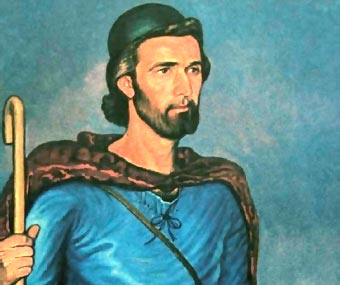
In the 12th century, Benjamin of Tudela, a Jewish traveller, journeyed across Persia to visit Jewish communities and holy sites. During his pilgrimage to the tomb of the prophet Daniel, he recognised the ruins of Susa — making him the first to record its ancient heritage.
By the 19th century, European archaeologists such as William Loftus, Jane and Marcel Dieulafoy, and Jacques de Morgan excavated the site extensively. Their discoveries — tablets, sculptures, jewellery, and palace foundations — revealed a continuous human presence stretching back nearly 9,000 years.
Among the most significant finds were the Darius Inscription, the Code of Hammurabi (recovered from Susa), and the architectural remnants of the Apadana Palace — all confirming Susa’s status as one of the great cradles of civilisation.
9. The Eternal City
Today, modern Shush is a modest town, its skyline marked by mounds of ancient brick. Yet beneath those mounds lies a city that once ruled empires, hosted kings, and fostered philosophies.
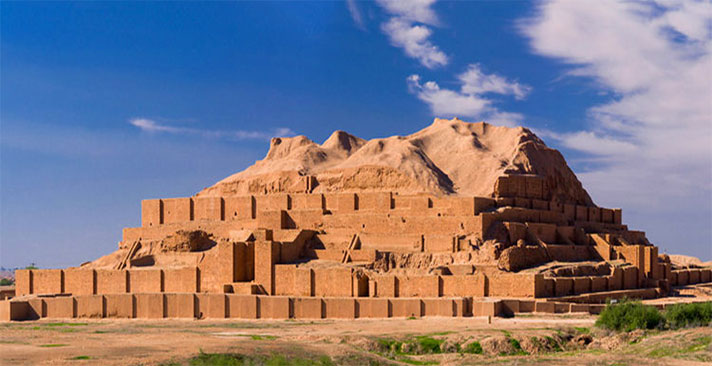
From Elam’s sacred ziggurats to Darius’s marble halls, from Seleucid merchants to Sasanian silk-weavers, Susa’s legacy endures as a mirror of human civilisation — resilient, adaptive, and timeless.
Its ruins whisper not only of power and loss but of continuity, reminding us that the essence of empire lies not in conquest, but in the endurance of culture.
In every fragment unearthed from Shush, the spirit of an empire breathes again — the Eternal City of Kings, where the rivers of history still flow.
Footnotes
- Potts, D. T. (2016). _The Archaeology of Elam: Formation and Transformation of an Ancient Iranian State._Cambridge University Press.
- Herodotus, Histories, Book I, trans. A. D. Godley, Loeb Classical Library.
- Stronach, D. (1989). “The Royal Road System of the Achaemenids.” Iranica Antiqua 24.
- Curtis, J. (2010). Ancient Persia. British Museum Press.
- De Morgan, J. (1905). Mission scientifique en Perse. Paris.
- Tabari, History of the Prophets and Kings (translated by Franz Rosenthal, SUNY Press, 1989).


Leave a comment