
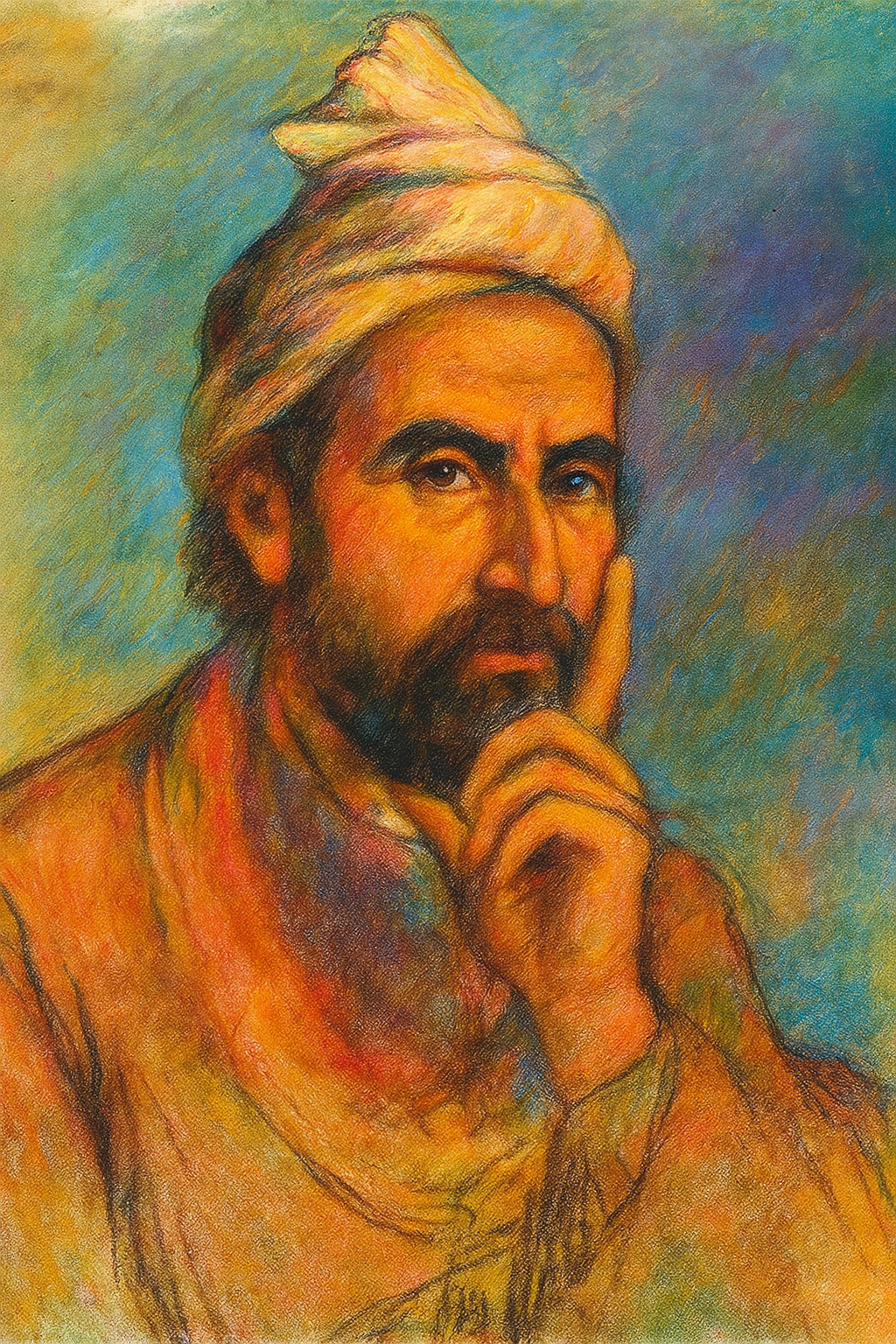
No. 74
Whether in Baghdad or in Balkh, life draws to its end,
When the cup is filled, sweet or bitter — naught to mend;
Drink wine — for after you and me, the moon shall fare
From dark to new, from new to dark — eternal in its trend. *
Philosophical Reflection
Baghdad and Balkh mark something more specific than the poles of the Islamic scholarly world: they are the farthest western and eastern reaches of the Persian Empire at its greatest extent. For Khayyam, these names carried the full weight of a civilisation’s territorial imagination — the western edge of the world Persia claimed and the eastern horizon it reached. To say that life ends the same whether in Baghdad or in Balkh is to sweep the entire breadth of Persian imperial history into a single argument from geography. The achievement of empire, the conquest of distance, the maintenance of civilisational reach from one end to the other — none of it changes the fact. Wherever the cup fills, it empties by the same logic.
In Persian, the cup carries a specific resonance: it is the measure of a life’s duration, the allocated portion of time within which a person exists. When Khayyam asks whether the cup is sweet or bitter, he is asking whether the life it measures has been filled with joy or with sorrow — and then immediately dismissing the question. Sweet or bitter, the cup fills to its measure and empties on the same terms. “Naught to mend” is exact — there is nothing to correct here, nothing that the quality of what was experienced changes about the terminal fact of completion. Human attention fixates on the qualitative: was it a good life, a sorrowful one, was the joy worth the sorrow? The cup registers none of this. It tracks duration and completion, with no column for joy or grief — only for full and empty.
The last two lines shift scale from the human to the celestial, and here Khayyam’s identity as a working astronomer becomes visible with unusual precision. He names the moon at its two hinge points: the darkness of the old crescent vanishing at the end of the lunar month, and the emergence of the new crescent at its beginning. This is not decorative lunar imagery — it is the technical vocabulary of the very calendar Khayyam spent years computing. As the chief architect of the Persian calendar reform of 1079 CE, he had measured the solar year to an accuracy that would remain unsurpassed for centuries. When he writes the moon moving from dark to new and back again, he is writing from inside an exact knowledge of celestial mechanics. The moon cycling above Baghdad or Balkh does not adjust its rhythm to the life or death of anyone below it. It proceeds from dark to new, from new to dark, with the same indifference the cup shows to the sweet or the bitter — and it will continue doing so, the quatrain notes with quiet precision, after both you and I are gone.
Given the geographical equivalence, the indifference of the cup, and the moon’s mechanical precision, the poem’s directive arrives with a weight that simple hedonism cannot account for. Drink — not to seize a sensory moment before the moon closes it, but to become, in the act of drinking, as indifferent as everything that surrounds you. The universe is indifferent to whether your life was sweet or bitter, whether it ended in Baghdad or in Balkh, whether the moon noticed your passing. The wine is the instrument for achieving that same indifference from the inside — for reaching, within the brief interval, the equanimity that the cosmos holds by nature. The correct response to universal indifference is not anguish at being ignored — it is to become, in some measure, indifferent yourself.
Footnote
* Source: Tarabkhaneh, Homaei, no. 74, translated by Kam Austine for Philosophy in Verse
چون عمر بسر رسد چه بغداد و چه بلخ
پیمانه چو پُر شود چه شیرین و چه تلخ
می نوش که بعد از من و تو ماه بسی
از سلخ بغره آید از غره به سلخ
Related Khayyam’s Treatises: Treatise on the General Properties of Existence · Necessity of Contradiction in the World, Determinism, and Immortality · Risāla dar ʿIlm Kulliyāt-e Wujūd (On the Universals of Being)
Internal Themes: #Existentialism #CosmicIndifference #Impermanence #LiveInThePresent #Nihilism #Astronomy
Published as part of the Omar Khayyam Project

 Kam Austine
Leave a comment