
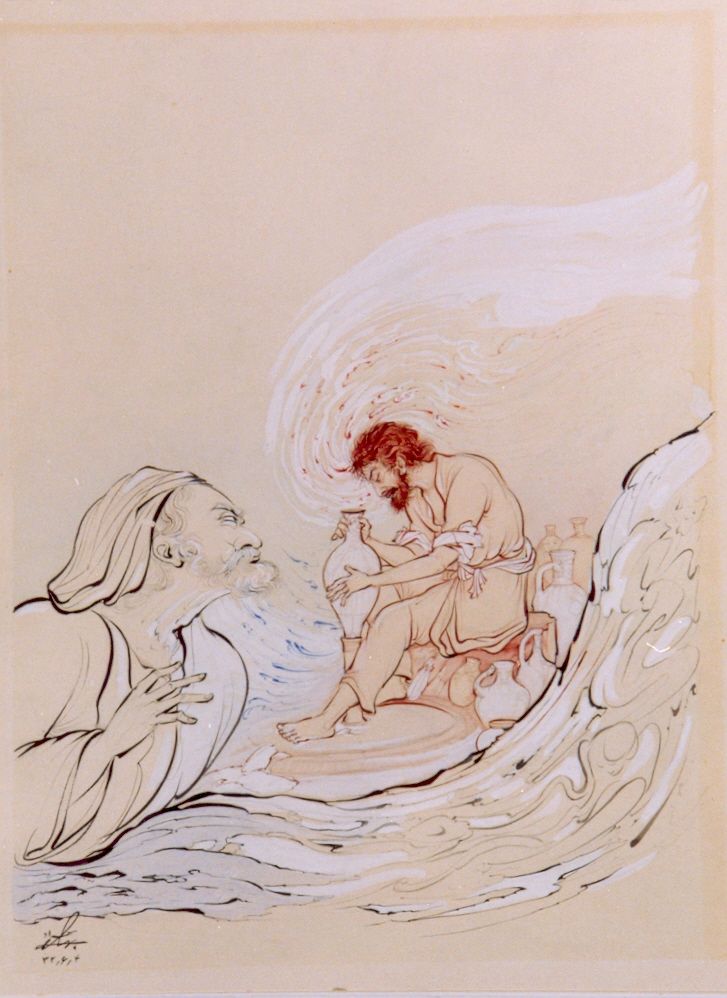
No. 268
Of being and non-being I know the outward show;
I know the inner side of all things, high and low;
yet, with all this, I am sick of all my learning,
if any rank beyond the drunkard’s state I know.*
Philosophical Reflection
The first two lines make the largest claim to knowledge a man of Khayyam’s century could make. Being and non-being are the whole subject of the philosophers; the outward and the inward of things are the two halves of every science, the one the scholar observes and the one the mystic claims to see beneath it; high and low take in the heavens and the earth. The speaker says he knows all of it. He does not boast, and he does not ask to be believed. He sets the claim down as a premise, and the rest of the poem tests what it is worth.
The third and fourth lines carry the test, and the logic sits in the word if. He does not say that his learning is worthless. He says he would be sick of it if it showed him any rank above the drunkard’s state. Rank is the language of ladders: of degrees of knowledge, of stations on the mystic’s road, of a hierarchy in which the learned stand above the common man and the ascetic above the drinker. The condition asks whether all that knowledge, carried to its end, puts anything higher than the man who has stopped climbing. If it does, he disowns it. The poem is written as if he already knows the answer.
The method is proof from the strongest case. Grant a knower who has seen the outside and the inside of everything, being and non-being alike. If any rank above drunkenness were real, he of all people would have found it. He has not, and so those who claim such ranks with less knowledge than his are claiming what the fullest knowledge cannot confirm. The ascetic who stands above the drinker, the scholar who stands above the unlearned, the seeker who claims a higher station: each rests on a height that the man who has surveyed everything could not locate. Whether the drunkard’s state is read as the wine itself or as the condition of a man who has let go of those claims and lives in the present, the argument is the same. Nothing in the whole of what can be known ranks above it.
The final message is a reversal of the usual order of values, but it is reached by knowledge, not against it. The speaker does not give up learning out of laziness or despair. He follows it all the way and reports where it ends: at the level of the man with the cup, who knew nothing of being and non-being and needed none of it. Knowledge, carried to its limit, gives no reason to look down on him, and anyone who claims otherwise must show the rank that the fullest learning could not find.
Footnote
* Source: Tarabkhaneh, Homaei, no. 268, translated by Kam Austine for Philosophy in Verse.
من ظاهر نیستی و هستی دانم
من باطن هر فراز و پستی دانم
با این همه از دانش خود بیزارم
گر مرتبهای ورای مستی دانم
Related Treatises: Risāla dar ʿIlm Kulliyāt-e Wujūd (On the Universals of Being)
Internal Themes: #LiveInTheUnconscious #Epistemology #Wine #Folly #LimitsOfKnowledge #PersianPhilosophy
Published as part of Philosophy in Verse — The Omar Khayyam Project


Leave a Reply