
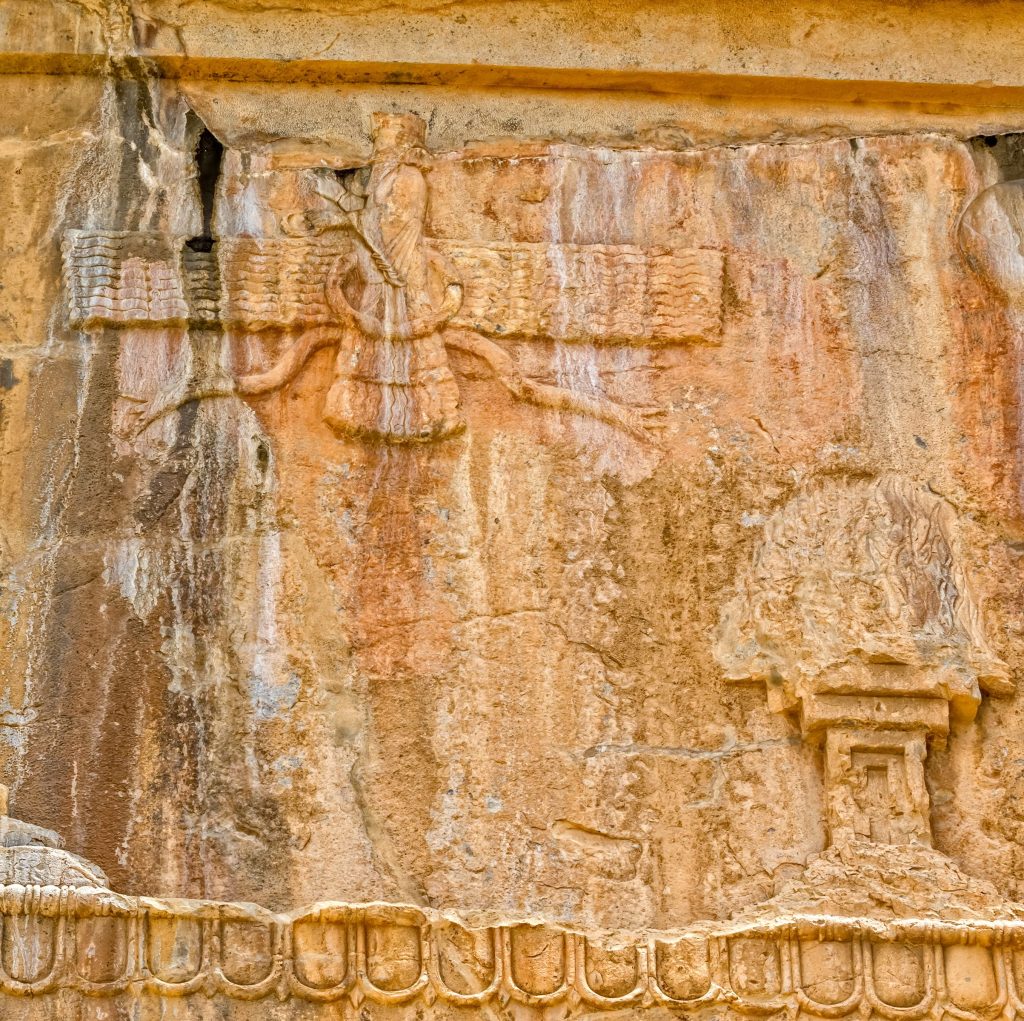
Religious systems rarely emerge in a complete and final form. What later appears as doctrine is often the result of a long process of refinement, shaped by generations of experience, interpretation, and transmission. Long before the teachings attributed to Zarathustra, the peoples of the Iranian plateau and its neighbouring regions were already engaging with one of the most enduring ideas in human thought: the tension between order and disorder, light and darkness, truth and deception. This was not yet a moral philosophy in the later sense, but rather a deeply felt structure of reality.
The Achaemenid Empire did not invent this worldview, nor did it inherit a fully formed religious system. Instead, it absorbed a series of long-standing cultural intuitions, shaped across centuries within Elamite, Mesopotamian, and early Indo-Iranian traditions. To understand the later prominence of concepts such as asha, one must begin earlier, in a world where duality was present not as doctrine, but as lived experience.
I. Before Doctrine: The Experience of Opposition
Human societies do not require formal theology to recognise contrast. The alternation of day and night, the unpredictability of weather, the cycle of growth and decay — these experiences naturally suggest a world structured by opposing forces. In early societies, such contrasts were not immediately moralised; they were observed, endured, and gradually interpreted.
In the ancient Near East, these tensions were often expressed through myth and ritual rather than abstract philosophy. They were not yet understood as a struggle between good and evil, but rather as a dynamic balance between forces that were both necessary and recurring. The world was not divided into moral absolutes, but it was clearly not uniform. This recognition laid the groundwork for later developments in both religious and philosophical thought.
II. Elamite Foundations: Order Without Moral Dualism
The civilisation of Elam, centred around the region of Susa, offers one of the earliest contexts in which structured ideas of order can be observed. Although Elamite religious texts are less well preserved than those of Mesopotamia, archaeological and comparative evidence suggests a worldview oriented toward divine order, protection, and continuity.
Elamite deities were associated with natural forces, political authority, and the maintenance of social stability. The emphasis was not on a cosmic battle between opposing moral principles, but on the preservation of equilibrium. Order existed, but it was not framed as being under constant ethical threat from an opposing force. Instead, disorder appeared as disruption — something to be managed rather than defeated in a final sense.
Even so, within this framework, one can detect early forms of tension. Stability was always vulnerable, whether to natural disaster, political upheaval, or external invasion. Divine favour was required to maintain continuity, and its withdrawal could result in collapse. These patterns do not constitute dualism in the later Zoroastrian sense, but they establish a crucial foundation: the idea that order is not automatic, and that it must be sustained against forces that threaten it [1].
III. Mesopotamian Influence: Conflict and Creation
In neighbouring Mesopotamia, the tension between order and chaos was articulated more dramatically. Mythological narratives, such as the Enuma Elish, depict the creation of the world as the result of divine conflict. Order emerges not simply through organisation, but through the defeat of primordial forces that resist structure.
These myths present a cosmos in which struggle is central. Gods battle for supremacy, and kingship is often portrayed as a continuation of this divine conflict within the human realm. The king becomes the agent through which order is imposed, reflecting a universe in which stability is achieved through decisive action [2].
Yet even here, the opposition is not strictly moral. Chaos is not evil in an ethical sense; it is primordial, necessary, and recurrent. What Mesopotamian thought contributes is not moral dualism, but the powerful idea that order must be actively established and defended. This concept would resonate deeply with later Iranian traditions, particularly in their emphasis on the maintenance of cosmic and social balance.
IV. Indo-Iranian Thought: The Emergence of Cosmic Order
Among early Indo-Iranian cultures, we find a more abstract formulation of order. In Vedic tradition, the concept of ṛta describes a fundamental principle governing both the natural and moral worlds. It is not personified as a deity, but understood as a law or structure that ensures the proper functioning of the cosmos.
The sun rises according to ṛta, rituals must align with it, and truth reflects its presence. This represents a significant development in thought, moving beyond mythological narrative toward a more conceptual understanding of order. The Iranian counterpart to this idea, asha, later becomes central in Achaemenid inscriptions and religious expression [3].
This shift marks an important transition. The world is no longer seen merely as a stage for conflict, but as a system governed by an underlying principle. Opposition still exists, but it is now understood in relation to a standard of alignment rather than as a simple clash of forces.
V. From Tension to Moral Meaning
By the time we reach the teachings associated with Zarathustra, the conceptual framework undergoes a further transformation. The tension between order and disorder is no longer merely structural; it becomes moral.
Truth is elevated from a cosmic principle to an ethical obligation. Falsehood is no longer simply disruption, but a form of moral failure. Most importantly, human beings are positioned as participants in this dynamic. They are no longer passive observers of cosmic order, but active agents who must choose alignment with truth.
This development does not emerge in isolation. It builds upon earlier traditions, refining and intensifying them rather than replacing them entirely. Zarathustra’s contribution, as later understood, is to clarify and moralise a pattern that had long been present in cultural experience.
VI. Achaemenid Religion: A Transitional Expression
When we turn to Achaemenid sources, particularly the inscriptions of Darius I, we encounter a form of dualism that reflects this transitional stage. Darius speaks explicitly of asha and drauga, framing his rule as aligned with truth and his enemies as embodiments of the lie.
This language introduces a clear moral polarity, yet it stops short of the fully developed dualism found in later Zoroastrian texts. There is no detailed cosmology of opposing divine forces, nor is there an explicit articulation of a final cosmic resolution.
Instead, what we see is a system in formation. The Achaemenid worldview incorporates ethical dualism without fully codifying it. It remains flexible, allowing it to function across a vast and diverse empire.
VII. Symbolic Expression: Balance Rather Than Victory
This intermediate position is also reflected in Achaemenid art. The well-known lion and bull motif at Persepolis does not depict a final victory, but an ongoing struggle. The lion does not annihilate the bull; the two remain locked in a dynamic tension.
This imagery suggests a worldview in which opposition is real, but not absolute. The goal is not the elimination of one force by another, but the maintenance of balance through continuous interaction. It aligns with a conception of time as cyclical, rather than linear, and reinforces the idea that order must be sustained rather than achieved once and for all.
VIII. Transmission Through the Magi
As explored in another article (Magi and the Temple Order: Priests Behind the Achaemenid Court), the Magi likely played a crucial role in transmitting these evolving ideas. Operating within oral traditions and ritual practices, they would have preserved and adapted inherited concepts, shaping them into forms suitable for both court and community.
Their influence helps explain how earlier traditions could persist while gradually transforming. Rather than imposing a fixed doctrine, they maintained continuity through practice, allowing ideas of order, truth, and opposition to evolve organically within the Achaemenid context.
IX. Dualism as a Tool of Governance
Within the imperial framework, the distinction between truth and falsehood acquired political significance. Under Darius, rebellion is not merely a challenge to authority; it is an expression of the lie. Loyalty, by contrast, becomes alignment with truth.
This framing transforms political conflict into moral narrative. It provides a powerful tool for legitimising authority and maintaining cohesion across a diverse empire. Order is no longer arbitrary; it is grounded in a universal principle.
At the same time, the absence of extreme dualism allows for flexibility. The system does not require absolute conformity, enabling it to accommodate a wide range of local traditions while maintaining a coherent ideological core.
Conclusion: Before Light Became Moral
The dualistic ideas associated with later Zoroastrianism did not emerge suddenly or fully formed. They were the result of a long process of development, shaped by multiple cultural influences and historical contexts.
In Elam, we see the importance of order and stability. In Mesopotamia, the drama of conflict and creation. In Indo-Iranian thought, the emergence of abstract principles governing reality. Together, these traditions laid the foundation for a worldview in which opposition was not only recognised, but eventually moralised.
By the time of the Achaemenids, this process had reached a critical stage. The language of truth and falsehood had become central to both religion and governance, yet it remained open, adaptable, and incomplete.
Before dualism became doctrine, it was already experience. Before it became theology, it was necessity.
Footnotes
- Pierre Briant, From Cyrus to Alexander, Harvard University Press, 2002.
- Henri Frankfort, The Art and Architecture of the Ancient Orient, Yale University Press, 1954.
- Encyclopaedia Iranica, “Aša”; Encyclopaedia Britannica, “Ṛta.”


Leave a Reply