
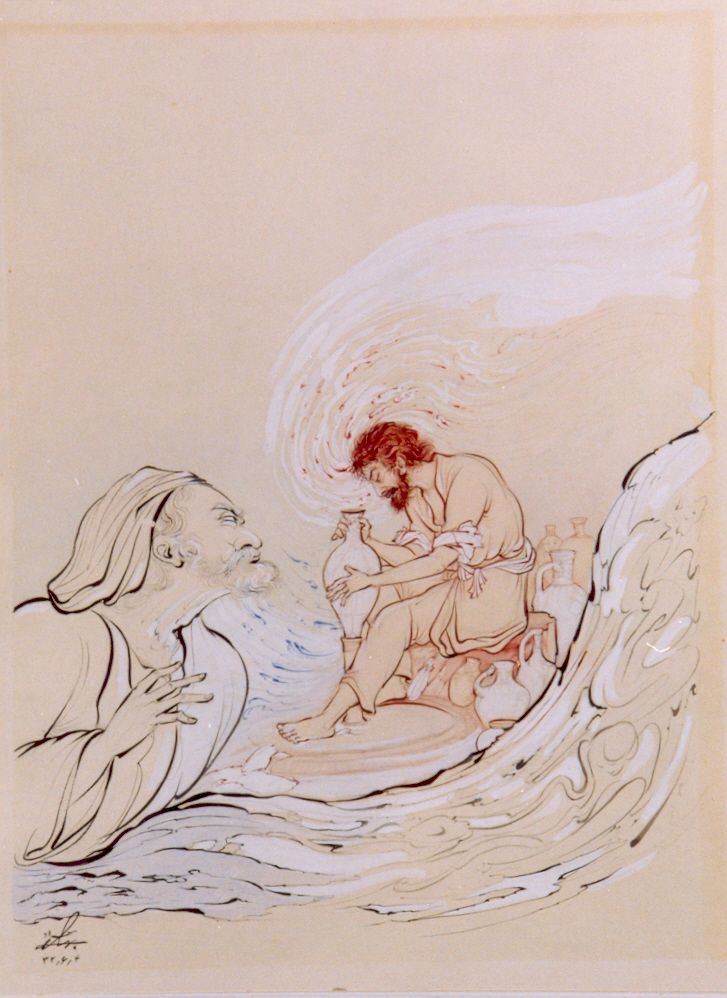
No. 112
That potter who fashioned the bowls of skulls once played his part,
In pottery revealed the secret craftsmanship of his art.
Above the table of existence he placed the upturned bowl of heaven,
And filled that overturned bowl with troubled thoughts and grieving heart. *
Philosophical Reflection
This quatrain extends one of Khayyam’s most recognisable motifs into unexpected cosmological territory. The potter who fashions skulls into bowls is a familiar figure across the rubāʿī — humanity as clay, shaped and discarded by an indifferent craftsman. But here the potter’s ambition does not stop at the human skull. His masterwork is the sky itself: an overturned bowl, suspended above the table of existence, and filled — not with light or rational order — but with saudā.
The word demands attention. In Persian, saudā carries a range that no single English equivalent contains: melancholy, restless longing, troubled thought, the agitation of a mind that circles without settling. It derives from the Arabic sawdāʾ (black), rooted in the humoral tradition’s conception of black bile as the substance of melancholic temperament. Khayyam does not say the sky is filled with darkness or emptiness or grief. He says it is filled with saudā — an active, cognitively restless condition: awareness that sees clearly and still cannot find rest.
The structural inversion is the poem’s most precise philosophical gesture — and Khayyam grounds it in astronomical fact. He was not only a poet but the architect of the Jalālī calendar, a man who measured the celestial sphere with greater precision than any before him. When he writes that the potter placed the sky as an overturned bowl above the table of existence, the image is exact: the heavens as a vast dome enclosing the earth, rendered in the same vocabulary as the human skull. The macrocosm answers the microcosm — bowl above and bowl below, the whole of existence a potter’s workshop. Khayyam accepts the craftsmanship — his art made manifest in the very act of creation. But what this finely made vault contains, what it pours onto the lives lived beneath it, is saudā. The cosmos is technically masterful. Its content is restless bewilderment.
This connects to a structural argument at the heart of Khayyam’s philosophical treatises. In Risāla dar ʿIlm Kulliyāt-e Wujūd, he describes contingent existence as structurally incomplete: every mumkin al-wujūd — every contingent entity — derives its being from outside itself, from the Necessary Being whose existence is essential rather than borrowed. The gap between what one is and what one is from cannot be closed from within. Saudā, in this reading, is not a temperamental mood but a metaphysical condition: the restlessness of a being that exists by borrowed existence, reaching toward a source it can sense but never fully grasp. The potter’s overturned bowl does not drip this condition downward by accident. It is what the structure of contingent existence feels like from the inside.
The image of the table of existence sharpens this further. A table is prepared to receive guests; what is placed upon it is meant to nourish. But the vessel set above this table is inverted. It holds what it contains rather than offering it; what escapes falls downward as troubled thought. The banquet of existence is not a feast. It is a setting beneath a leaking dome. Khayyam does not reach for consolation here, nor for the wine that so often resolves other quatrains. He accepts the craftsmanship and names what was crafted into it. The potter made a fine bowl. It was filled with saudā.
Footnote
* Source: Tarabkhaneh, Homaei, no. 112, translated by Kam Austine for Philosophy in Verse
آن کاسهگری که کاسه سرها کرد
در کاسهگری صنعت خود پیدا کرد
بر خوان وجود ما نگون کاسه نهاد
و آن کاسه سرنگون پر از سودا کرد
Related Treatises:
Risāla dar ʿIlm Kulliyāt-e Wujūd (On the Universals of Being)
Necessity of Contradiction in the World, Determinism, and Immortality
Translation of Avicenna’s Khutbat al-Ghurrā’
Internal Themes: #Metaphysics #CosmicOrder #PotterMetaphor #ContingentExistence #Saudā #Existentialism #Nihilism
Published as part of the Philosophy in Verse series — under “Meaning & Doubt.”
Translated by Kam Austine


Leave a comment