
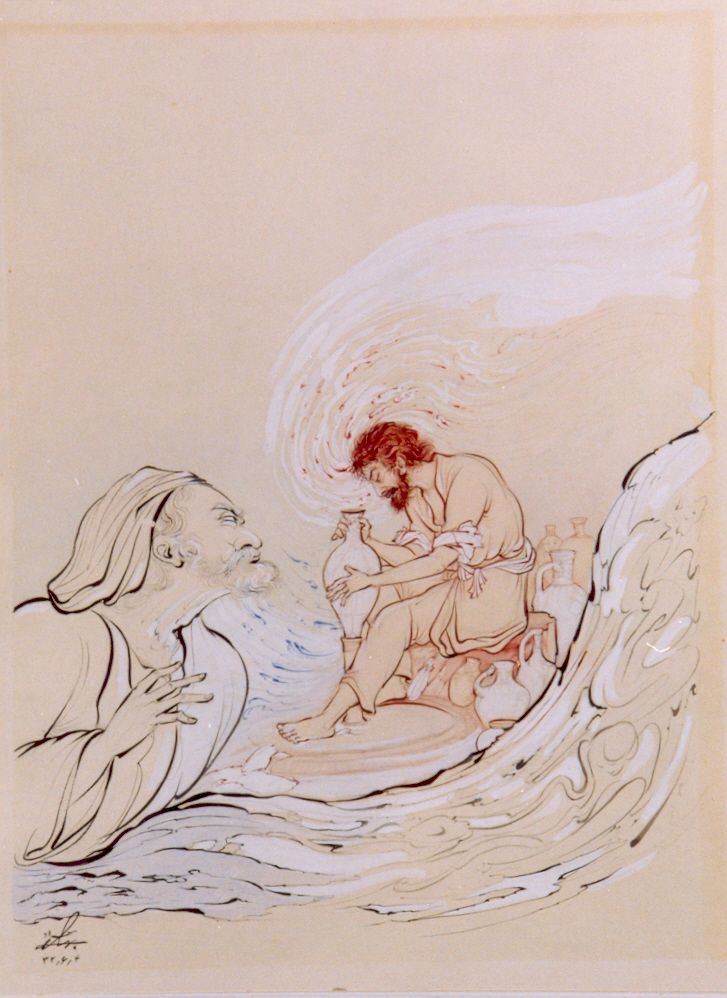
No. 100
The good and evil that in the nature of man are found,
The joy and grief that within the laws of fate are bound,
Blame not the wheel of heavens — let reason be your ground:
The wheel is a thousand times more desperate, spinning round. *
Philosophical Reflection
This quatrain makes a double move. The first two lines accept, without argument, what Khayyam takes as given: good and evil are embedded in human nature from the start, and joy and grief are written into the structure of fate and destiny. This is not fatalism as resignation — it is fatalism as clear-sightedness. The conditions of human life are not imposed from outside as punishment or reward; they are constitutive, built into what it means to be the kind of being that we are.
The pivot comes in the third line. A common human response to suffering is to blame the cosmic order — the turning of the heavens, the indifference of the sky. Khayyam does not dispute that the heavens turn; he disputes that they are to blame. His reason: the heavens themselves are not agents but subjects. Whatever force moves the wheel of fate moves the wheel too — the circling sky does not choose its path any more than the one who stands beneath it. To blame the heavens is to mistake a fellow prisoner for the jailer.
The fourth line drives this home with an image that is more unsettling than it first appears. The word Khayyam uses for “heavens” here means, literally, the wheel — the great turning sphere whose ceaseless rotation is the very motion of cosmic time. That spinning is not a sign of power; it is a sign of confusion. The wheel that turns without pause is not a sovereign directing events from above; it is something caught in its own motion, dizzy in its perpetual circling, more disoriented than the human standing beneath it. A thousand times more desperate is not hyperbole — it is an image of the entire natural order spinning in confusion, mistaken by us for authority simply because it turns so relentlessly and so large.
What remains, then, is reason — not as a solver of the problem, but as the proper instrument for seeing it clearly. The quatrain does not offer a way out of determinism; it refuses the comforting fiction that the heavens know what they are doing. This is the characteristic Khayyamian position: strip the cosmos of false authority, hold the situation as it actually is, and do not insult the intelligence by projecting mastery onto what is itself adrift.
Footnote
* Source: Trabkhaneh, Homaei, no. 100, translated by Kam Austine for the book Philosophy in Verse
نیکی و بدی که در نهاد بشرست
شادی و غمی که در قضا و قدرست
با چرخ مکن حواله، کاندر بر عقل
چرخ از تو هزار بار بیچارهترست
Related Khayyam’s Treatises:
Necessity of Contradiction in the World, Determinism, and Immortality
Treatise on the General Properties of Existence
A Response to Three Questions in Philosophy and Theology
Internal Themes: #Determinism #Metaphysics #Existentialism #Nihilism #Folly
Published as part of the Philosophy in Verse Series — under “Meaning & Doubt.”


Leave a Reply