
Introduction: Clothing as Visible Power
In the Achaemenid world, identity was often seen before it was spoken. A person’s clothing, jewellery, headgear, hairstyle, weapons, posture, and bodily presentation could announce rank, origin, occupation, gender, and relationship to the king. At Persepolis, the imperial centre built by Darius I and his successors, the stone reliefs do not simply show men wearing garments. They show a world in which dress itself had become a language of order.
The Achaemenid Empire ruled over a vast range of peoples, from Anatolia and Egypt to Bactria, Sogdia, Babylonia, Elam, India, and the Iranian plateau. Such a diverse empire required more than military force or taxation to hold it together. It needed visible systems through which people could recognise hierarchy, loyalty, privilege, and belonging. Clothing was one of those systems. The king’s robe, the Median riding dress, the Persian court garment, the headgear of delegations, the jewellery of nobles, the weapons of guards, and the gifts carried by subject peoples all formed part of an imperial grammar.
This does not mean that clothing in ancient Persia can be reconstructed with certainty in every detail. The evidence is uneven. Royal men, guards, courtiers, and foreign delegations are much more visible in surviving art than women, children, workers, and common people. Greek writers describe Persian luxury, but they often do so through their own cultural assumptions. Archaeological finds preserve metal, stone, clay, and seals more readily than cloth. The result is a history of dress built from fragments: reliefs, tablets, seal impressions, jewellery, vessels, classical texts, and careful comparison.
Yet even these fragments reveal something essential. In the Achaemenid court, clothing was not merely fashion. It was a form of political meaning. It helped define the distance between king and subject, Persian and foreigner, noble and worker, warrior and courtier, man and woman, centre and frontier. To understand Persian clothing is therefore to understand how the empire made power visible.

The Evidence: Reliefs, Texts, Tablets, and Objects
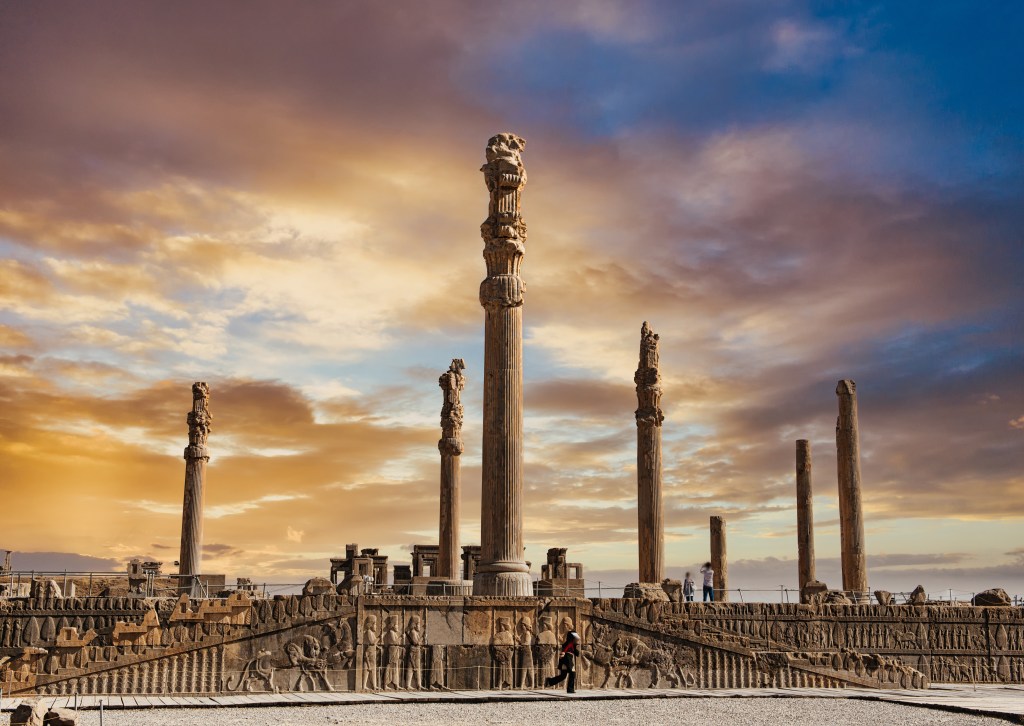
The most important visual evidence for Achaemenid elite dress comes from Persepolis. The staircases of the Apadana, the audience scenes, the royal guards, the court attendants, and the tribute-bearing delegations all preserve carefully carved images of clothing, headgear, weapons, and bodily posture. These reliefs were not ordinary snapshots of daily life. They were official images. Their purpose was to present the empire as ordered, harmonious, and centred on the king. For that reason, they must be read both as evidence for dress and as statements of ideology.[1]
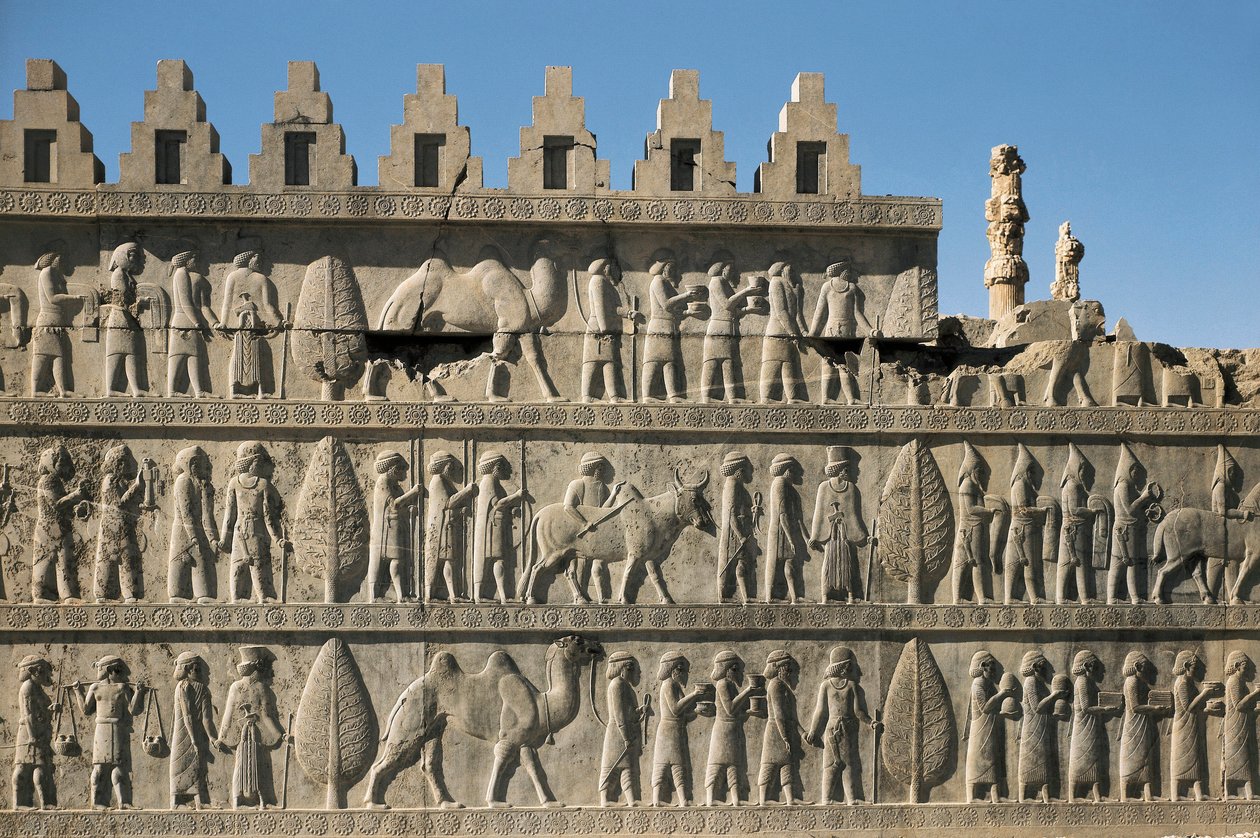
The reliefs are especially valuable because they distinguish between different groups through visual markers. Persians and Medes wear different styles of dress. Delegations from across the empire are identified by their clothing, hats, shoes, weapons, hair, and gifts. Guards appear in standardised forms. Officials use gestures and garments to express rank and ritual order. The Apadana reliefs show twenty-three delegations bringing gifts or tribute, each guided by a Persian or Median usher. Clothing here is not incidental. It is one of the main ways the imperial world becomes legible.[2]
Textual evidence is more complicated. Greek authors such as Herodotus, Xenophon, Ctesias, and later writers provide descriptions of Persian dress, luxury, court life, and military equipment. Their testimony is valuable, but it must be handled carefully. Greek writers often used Persian clothing as a moral symbol. Trousers, long sleeves, jewellery, soft garments, perfumes, and elaborate robes could be described admiringly, but they could also be treated as signs of “Eastern luxury” or political softness. Such descriptions tell us something about Persia, but also much about Greek anxieties.[3]
The Persepolis Fortification Tablets and Treasury Tablets provide a different kind of evidence. They do not usually describe clothing in the visual detail found in the reliefs, but they reveal the broader social world behind the court: workers, travellers, administrators, royal women, labour groups, ration systems, and economic institutions. These tablets remind us that Achaemenid society was not made only of kings and nobles. It included women who managed estates, female labourers receiving rations, officials, artisans, animal handlers, priests, and workers moving through the administrative system.[4]
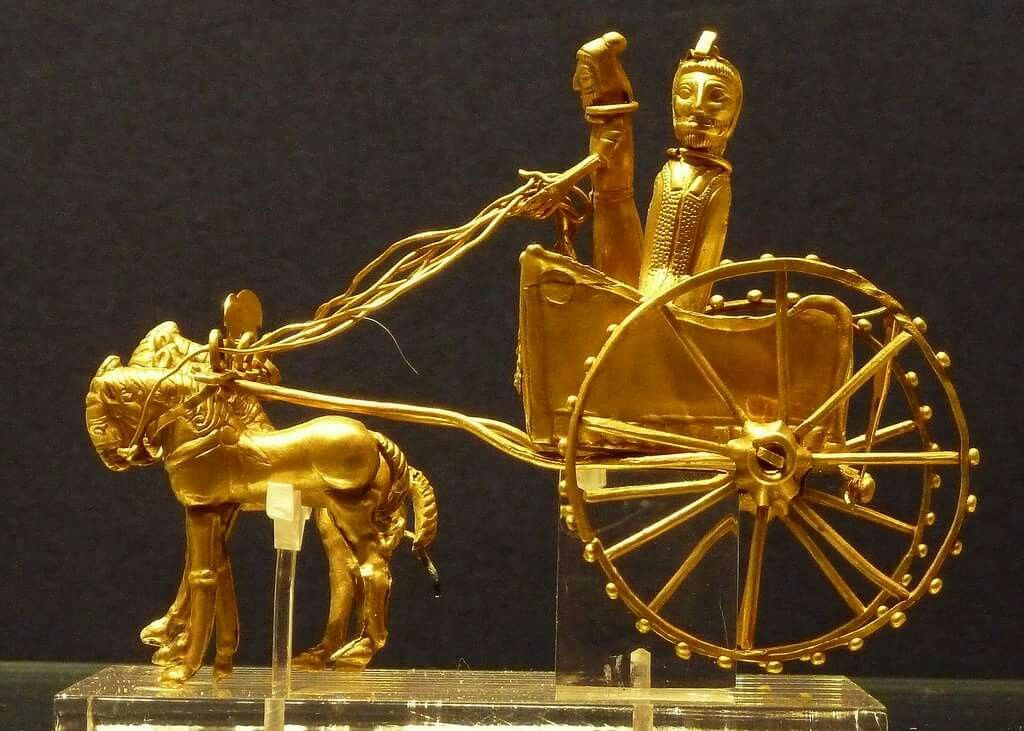
Archaeological objects add another layer. Gold and silver vessels, armlets, bracelets, seals, beads, weapons, textiles preserved in rare contexts, and luxury objects associated with the Oxus Treasure and other finds help us imagine the material richness of elite identity. Jewellery was not only personal decoration. It could be tribute, gift, payment, reward, and symbol of favour. In an empire where the king distributed honour as well as command, objects worn on the body could carry political meaning.[5]
The historian must therefore move between different kinds of evidence. The reliefs show idealised order. Greek texts show foreign perception. Administrative tablets show economic reality. Objects show elite display and craftsmanship. None of these sources is complete by itself. Together, however, they allow us to reconstruct a world in which dress and identity were deeply connected.
Persian and Median Dress: Two Traditions of Elite Appearance
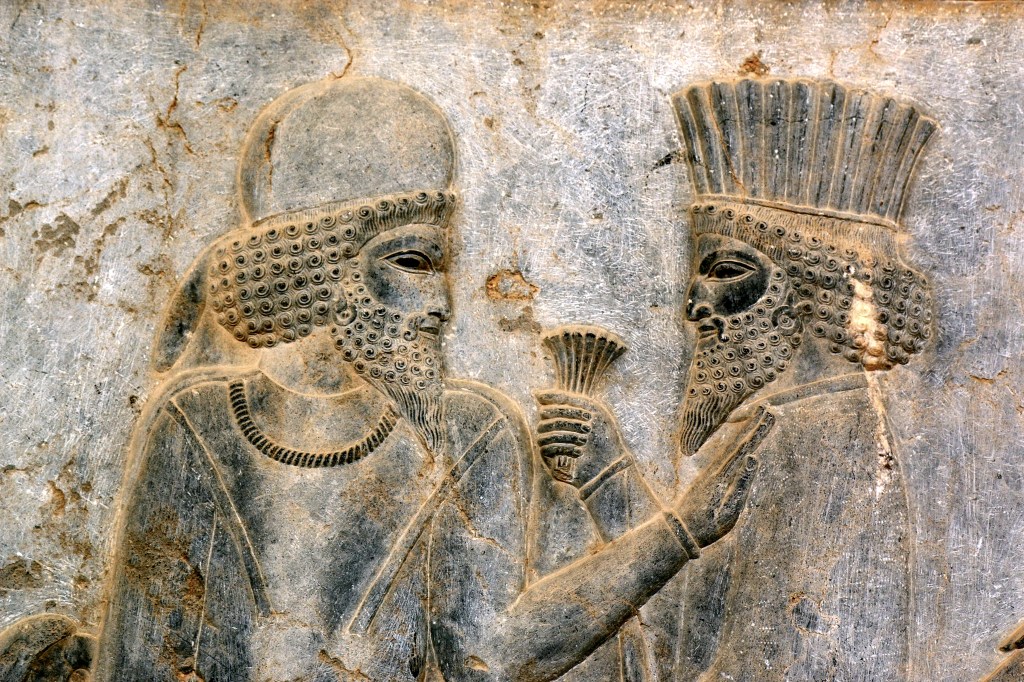
Achaemenid elite dress is often discussed through the contrast between Persian and Median clothing. This distinction appears in ancient art, especially at Persepolis, where Persians and Medes can often be identified by different garments. The Persians are frequently shown in long, pleated robes, while Medes often appear in riding dress: tunics, trousers, boots, and cloaks. These categories should not be treated too rigidly, because styles could be adopted, adapted, and shared across the imperial elite. Still, the distinction mattered visually.
The Persian robe, as seen in Persepolis reliefs, was long, elegant, and highly formal. It could be pleated and arranged in a way that gave the body a dignified, almost architectural appearance. This was not the clothing of manual labour or horseback mobility. It belonged to court, ritual, rank, and ceremony. The robe created stillness. It slowed the body down. It made the wearer appear composed, ordered, and fitted to the ceremonial environment of palace and audience hall.
Median dress, by contrast, preserved a stronger connection to movement and riding. It usually included trousers, a tunic or coat, boots, and a form of head covering or cap. This style was practical for horsemen, soldiers, travellers, and nobles whose identity remained connected to the Iranian plateau’s equestrian traditions. The Medes had been the great Iranian power before the rise of Cyrus, and their cultural influence on the Persians remained significant. In adopting and displaying Median dress, the Achaemenid elite did not merely imitate a neighbour. They incorporated an older Iranian aristocratic language into imperial style.[6]
Trousers deserve special attention. To Greeks, trousers were one of the most recognisable markers of Persian or “barbarian” clothing. To Iranian peoples, however, they were practical garments suited to riding, cold climates, hunting, and military life. Their presence in Achaemenid dress reminds us that Persian civilisation was not born only in palaces. It also emerged from highlands, roads, pastures, military camps, and mounted aristocracies. The court robe and the riding outfit together express two sides of Achaemenid identity: ceremony and mobility.
Headgear was equally meaningful. Caps, turbans, soft hoods, felt headdresses, and regional forms of covering helped distinguish peoples and functions. At Persepolis, delegations can sometimes be identified partly by their hats. Some wear rounded caps, others pointed or folded headgear, others wrapped forms. Headgear protected the body from climate, but in imperial art it also protected identity. It allowed diversity to be recognised within the ordered visual world of the empire.
This combination of Persian robe and Median riding dress gives the Achaemenid elite a distinctive character. They were not simply “Eastern” in the vague Greek sense, nor simply nomadic, nor purely urban. Their clothing joined court ceremony, Iranian horse culture, Elamite and Mesopotamian traditions of kingship, and the artistic language of a multi-ethnic empire.
The King’s Body: Royal Dress and Imperial Distance
The king’s body was the centre of Achaemenid visual order. Whether enthroned, standing before a fire altar, receiving an official, or shown in heroic combat with symbolic creatures, the king appears as a figure of control. His clothing contributes to this effect. The royal garment is not meant to expose individuality, movement, or private emotion. It frames the king as a ceremonial body: still, dignified, and separated from ordinary life.
In the audience scenes at Persepolis, the king’s clothing helps establish distance. He sits or stands above others, attended by officials and guards. His robe falls in ordered folds. His beard and hair are carefully arranged. His staff, throne, crown or headgear, and attendants all reinforce his position. Nothing appears accidental. The royal body is organised because the empire itself is meant to be organised.
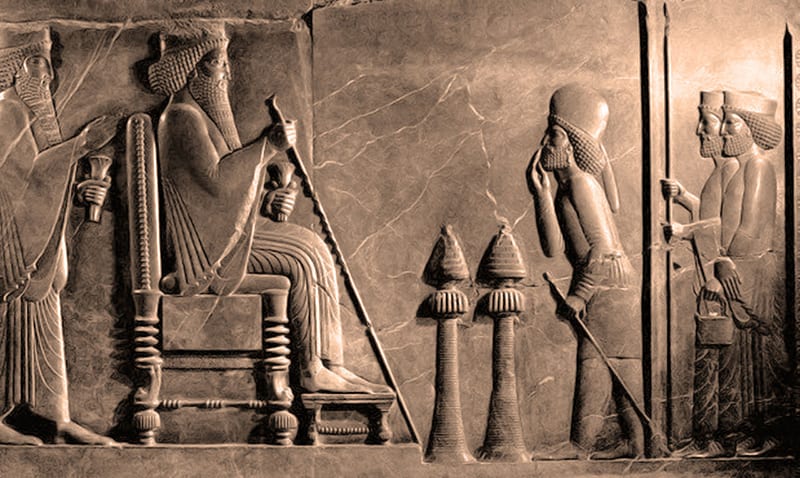
This does not mean that the king’s clothing was always identical in every context. The Achaemenid king could be represented as ruler, warrior, hunter, worshipper, builder, and judge. Different settings required different visual emphasis. Yet the general principle remained the same: royal appearance was controlled. The king did not appear as a casual man. He appeared as the visible point where power, legitimacy, divine favour, and imperial order met.
Luxury was part of this royal distance. Fine textiles, precious metals, carved furniture, decorated weapons, and ceremonial vessels surrounded the king. But Achaemenid luxury should not be reduced to indulgence. In the Persian court, luxury was also administrative and political. It marked access to the king, rewarded loyalty, displayed tribute, and transformed the wealth of many lands into the splendour of one centre. The king’s dress therefore participated in the same system as the palace, the throne, the audience ritual, the gifts, and the inscriptions.
Greek authors often described Persian kings and nobles as lovers of luxury. Sometimes this was admiration; sometimes criticism. But from within the Achaemenid world, royal splendour had a different meaning. It was not simply softness. It was sovereignty made visible. A king who ruled from the Aegean to the Indus could not appear as an ordinary chieftain. His body had to carry the empire’s scale.
Elite Men: Nobles, Courtiers, and the Courtly Body
Achaemenid noblemen stood between the king and the wider empire. Their dress had to express both closeness and subordination. At Persepolis, courtiers are shown in ordered lines, often holding flowers, staffs, weapons, or ceremonial objects. Their gestures are controlled. Their robes and garments echo the visual discipline of the court. They are not anonymous, but neither are they independent centres of power. Their appearance reflects their place within the hierarchy.
The elite male body in Achaemenid art is rarely shown in disorder. Hair and beards are carefully arranged. Garments are neat. Posture is formal. Even when weapons are present, they are displayed with restraint. This is important. Persian aristocratic identity included military ability, horsemanship, hunting, and command, but court art placed these qualities under ceremonial control. The nobleman was not merely a warrior. He was a servant of royal order.
Courtly dress also shaped behaviour. Long robes require a different movement from riding clothes. A man dressed for audience does not stride like a soldier on campaign. He enters, waits, bows, gestures, and speaks within rules. Clothing therefore trained the body. It reminded the wearer how to behave and reminded observers how to read him.
In this sense, Achaemenid dress was part of etiquette. A nobleman’s garment, beard, belt, headgear, jewellery, weapon, and position in the room would all contribute to his social meaning. In a court filled with Persians, Medes, Elamites, Babylonians, Egyptians, Lydians, Greeks, Bactrians, Indians, and others, such visible codes were essential. They helped people navigate a world where language, origin, and rank were constantly interacting.
The court was not merely a place where power was exercised. It was a theatre in which power was displayed. Elite clothing was one of its costumes, but “costume” here should not imply artificiality. These garments were real instruments of rank. To be dressed correctly was to be placed correctly.
Elite Women and Courtly Presentation
The clothing of Achaemenid royal and noble women is more difficult to reconstruct than that of elite men. Women are far less visible in the monumental reliefs of Persepolis, and this absence has shaped the modern imagination. It would be wrong, however, to conclude that women were unimportant simply because they are not displayed on the main public reliefs. The Persepolis Fortification Tablets show that royal women possessed economic resources, travelled, managed estates, received allocations, and participated in the structures of elite life.[7]
The problem is not that Achaemenid women lacked status. The problem is that their status was represented differently. Monumental palace art focused on kings, male courtiers, guards, and delegations. Women’s power often appears instead in administrative records, Greek narratives, seals, and later traditions. For clothing, this means that we must proceed cautiously. We can discuss likely elite materials, jewellery, veils or coverings, hairstyles, and courtly presentation, but we should avoid pretending that the evidence gives us a complete wardrobe.
Royal and noble women almost certainly had access to fine textiles, jewellery, servants, cosmetics, perfumes, and carefully managed presentation. Their garments may have included long robes, layered fabrics, belts, cloaks, head coverings, and regional variations, but the exact forms are debated. Some images from seals and related Near Eastern traditions suggest women in long garments, sometimes with veils or elaborate hair arrangements. Yet we should be careful not to impose later Iranian, Greek, or Near Eastern customs automatically onto Achaemenid Persia.
Jewellery provides firmer ground. Elite women likely wore earrings, necklaces, bracelets, armlets, rings, beads, and ornaments made of gold, silver, precious stones, glass, faience, carnelian, turquoise, lapis lazuli, and other materials available through imperial networks. Jewellery could express wealth, family rank, marriage connections, courtly favour, and ritual dignity. A queen or princess did not need to appear in public relief to be visually powerful within palace space.
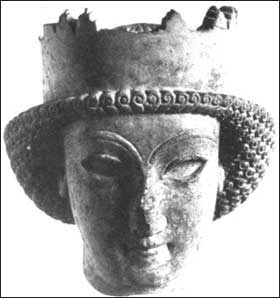
Jewellery, Ornament, and the Display of Rank
Jewellery in the Achaemenid Empire belonged to a larger culture of precious objects. Gold and silver vessels, rhyta, bowls, bracelets, armlets, rings, seals, decorated weapons, and luxury textiles all circulated through systems of tribute, gift exchange, royal favour, and elite display. Such objects were beautiful, but beauty was only part of their function. They marked relationships.
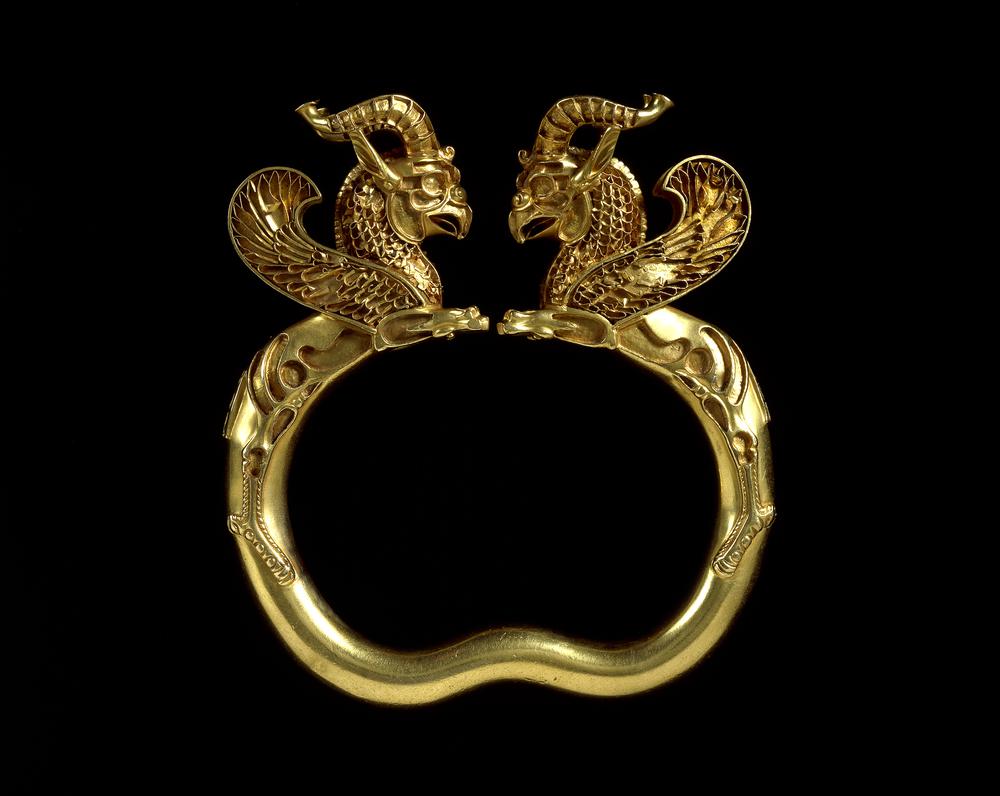
The Oxus Treasure, although complex in its history and interpretation, gives a vivid impression of Achaemenid precious-metal work. Gold armlets with animal-headed terminals, plaques, rings, vessels, and other objects show the technical skill and visual richness associated with elite Persian culture. Some armlets were made not simply as thin ornaments but as heavy, impressive signs of rank. Their animal forms, inlays, and precious materials linked the wearer to wealth, power, and courtly taste.[8]
Animal-headed bracelets and armlets are especially revealing. The use of griffins, lions, goats, bulls, and other creatures was not merely decorative. Achaemenid art often used animal forms to express strength, protection, royal energy, and cosmic order. A bracelet ending in animal heads transformed the human arm into a site of symbolic force. The body carried empire in miniature.
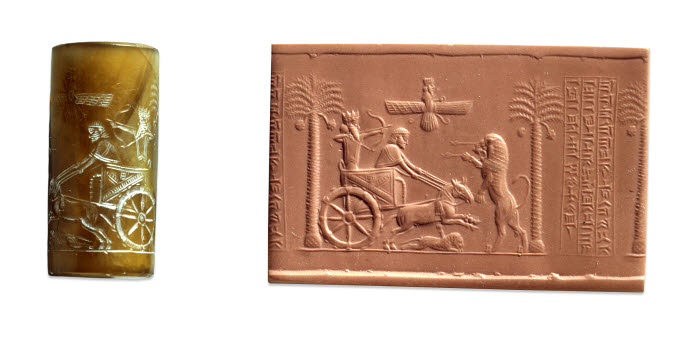
Seals also mattered. A seal was not only jewellery or a personal possession. It was an administrative and legal instrument. To own and use a seal was to participate in systems of authority, property, command, and recognition. Seal imagery could show heroic combat, royal figures, divine symbols, animals, worship scenes, or elite motifs. A seal worn on the body connected appearance with action. It marked the person who could authorise, secure, and command.
Jewellery also moved through the empire as gift and reward. Xenophon and other classical writers describe the Persian court as a world in which honour could be expressed through robes, necklaces, bracelets, horses, weapons, and other prestigious gifts.[9] Even if such accounts are shaped by Greek literary aims, they fit the broader evidence for an imperial gift economy. The king’s favour could be worn. A bracelet or robe was not simply owned; it remembered a relationship.
This helps explain why jewellery should not be treated as private luxury alone. At the Achaemenid court, ornament could be political memory. It could say: this person has served, received, inherited, married, conquered, or been honoured. In a society where rank was read visually, jewellery was a language of proximity to power.
Soldiers, Guards, and Military Appearance
The Achaemenid soldier could appear in many forms. The empire drew troops from across its lands, and Greek descriptions of Persian armies emphasise diversity: Persians, Medes, Elamites, Bactrians, Saka, Egyptians, Indians, and others equipped in different ways. Yet at the imperial centre, guards and soldiers were presented with striking order.
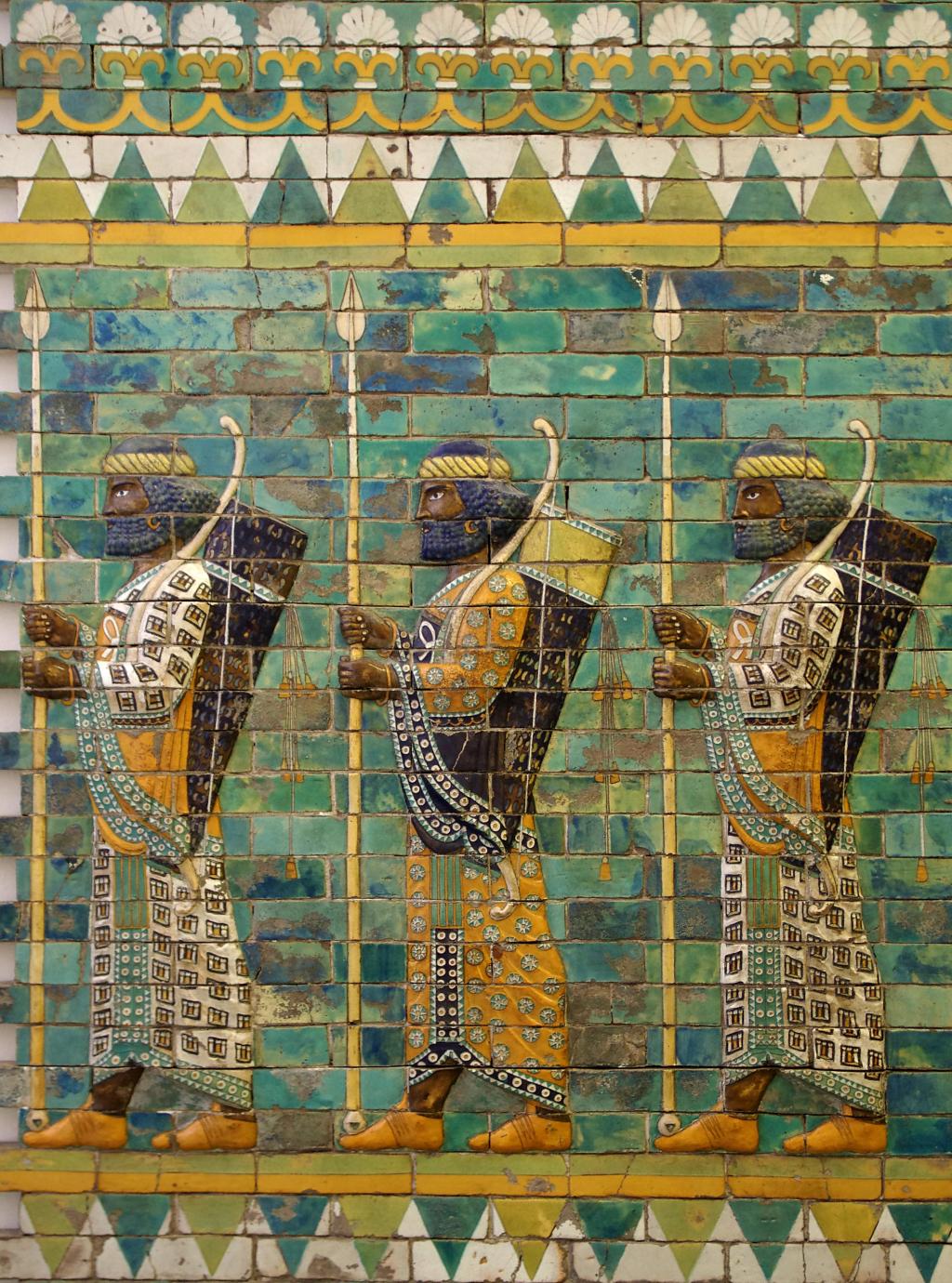
The royal guards at Persepolis are among the most recognisable images of Achaemenid military appearance. They wear carefully arranged garments and headgear, carry spears, bows, and quivers, and stand in disciplined repetition. Their clothing is not chaotic campaign dress. It is ceremonial military dress. The guard’s body is both martial and ornamental. He protects the king, but he also decorates the palace with the image of loyalty.
Some guards are shown in long Persian robes, others in garments associated with Median or riding dress. The bow, spear, quiver, and sometimes the short sword or akinakes help identify military function. The combination of elegant clothing and weapons may seem unusual from a modern perspective, but in the Achaemenid court it made sense. The ideal noble warrior was not dirty, uncontrolled, or merely violent. He was disciplined, beautiful, and placed within royal order.

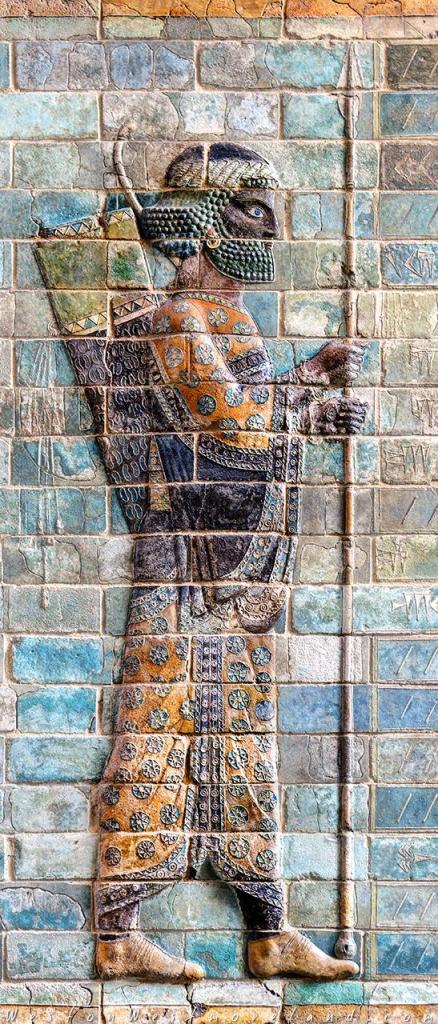
On campaign, clothing would have been more practical. Trousers, boots, belts, caps, cloaks, and tunics allowed movement, riding, and protection from climate. The Persian army operated across deserts, mountains, river valleys, steppe zones, and coastal regions. A soldier’s clothing had to meet the demands of heat, cold, dust, wind, rain, and long movement. The court reliefs cannot show all of this, but they preserve the symbolic version of the military body.
The famous “Immortals”, the elite Persian force described by Herodotus, are often imagined through a mixture of Greek description and Persepolis imagery. Herodotus mentions gold ornaments, spears, bows, quivers, and rich equipment among Persian elite troops, but his account must be compared carefully with visual evidence.[10] What matters for this article is not the fantasy of a uniformed modern regiment, but the ancient principle: elite soldiers were visually marked. Their appearance expressed discipline, privilege, and closeness to the king.
Military dress therefore linked battlefield and court. The same empire that carved tribute delegations also carved armed guards. Power was shown not only through conquest but through controlled force. Weapons, like jewellery, could be signs of rank. A sword, bow-case, spear, or decorated quiver could tell the viewer who a man was and how he stood in relation to royal authority.
Ethnicity and Empire: Dress on the Apadana Reliefs
Nowhere is the political meaning of clothing clearer than on the Apadana reliefs at Persepolis. There, delegations from across the empire approach the king, guided by Persian or Median officials. Each group is distinguished by dress, hair, headgear, weapons, animals, vessels, textiles, and gifts. The result is one of the most sophisticated visual statements of empire in the ancient world.
The reliefs do not present subject peoples as identical. They preserve difference. Medes, Elamites, Armenians, Babylonians, Lydians, Egyptians, Indians, Bactrians, Saka, and others can be differentiated by what they wear and what they bring. A delegation’s clothing becomes part of its identity. The empire is shown as a collection of recognisable peoples, not as a mass of faceless subjects.
Yet the reliefs also control difference. The delegations move in ordered procession. They do not fight, resist, or appear humiliated. They are guided by imperial ushers, and their gifts move toward the royal centre. Their diversity is real, but it has been arranged. Clothing helps express this balance: each people remains visible, but all are placed within the same ceremonial rhythm.
This is one of the great achievements of Achaemenid visual ideology. The empire did not present unity by erasing local identity. It presented unity by organising local identity around the king. Clothing made this possible. A viewer could see difference and order at the same time.
For the Persians themselves, this may have expressed a political philosophy of imperial rule. The king was not simply ruler of Persians, but “king of lands” and “king of peoples”. Each land had its products, customs, elites, and visual identity. The Apadana turned that diversity into stone. The clothing of delegations was therefore not ethnographic detail alone. It was imperial thought carved into bodies.
Common People, Workers, and Practical Clothing
The clothing of common people is much harder to reconstruct than that of kings and nobles. Monumental art favours the court. Luxury objects favour elites. Greek writers favour kings, armies, and stereotypes. The ordinary worker, merchant, porter, farmer, craftsperson, servant, and traveller appears only indirectly.
Yet the Achaemenid Empire depended on such people. The Persepolis administrative archives show a large working world of labour groups, ration recipients, travellers, officials, artisans, and women workers. These people did not dress like royal courtiers. Their clothing would have been shaped by work, climate, income, region, and material availability.
Practical garments probably included tunics, simple robes, cloaks, belts, sandals, boots, head coverings, and working cloths. Wool and linen would have been important materials, though textile use varied across the empire. Leather, felt, and animal skins may have been used for shoes, caps, bags, and protective clothing. Dyes and decorated fabrics would have been more available to some groups than others. A merchant in a major city, a shepherd in the highlands, a woman worker near Persepolis, and a boatman in Babylonia would not have dressed the same way.
Common clothing should not be imagined as colourless. Ancient textiles were often dyed, patterned, bordered, patched, and layered. Even modest garments could carry regional identity, family habit, occupation, and taste. The difference between elite and common dress was not necessarily the presence or absence of beauty, but the quality, quantity, rarity, and political meaning of materials.
This is important for reconstructing Achaemenid daily life. A market street would not have been a simple contrast between rich robes and poor rags. It would have contained many levels of dress: porters with practical belts, travellers with cloaks and dust-covered shoes, scribes with seals, women carrying goods, soldiers in riding garments, foreign merchants in regional styles, servants attached to noble households, and officials whose clothing marked authority. Clothing would have made the city readable.
The world of common dress also reminds us that imperial identity did not flow only from palace to subject. People carried their own local styles into imperial spaces. Achaemenid Persia was not one costume. It was a system in which many forms of dress met, mixed, and were ranked.
Textiles, Colour, and the Sensory Court
The stone reliefs of Persepolis can mislead the modern eye because they now appear pale and still. In antiquity, many architectural and sculptural surfaces were painted. Traces of pigment, including blue, have been identified on some relief fragments. The original visual world of Persepolis was therefore more colourful than the surviving stone suggests.[11]
This matters for clothing. The garments carved in relief were not necessarily imagined as plain stone. They may have represented coloured textiles, patterned borders, decorated surfaces, and contrasts between fabric, skin, hair, metal, and painted architectural background. The Achaemenid court was likely a sensory environment: coloured robes, polished stone, gold and silver vessels, incense, leather, horses, flowers, perfumes, food, music, and the movement of attendants through halls and courtyards.
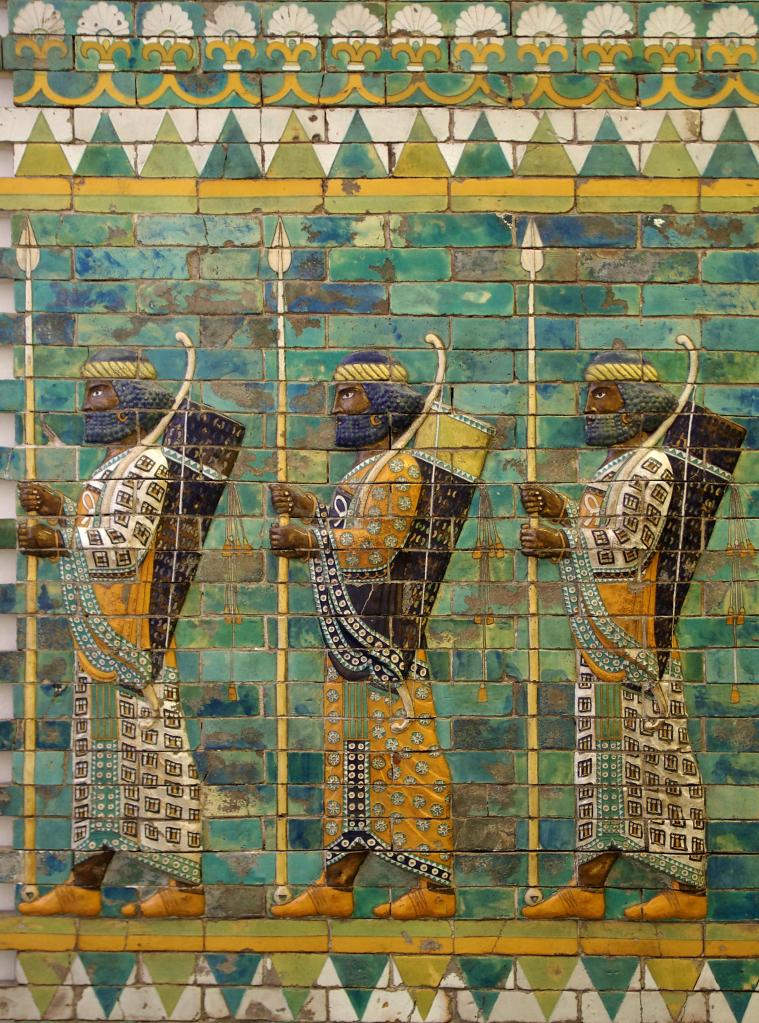
Colour itself may have carried status. Deep dyes, bright borders, patterned textiles, and imported materials required labour and access. Fine cloth could be tribute, gift, payment, or royal issue. Textiles were portable wealth. Unlike stone palaces, they could move with the court, be stored in treasuries, given to loyal servants, worn in ceremony, or sent across provinces.
The robe as an object therefore deserves as much attention as the bracelet or vessel. A fine garment could embody labour from many hands: shepherds, dyers, spinners, weavers, embroiderers, traders, administrators, and servants. When an elite figure entered a court ceremony in an impressive robe, he or she carried not only personal taste but also networks of production.
This gives clothing a deeper economic meaning. Dress was one of the ways empire touched the body. Wool from one region, dyes from another, metal from another, stones from another, and skilled labour from yet another could meet in a single courtly appearance. The dressed elite body became a small map of imperial resources.
Scholarly Discussion: Luxury, Stereotype, and Imperial Reality
Modern interpretation of Achaemenid clothing must avoid two extremes. The first is romanticisation: imagining Persian dress only as splendour, gold, silk-like softness, and timeless elegance. The second is Greek stereotype: treating Persian clothing as evidence of decadence, weakness, or excessive luxury. Both approaches flatten the evidence.
Persian clothing was luxurious in elite contexts, but luxury itself had political function. It marked rank, rewarded loyalty, displayed imperial resources, and created ceremonial distance. A gold armlet was not merely vanity. A royal robe was not merely softness. A fine vessel was not merely indulgence. Such objects belonged to the symbolic economy of empire.
At the same time, Persian dress was not only ceremonial. It was also practical, especially in the riding clothes associated with Median and Iranian traditions. Trousers, boots, cloaks, and tunics were suited to movement, horses, weather, and war. The same elite culture that loved fine robes also valued archery, riding, hunting, and military command. Greek contrasts between “soft Persians” and “hard Greeks” tell us more about Greek ideology than Persian reality.
Scholars have also debated the relationship between Persian and Median dress. Did Persians adopt Median garments after Cyrus’s conquest of Media? Did the distinction reflect real ethnic dress or court convention? Were certain garments attached to rank rather than ethnicity? The safest answer is that dress operated on several levels at once. It could signal ethnic tradition, social role, function, and courtly status, depending on context.[12]
The representation of women remains another debated area. Because women are not prominent in the Persepolis monumental programme, older interpretations sometimes underestimated their importance. The administrative evidence has corrected that picture. Royal women could control resources and move within the economic structures of the empire. But their clothing remains less visible than their economic presence. Here, caution is a scholarly virtue.
The strongest interpretation, then, is balanced: Achaemenid dress was practical, ceremonial, ethnic, political, economic, and symbolic. It cannot be reduced to any one of these categories. Its power lay precisely in the way it joined them.
Conclusion
To study Persian clothing, jewellery, and elite identity is to enter the Achaemenid world through its surfaces, but those surfaces are not shallow. A robe can reveal court ceremony. A pair of trousers can reveal riding culture. A bracelet can reveal royal favour. A seal can reveal administrative authority. A delegation’s headgear can reveal how empire organised diversity. A woman’s jewellery can suggest dynastic dignity even where monumental art remains silent.
The Achaemenid Empire was not held together only by roads, satraps, armies, taxation, and royal inscriptions. It was also held together by images, ceremonies, gifts, and codes of recognition. Clothing belonged to that world of visible order. It allowed people to read one another and to understand where they stood in relation to the king.
For the historian, dress offers evidence. For the novelist, it offers atmosphere. Generally it offers a bridge between court life, imperial ideology, social structure, gender, military culture, and daily experience. Persian clothing was not merely what people wore. It was one of the ways the empire saw itself.
Footnotes
[1] Margaret Cool Root, The King and Kingship in Achaemenid Art: Essays on the Creation of an Iconography of Empire; Pierre Briant, From Cyrus to Alexander: A History of the Persian Empire.
[2] The Apadana reliefs at Persepolis remain central to the study of Achaemenid imperial representation. See also the Institute for the Study of Ancient Cultures, University of Chicago, photographic archives and discussions of the Apadana.
[3] Herodotus, Histories, especially Books 1 and 7; Xenophon, Cyropaedia and Anabasis. For Greek perceptions of Persia, see also Amélie Kuhrt, The Persian Empire: A Corpus of Sources from the Achaemenid Period.
[4] Richard T. Hallock, Persepolis Fortification Tablets; Wouter Henkelman, studies on the Persepolis Fortification Archive; Pierre Briant, From Cyrus to Alexander.
[5] John Curtis and Nigel Tallis, eds., Forgotten Empire: The World of Ancient Persia; British Museum material on the Oxus Treasure; Metropolitan Museum essays on Achaemenid art.
[6] Encyclopaedia Iranica, “Clothing ii. In the Median and Achaemenid Periods”; G. Thompson, “Iranian Dress in the Achaemenian Period.”
[7] Maria Brosius, Women in Ancient Persia, 559–331 BC; Encyclopaedia Iranica, “Women i. In Pre-Islamic Persia”; Persepolis Fortification Archive studies.
[8] British Museum, Oxus Treasure objects, especially gold armlets and bracelets; Curtis and Tallis, Forgotten Empire.
[9] Xenophon, Cyropaedia; Briant, From Cyrus to Alexander, especially discussions of gift exchange, court hierarchy, and royal favour.
[10] Herodotus, Histories 7; Matt Waters, Ancient Persia: A Concise History of the Achaemenid Empire.
[11] British Museum object records for Persepolis relief fragments note traces of pigment, including Egyptian blue, reminding us that Achaemenid reliefs were not originally plain white stone.
[12] Encyclopaedia Iranica, “Clothing ii”; G. Thompson, “Iranian Dress in the Achaemenian Period”; Root, The King and Kingship in Achaemenid Art.
References
Briant, Pierre. From Cyrus to Alexander: A History of the Persian Empire. Translated by Peter T. Daniels. Eisenbrauns, 2002.
Brosius, Maria. Women in Ancient Persia, 559–331 BC. Clarendon Press, 1996.
Curtis, John, and Nigel Tallis, eds. Forgotten Empire: The World of Ancient Persia. British Museum Press, 2005.
Hallock, Richard T. Persepolis Fortification Tablets. Oriental Institute Publications 92. University of Chicago Press, 1969.
Herodotus. The Histories. Various translations.
Kuhrt, Amélie. The Persian Empire: A Corpus of Sources from the Achaemenid Period. Routledge, 2007.
Root, Margaret Cool. The King and Kingship in Achaemenid Art: Essays on the Creation of an Iconography of Empire. Brill, 1979.
Thompson, G. “Iranian Dress in the Achaemenian Period.” Iran, vol. 3, 1965.
Waters, Matt. Ancient Persia: A Concise History of the Achaemenid Empire, 550–330 BCE. Cambridge University Press, 2014.
Xenophon. Cyropaedia. Various translations.
Encyclopaedia Iranica. “Clothing ii. In the Median and Achaemenid Periods.”
Encyclopaedia Iranica. “Women i. In Pre-Islamic Persia.”
Institute for the Study of Ancient Cultures, University of Chicago. Persepolis Fortification Archive and Persepolis photographic archives.
British Museum. Object records for Achaemenid Persepolis relief fragments and Oxus Treasure jewellery.


Leave a Reply