
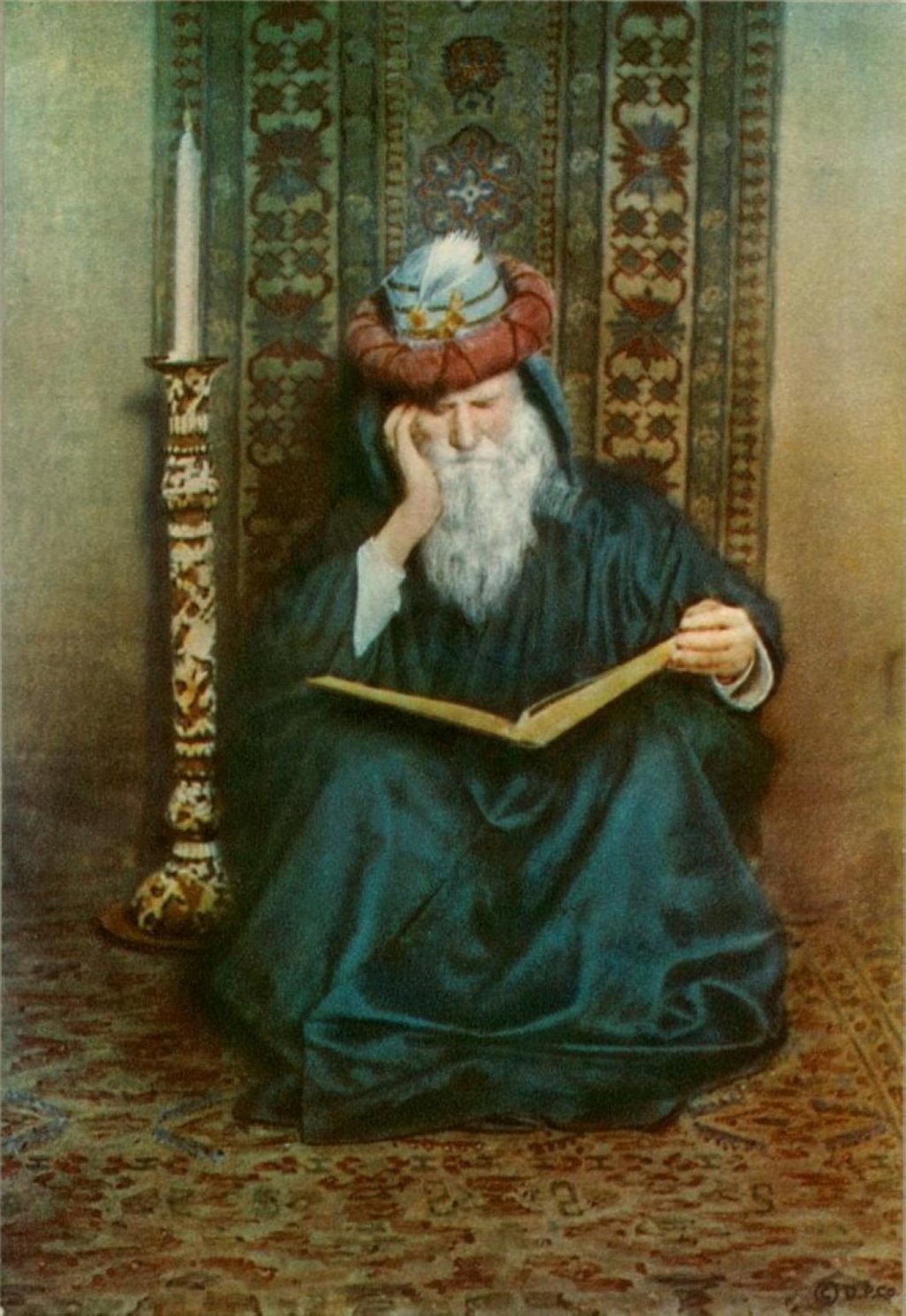
No. 537
Those who worship prayer-rugs are asses all,
For under loads of sanctimonious guile they crawl.
Strangest of all — behind the veil of pious show,
They sell their Islam, worse than unbelievers all.
Philosophical Reflection
The prayer-rug is the most intimate object in Islamic devotional practice — small enough to carry on a journey, specific to its owner, unrolled only at the moment of prostration. By choosing it rather than the mosque, the Quran, or prayer itself, Khayyam targets something precise: what happens when the instrument of worship becomes the object of worship. To worship the prayer-rug is to have made an idol of the very thing designed to prevent idolatry — the form has swallowed what it was supposed to carry. The accusation of being asses is not merely insulting; it is structurally exact. A beast of burden carries its load without understanding what it carries or why. These people carry the weight of their performed piety as pack animals carry goods: submissively, without comprehension, unable to put the burden down.
The underlying hypocrisy is specifically religious — not dishonesty in general, but the performance of holiness as a social instrument: piety deployed for social gain. Every display of religious seriousness generates an obligation for the next display; every public act of faith requires a more convincing demonstration to follow. The performance has its own logic of escalation. The practitioner becomes trapped beneath the accumulating weight of his own claims, unable to set the burden aside without dismantling the entire structure of social standing built on top of it. This is the load Khayyam describes: not something imposed from outside, but constructed piece by piece by the person who carries it, growing heavier the longer it is sustained.
Ascetic self-denial — the deliberate renunciation of worldly comfort as a path toward God — was one of the most respected postures in classical Islamic spiritual culture. Khayyam takes this most revered posture and identifies it as the most effective cover for commerce. The logic is precise: voluntary poverty is a credible advertisement for trustworthiness; trustworthiness is the foundation of social authority; social authority is the basis of trade. The greater the show of renunciation, the more convincing the front behind which the exchange operates. “They sell their Islam” — faith has become a commodity. What is sold is not personal belief but the social credit that attaches to the performance of belief. And once something enters the logic of exchange, the seller holds it at a transactional distance: they have a commercial relationship with faith, not a relationship of sincerity.
The poem’s final move is its most philosophically radical. In classical Islamic jurisprudence, the unbeliever occupies the lowest position in the moral hierarchy — the category from which no social or spiritual credit flows. To declare the hypocritical believer worse than the unbeliever is to overturn this entire structure. Khayyam’s criterion is not theological orthodoxy but sincerity — the one condition without which no moral standing is possible. The unbeliever stands honestly outside the system: they do not use faith’s vocabulary to hollow it out from within. The hypocrite does something structurally more corrosive — they occupy the institution, use its apparatus for private commerce, and leave it functionally empty while its outward form remains standing. A system whose most visibly devout members are its most active corruptors cannot adjudicate moral rank. The hierarchy it claims to represent has already been sold.
Related Khayyam’s Treatises:
Risāla fī al-Kawn wa al-Taklīf — On the World and Duty
Ḕarūrat al-Taḍādd — Letters on Contradictions, Determinism, and Mortality
Risāla fī Mīzān al-Ḥikma — On Determining the Mixture of Gold and Silver
Internal Themes: #MockingTheSacred #Theology #Folly #ChallengeWithTheCreator #Nihilism
From “Philosophy in Verse” by Kam Austine — a philosophical restoration of Omar Khayyām’s quatrains from Homaei’s Tarabkhaneh.
View the full Omar Khayyām Project.


Leave a comment