
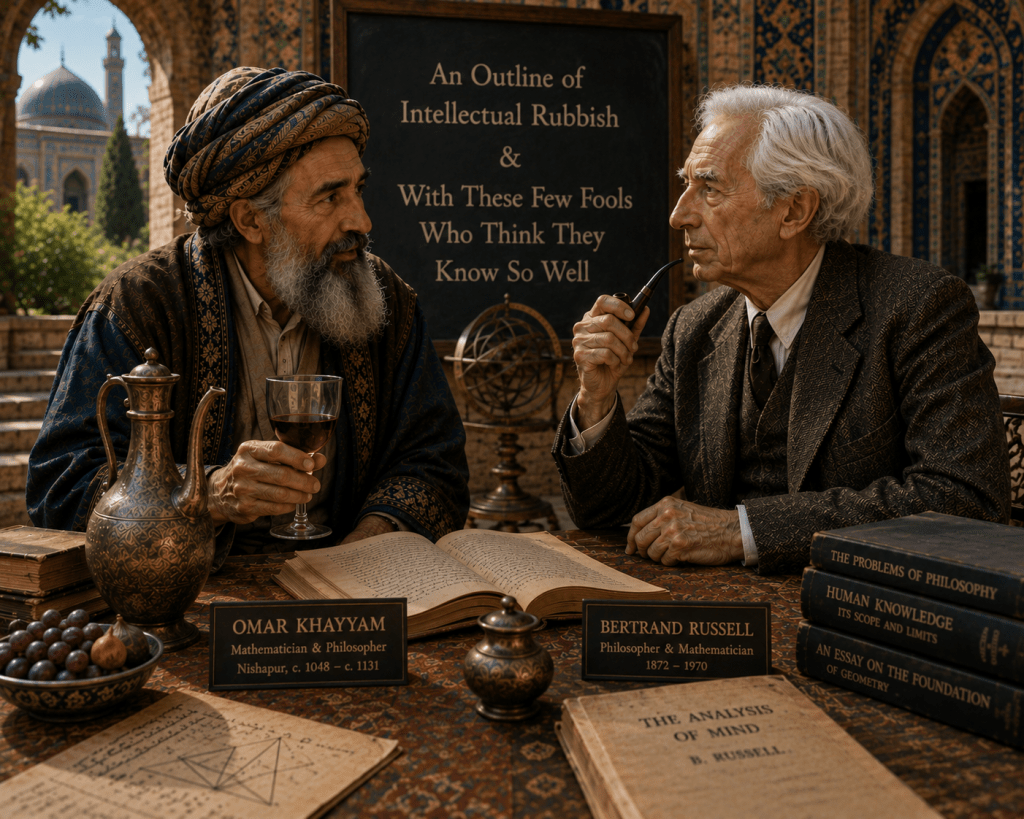
I. Two Iconoclasts, Nine Centuries Apart
In 1943, Bertrand Russell sat down to write an essay whose title alone constituted a provocation: “An Outline of Intellectual Rubbish.” Its subject was the stubbornness of irrational belief — the persistence of superstition, the cruelty of religious enforcement, the logical incoherence of doctrines nobody had stopped to examine, and the fear that kept the machinery of all of it running. Russell was seventy-one. He had been jailed, sacked, and vilified over his views; his patience with inherited nonsense was, by this point, geological. The essay is a catalogue of rubbish. It is also, beneath its wit, a genuine philosophical complaint: that human beings, in the absence of evidence, will believe anything they were told early enough, and defend it with the fury that belongs to things they have never examined.
Omar Khayyam is not mentioned in Russell’s essay. He could have been. Writing in the late eleventh and early twelfth century in Nishapur, Khayyam produced a body of quatrains whose targets overlap with Russell’s own almost point for point: the clergy who hold power without knowledge, the theological architecture of hell and paradise maintained by fear rather than argument, the logical collapse of sin under omnipotence, the demand to produce an eyewitness before making claims about the afterlife, and the recognition that all inherited systems of belief are transmitted, not verified — received from the community one was born into, defended as sacred precisely because they were never chosen. Russell calls this “intellectual rubbish.” Khayyam calls it something older and sharper.
Some ponder long upon the path of creed,
Quatrain no. 41
Some, seemingly, claim certainty indeed;
I fear the day a cry may rise and say:
“O heedless minds! The path is neither of these you heed.”
The parallel announced here may not be entirely coincidental. Edward FitzGerald’s Rubáiyát of Omar Khayyám had been one of the most widely read poems in the English-speaking world since its publication in 1859, and Russell — a voracious reader writing in 1943 — was almost certainly aware of it. Whether it shaped his thinking on superstition and clerical authority we cannot know. The parallel is in any case structural: two men arriving at the same diagnosis by the same method — looking at what people actually believe, asking what grounds those beliefs rest on, and finding, repeatedly, that the answer is fear, tradition, and the social pressure of the community they were born into.
Khayyam’s “neither” is the first move. Both the religious and the rationalist paths, he says, fail to deliver what they promise. Russell begins from the same place — with man described as “a rational animal, so at least I have been told,” and then proceeds to demonstrate, patiently and at length, that the evidence does not support the description. What follows in both thinkers is not a rival system but a sustained act of dismantling.
II. When the Clergy Had Things All Their Own Way
Russell opens his critique with the clergy because, as he explains, they are the figures “all right-thinking people acknowledge to be the wisest as well as the best of men.” If the wisest and best fail to be rational, what follows for the rest? His answer is historical: the Ages of Faith — so praised by those who never lived in them — were precisely the period when clerical power was at its highest and knowledge at its lowest. Daily life was populated by miracles, demonic possession, and divine punishment visited through earthquake and pestilence. When Benjamin Franklin invented the lightning rod, the clergy condemned it as an impious attempt to defeat God’s will. When a lightning rod was installed in Massachusetts and the region was subsequently shaken by earthquakes, a prominent Boston divine attributed the tremors to God’s fury at the iron points. The argument was circular and unfalsifiable — a feature, not a defect, of this class of reasoning.
Khayyam’s equivalent is not the clergy of Christendom but the ascetics, jurists, and moralizing overseers of medieval Persia — figures who wielded the same combination of social authority and epistemic confidence. His critique is identical in structure: those who claim to know most have examined their knowledge least, and use the social machinery of condemnation to suppress anyone who points this out.
With these few fools who think they know so well,
Quatrain no. 324
from sheer ignorance they rule and judge and tell;
be a fool — for this clan, in excess of their folly,
calls anyone not so a blasphemer from hell.
The word “blasphemer” is the enforcement mechanism. To name a dissenter a blasphemer is not to refute his argument; it is to disqualify him from the conversation. Russell documents the same device across centuries: Galileo’s views were not refuted, they were condemned; the Inquisition was not interested in evidence. Khayyam identifies the mechanism at its source — in the “excess of folly” that mistake confident ignorance for knowledge. The remedy he offers, with characteristic wit, is to become a fool in their terms: anyone who does not follow their reasoning is already outside their accounting, and the label costs nothing to a person who has examined the reasoning and found it empty.
The critique extends to the most revered figures within the tradition. Named individuals are not spared:
The clay that caps the jar, than the realm of Jam, is better;
Quatrain no. 196
the wine-cup’s scent, than the food of Maryam, is better;
the dawn-drawn sigh from a drunkard’s breast,
than the wail of Bū-Saʿīd and Adham, is better.
Abū Saʿīd ibn Abī al-Khayr and Ibrāhīm ibn Adham were among the most venerated Sufi ascetics of the classical tradition. Khayyam does not argue that their piety was insincere; he argues that the drunkard’s dawn-sigh — a single honest exhalation of authentic feeling — outranks their wailing devotion. The criterion is not orthodoxy but sincerity, and the moralizing authority fails that test not by being hypocritical but by confusing the performance of devotion with its substance.
O mufti, we outwork thee, plain to see;
Quatrain no. 330
and, drunk as ever, soberer than thee;
thou drink’st men’s blood, and we the blood of the vine —
be fair — the worse blood-drinker, thou or me?
The address is to the jurist — the mufti who issues legal rulings that govern the conduct of others. Khayyam’s complaint is not merely that the jurist is wrong; it is that the jurist is the worse offender by his own standards. “Thou drink’st men’s blood” — the juridical authority that consumes livelihoods, freedoms, and reputations is the real predator. The drinker takes only the vine’s blood: an honest transaction between himself and the grape. The moral charge is inverted, and the final appeal — “be fair” — is the most cutting touch: a call for the very fairness the jurist claims to embody, turned squarely against him.
And the overseer is addressed directly:
O master, grant one boon, and humour us:
Quatrain no. 216
speak out, and to God’s work deliver us;
we walk straight on, but you see all awry —
go, heal your eye, and disencumber us.
The defect, Khayyam insists, is not in the observed but in the eye that observes. The moralizing master who polices the conduct of others needs to correct his own perception before presuming to correct theirs. This is Russell’s argument in miniature: the authorities who claimed to know were the ones who had examined their beliefs least.
III. Fear, Hell, and the Management of Obedience
Russell’s most pointed diagnosis is also his simplest: “Fear is the main source of superstition and one of the main sources of cruelty. To conquer fear is the beginning of wisdom, in the pursuit of truth as in the endeavour after a worthy manner of life.” The doctrines of hell and paradise, on this account, are not primarily theological claims; they are instruments of fear management. Every major religious institution across traditions shares this driver — the threat of hell to prevent defection and the promise of paradise to sustain compliance. Whether the institution is a mosque, a church, a cloister, or a synagogue makes no structural difference. The machinery operates the same way.
Khayyam observes the same machinery across institutions:
In school, in cloister, church, and synagogue addressed,
Quatrain no. 20
they tremble at hell’s fire and heaven’s quest;
but he who knows the secrets of the Lord
plants none of these within his heart’s nest.
The universal reach — school, cloister, church, synagogue — is deliberate. This is not a critique of any one tradition but of a mechanism that operates across all of them. And the one who knows God genuinely, Khayyam says, is not driven by this engine. Fear and reward are not the architecture of knowledge; they are its substitute. The person who needs the threat of hell to behave well has not understood the argument; he has merely accepted the terms of the institution.
The paradise promise in particular receives Khayyam’s most precise attention. What is being promised? A place no one has seen, offered by people who have not been there, to be received after death. Khayyam applies the proverb:
They say that Eden with its nymphs’ allure is sweet;
Quatrain no. 414
I say the grape’s own juice, the vintage pure, is sweet;
take the ready cash, and let the credit be —
a drum, heard faint and far, obscure, is sweet.
The final line is the argument. A drum sounds exciting from a distance — its precise noise, its actual volume at close range, cannot be heard from afar. Paradise sounds wonderful precisely because no one is close enough to know what it actually is. The credit (the deferred promise of the afterlife) is distinguished from the cash (what is here, now, in hand). The financial metaphor is not decoration; it is the point. A credit note is a promise, backed by the issuer’s reputation — and the reputation of these particular issuers Khayyam has already examined. Hell and paradise together are then swept aside in a single word:
When in the world fresh blossoms herald spring’s array,
Quatrain no. 391
bid, O my idol, wine in measure they purvey;
of hell, of heaven, of nymphs, of palaces —
sit free: all these are naught but hearsay.
“Hearsay” is the juridical term for unverified testimony — exactly what Russell means by belief grounded not in observation but in transmission. The entire theological apparatus of reward and punishment — hell, heaven, houris, palaces — is classified not as false but as hearsay: the category of claims for which no firsthand witness can be produced. If the logic is followed, paradise is not merely undesirable compared to present pleasure; it is logically empty:
To drink wine and move among the truly free
Quatrain no. 338
is better than the pious mask of sanctity.
If lovers and the drunkards are bound for hell,
then paradise’s face no one shall see.
This is a reductio. If sincere love and honest pleasure constitute the grounds for damnation, then paradise has no occupants — because the condition for damnation (authenticity of feeling, directness of pleasure) is also the condition for any recognisably human good. A heaven that excludes the honestly joyful is structurally incoherent. And the escape from the entire framework:
A heart where love was never made to dwell,
Quatrain no. 44
be you of the prayer-rug, be you of temple’s cell,
whoever’s name love’s ledger comes to spell
is free of heaven, and released from hell.
Not rescued from hell and delivered to heaven — but released from both. The exit is not into an alternative afterlife but out of the framework altogether. This is Russell’s prescription for the fear-management system: not to exchange one threat for a comfort, but to see the mechanism clearly enough that neither the threat nor the promise retains its grip.
IV. The Logic of Sin and the Problem of Omnipotence
Russell identifies the central logical difficulty with theological ethics with characteristic precision. Sin is defined as disobedience to God’s commands. God is held to be omnipotent. But if God is omnipotent, nothing occurs against His will — including every act of sin. Therefore, when a sinner disobeys God’s commands, God must have willed that disobedience. St. Augustine, Russell notes, accepted this boldly: God afflicts men with the blindness that leads them to sin. But modern theologians, finding it intolerable to send people to hell for what God caused them to do, have tried to escape the dilemma by limiting omnipotence — introducing, in effect, competing powers of evil with a genuine share in causation. Neither exit resolves the problem; both abandon the classical doctrine.
Khayyam does not merely notice this incoherence; he performs it, in quatrains that range from the gravely philosophical to the outrightly comic:
I drink; and any worthy soul as I
Quatrain no. 394
counts my wine-drinking slight, and passes by;
God the Bestower knew it, ages gone —
drank I not, God’s own knowledge proves a lie.
The argument is airtight. If God is omniscient as well as omnipotent, then God knew from eternity that Khayyam would drink. Khayyam’s drinking is therefore inscribed in divine foreknowledge. To abstain would not be virtue; it would falsify omniscience, making “God’s own knowledge a lie.” The logic is formally identical to Russell’s — but deployed not as philosophical analysis but as straight-faced self-justification, which is both funnier and more devastating. The person citing divine foreknowledge as the grounds for his cup of wine has reduced the theological apparatus to the tools of his own vindication.
The predestination-and-judgment problem is pressed from the other end:
Though love be a bane, ’tis a doom none defy;
Quatrain no. 443
to blame men for fate’s decree is awry;
each good and ill of man, God writes on high —
why then, on the Last Day, his reckoning? Why?
If God writes every good and ill in advance, the Last Day’s reckoning is a judgment of outcomes that were always already determined. The creature is condemned for what the Creator wrote. The question Khayyam puts — why then the reckoning? — is not rhetorical flourish; it is the argument in four words. Russell says the same thing in a paragraph; Khayyam says it in four. The question of reciprocity extends the point:
Who lives on earth and never once has sinned — tell me.
Quatrain no. 8
And he who sinned not — how his life was lived — tell me.
If I do ill, and You return me ill,
then what divides my soul from Yours — twinned, tell me.
If the divine response to human wrongdoing is the return of wrongdoing, then the distinction between divine justice and human transgression collapses. God becomes not the corrective to sin but its mirror — and the moral distinction between creator and creature dissolves at the point where both respond identically to provocation. The theological framework’s own terms reveal its incoherence. Even the structure of religious penitence is shown to contradict itself from within:
Khayyam, for sin, what is this long lament?
Quatrain no. 134
From grief, what gain in great or small extent?
For one who hasn’t sinned, no pardon comes —
forgiveness came for sin — why grief, why this torment?
The argument is tight. Pardon presupposes transgression — by the theology’s own terms, a sinless life is a life that receives no pardon. The sinner’s grief is therefore irrational: the sin is the necessary condition for the forgiveness the believer hopes for. To grieve over sin is to grieve over the very thing the system requires. The practice of mourning over transgression contradicts the theological mechanism it is supposed to support. Russell would have enjoyed this one.
V. The Demand for Evidence
Russell’s practical prescription for avoiding “silly error” is stated plainly: “If the matter is one that can be settled by observation, make the observation yourself.” His illustration is Aristotle, who held that women have fewer teeth than men — a claim he could have tested at any moment by the simple method of asking his wife to open her mouth. He did not, because he thought he knew. The same principle applies to the grander claims of theology: before accepting what has been transmitted, ask for an eyewitness. Russell: “As soon as we abandon our own reason, and are content to rely upon authority, there is no end to our troubles. Whose authority? The Old Testament? The New Testament? The Koran? In practice, people choose the book considered sacred by the community in which they were born.”
Khayyam’s equivalent demand for a witness is among the oldest and most direct lines in his corpus. The claim that paradise and hell exist is a claim that, on Russell’s terms, calls for observation. Khayyam asks the one question that collapses it:
A cup, a love, a cupbearer, by the green;
Quatrain no. 211
for me, cash down; for you, heaven yet unseen;
heed no one’s talk of heaven and of hell —
who went to hell, who came from paradise serene?
“Who went to hell, who came from paradise?” — in one line, the entire afterlife economy is challenged on the only grounds that matter: evidence. Who is the witness? Who has returned to report? The testimony on which the whole apparatus rests is secondhand at best. Quatrain 391 calls this hearsay; Quatrain 211 puts the demand positively: produce a witness. The epistemological argument is also available in what observation does reveal. If the cosmos were just, the evidence should show:
If heaven’s work were weighed on justice’ scale,
Quatrain no. 446
then all its motions fair would never fail;
had justice ruled the turning of the skies,
the learned’s hearts would never sorrow’s tale.
The suffering of the wise — those best equipped to perceive the structure of things — is itself the empirical argument against the claim that a just intelligence governs the cosmos. This is not an argument from theology but from observation. The astronomer who has measured the heavens finds no justice in their arrangement; the evidence is precisely the reverse of what the doctrine predicts. Even the most careful inquiry into the structure of the cosmos yields no certainty:
The spheres that dwell within this vaulted dome
Quatrain no. 120
set wise men wavering far from mental home.
Beware lest reason lose its guiding thread —
for those who chart their course wander as they roam.
This is not a counsel of despair but of epistemic honesty. Even those who have spent their lives charting the heavens — Khayyam among them, as the chief architect of the Persian calendar reform of 1079 CE — find that the cosmos resists the certainty the tradition claims to have already achieved. The thread of reason must be held carefully precisely because the material it engages with does not resolve into the neat theological picture. The observer who charted the stars more accurately than any of his contemporaries says: even the stars do not tell you what the clergy claim they tell you.
VI. Self-Importance, Species Pride, and “A Brief Episode”
Russell identifies self-importance as the deepest source of religious belief: “Self-importance, individual or generic, is the source of most of our religious beliefs.” The universe was made for Man; the sun was placed to light the day; the white tails of rabbits were given to make it easier for sportsmen to shoot them. The teleological reading of evolution — billions of years of slime, trilobites, giant ferns, dinosaurs, bees, and wild flowers, culminating in the “Great Climax” of Man — Russell finds the most risible of all: “including such specimens as Nero and Caligula, Hitler and Mussolini, whose transcendent glory justified the long painful process.” His conclusion: “man is a brief episode in the life of a small planet in a little corner of the universe, and, for aught we know, other parts of the cosmos may contain beings as superior to ourselves as we are to jellyfish.”
Khayyam’s deflation of the human figure arrives at the same place by the same path — but with an economy that takes nine centuries to appreciate:
O unaware of the world’s whole plan, you are nothing;
Quatrain no. 149
your base is wind, and no more than that you began — you are nothing;
between pre-eternity and void to come, your being stands —
around you naught, within this span — you are nothing.
The tripled refrain is an address — not a lament but a statement of structure. Foundation is wind. Both sides of existence are void — pre-eternity and post-eternity. Nothing surrounds within this span. No emotion is attached to this; it is presented as topology. “Around you naught, within this span” — the spatial and temporal coordinates are both zero. Russell’s “brief episode” is a long paraphrase of this.
The same argument in its most compressed form:
A drop of water, once it was — in the great sea, dissolved as spray;
Quatrain no. 156
a speck of dust, once it was — in the vast earth, made one with clay;
what, then, is your coming and going in this brief and fleeting world?
a fly came, once it was, appeared, then disappeared away.
The structure is comparison, then application. The drop dissolves into the sea, the speck into the earth, until no trace of the individual remains — and the question posed is: what is your coming and going, by comparison? The answer is the fly. Not a great animal, not a creature of consequence — a fly, which came, appeared, and disappeared. The “once it was” repeating across the lines is the formal device: everything is in the past tense before it has finished existing. The temporal symmetry completes the picture:
For a long time we shall not be — yet the universe will be;
Quatrain no. 168
no name of ours, no trace of us in this verse will be.
Before we came, nothing in it was missing;
when we are gone, the same traverse will be.
The universe did not wait for us; it will not register our absence. There was no vacancy before; there will be none after. This is the counter-argument to every theological system that places Man at the centre of cosmic purpose — not by disputing the theology but by describing the geometry. And the fullest catalogue of what existence amounts to:
Seek not the crown — life’s harvest is but a moment’s grace;
Quatrain no. 142
each dust-speck was once a Kayqobād or a Jamshid in his place;
the world’s state, mortal life, and existence —
are a dream, a phantom, a fraud, a passing breath’s brief trace.
The four-term litany in the closing line — dream, phantom, fraud, passing breath — advances in severity. Existence does not merely fade; it deceives. “Fraud” is the strongest word in Khayyam’s philosophical vocabulary here, and its placement is exact: the universe is not just brief and empty — it presents itself as meaningful and is not. Russell finds the same dishonesty in every system that inflates Man’s importance beyond what observation warrants.
VII. Inherited Claims and the Freedom of the Unaffiliated
Russell’s epistemological counsel on the problem of authority: “In practice, people choose the book considered sacred by the community in which they are born, and out of that book they choose the parts they like, ignoring the others.” Tradition is not chosen; it is received. And what is received uncritically tends to be defended with the ferocity that belongs to the unexamined. “Man is a credulous animal, and must believe something; in the absence of good grounds for belief, he will be satisfied with bad ones.” The specific content of the inherited belief matters less than the mechanism — the credulity that fills the available space with whatever was transmitted.
Khayyam punctures inherited cosmology at its foundations. The folk picture of the universe — a celestial bull bearing the sky, a great cow upholding the earth beneath — is the received architecture of creation. Khayyam looks at it and looks at those who hold it:
A cow there dwells in heaven — Taurus, throned on high;
Quatrain no. 421
another cow lies hidden where earth’s foundations lie;
open the eye of thy reason, and look with a certain eye:
above, below the pair of cows — a fistful of asses spy.
“Open the eye of thy reason.” This is Russell’s prescription stated as poetry: make the observation yourself. Look at the picture you have received — celestial cow above, underground cow below — and then look at who believes it. The result of that examination is “a fistful of asses.” The wit is brutal and the argument is complete: the inherited cosmological picture, once examined, reveals not the structure of the universe but the credulity of those who accepted it without looking.
The critique extends to the relationship between the sacred text and the life actually lived. Khayyam’s most precise formulation turns on a pun that the poetry performs:
The Quran, the Word supreme, unsurpassed, they read;
Quatrain no. 385
now and then, not held to last, they read;
yet on the wine-cup’s rim a bright verse stands —
which, everywhere and always, steadfast, they read.
The sacred text is called the supreme and everlasting Word. But the Persian word for “continually” (davām) is also the word for “permanence, everlastingness” — so the line that says the Quran is read “not continually” also says it is not held to be everlasting, touching the orthodox doctrine of the uncreated, eternal Quran and quietly declining assent. Meanwhile, the word for “continually” in the final line (modām) is also the poetic word for wine, so the ever-read verse on the cup is wine itself. The pun is the argument: what is actually read constantly, devotedly, everywhere — what functions as the real sacred text in human life — is the cup, not the book. Khayyam has built an innocent-sounding surface that the theologically literate could not fail to hear beneath.
The inherited identity of religious community — the name one was born into — receives the same treatment:
Where is that ruby lip, that radiant sight?
Quatrain no. 227
Where is that soul’s repose, that fragrance bright?
Though wine be called forbidden in Islam —
drink on — for where is one Muslim in plain sight?
The prohibition has no subjects: there are no Muslims in evidence, so the prohibition is unenforceable. This is not cynicism about Muslim observance; it is a point about identity categories received rather than chosen. The name “Muslim” — the inherited religious designation — turns out, on inspection, to refer to no one present. And the figure who has abandoned all inherited categories entirely:
I saw a rogue seated on the mute, pale land,
Quatrain no. 544
neither creed nor unbelief, nor world nor faith at hand;
neither truth nor certainty, nor law nor sacred claim —
who in both worlds would dare to take such a stand?
The admiration in the closing question is unmistakable. The rogue who has released creed and its opposite, faith and its opposite, law and its opposite — who has declined to inherit any of the available frameworks — is presented not as lost but as occupying a position that almost no one has the clarity, or the courage, to take. Russell admires the same thing, though he calls it by a different name: intellectual honesty, the willingness to hold no belief beyond what the evidence supports, however uncomfortable the resulting vacancy.
VIII. Not Despair — Diagnostic Wit
Russell ends his essay not with horror at the rubbish he has catalogued but with something closer to appreciation. He describes a prophetess who announced she would walk on water at eleven o’clock one morning; at the appointed hour, with thousands assembled, she asked whether they were all persuaded she could walk on water, received their unanimous assent, and replied: “In that case, there is no need for me to do so.” And they all went home, Russell notes, “much edified.” He closes: “of intellectual rubbish he will find an abundant diet, in our own age as in every other.”
This is not the voice of a man in despair. It is the voice of a man who has made his peace with the species — who finds the rubbish, if not exactly delightful, at least inexhaustible and therefore not grounds for desolation. The appropriate response to discovering that the rubbish is perennial is not anguish but a kind of seasoned, amused recognition that this is what the animal is like. And then one pours wine.
Khayyam arrives at the same place:
Those who became the sea of art and lore,
Quatrain no. 52
who lit their fellows to the sciences’ core,
found from this dark night no way out —
they told a tale, and slept, and stirred no more.
The greatest scholars — oceans of learning, lamps to their contemporaries — reached exactly nowhere. They could not find the road out of the dark night. And what did they do? They told a story (fasāne — a fable, a fairy tale, a tale told in the evening to explain things that cannot otherwise be explained) and then died. The word fasāne is not a compliment. It is what Khayyam calls all the grand systems, the theological architectures, the cosmological certainties — fairy tales, told by brilliant men who could not find the way out, and then went to sleep. This is Russell’s “intellectual rubbish” in four lines. And it is not the voice of despair: the lightness of the telling, the wry “stirred no more,” the almost affectionate observation that even the best minds told fables — this is the same register as Russell’s prophetess.
What remains when the fables are set aside:
O you who came from the hot spirit of heaven,
Quatrain no. 238
dazed among the five, four, six, and seven;
drink — you do not know the place you came from;
be glad — you do not know where you are driven.
The five, four, six, and seven are the classical scheme inside which the bewildered soul finds itself: five senses, four elements, six directions, seven planetary spheres. The soul is dazed — lost in the cosmological apparatus, uncertain of origin and destination. Both are sealed. And the prescription that follows from that double ignorance is not philosophy but a double imperative: drink, be glad. Not because the wine dissolves the ignorance — it does not — but because the correct response to genuinely sealed questions is not to compound the uncertainty with grief. Russell says the same thing: the appropriate response to perennial rubbish is not gloom, because “gloom is a useless emotion.” Both men surveyed the intellectual landscape of their species, found it comprehensively disappointing, and prescribed — one with a glass of wine, one with a dry English joke — something like equanimity.
The encounter between Khayyam and Russell is, in the end, a conversation that never happened between two men who had already agreed. Both identified fear as the engine of superstition. Both demanded evidence before accepting inherited claims. Both found the logical foundations of theological ethics incoherent. Both noted that the wisest and most learned among their contemporaries had told fairy tales and gone to sleep. And both, having said all this, declined to be miserable about it.
Published as part of the Khayyam’s Philosophy Series — The Omar Khayyam Project


Leave a Reply