
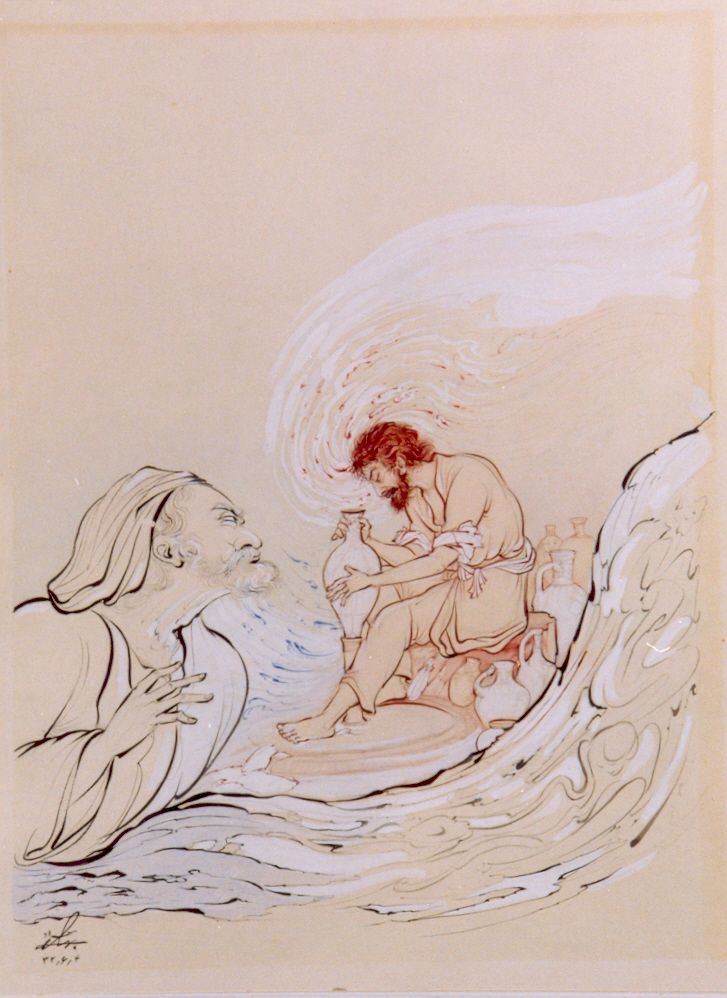
No. 114
Upon the face of the rose the Nowruz breeze is bright and sweet,
Within the garden court the heart-delighting face is light and sweet.
Whatever you say of yesterday, now passed is never sweet,
Be joyful and speak not of yesterday — for today is delight and sweet.*
Philosophical Reflection
Khayyam does not begin with an argument. He begins with a fact: the Nowruz breeze crossing the face of the rose, a heart-delighting presence in the garden court. Two lines of precise sensory observation, and then — only then — the philosophical turn. This sequencing is not rhetorical decoration. It is the method. Before any claim is made about how one should live, Khayyam has already placed us inside the experience that makes the claim self-evident. The beauty is presented first; the conclusion follows because it must.
For most readers, “Nowruz” is seasonal atmosphere — the Persian New Year, spring’s arrival, a familiar backdrop for lyric poetry. For Khayyam, it was something more precise. He was the principal architect of the Jalālī calendar reform of 1079 CE, and he devoted an entire treatise — Risāla dar Kashf-e Ḥaqīqat-e Nawrūz — to the philosophical significance of the year’s renewal. Nowruz, he argued, was not custom but recognition: a human act of alignment with the structure of cosmic time. The breeze that arrives on the face of the rose in the poem’s first line is, in Khayyam’s own philosophical vocabulary, an astronomically exact event — the cosmos returning to itself on a schedule his mathematics had measured to the day. When he invokes it in verse, he is not reaching for a pleasant image. He is invoking a cosmic argument.
Every line in the Persian ends with khosh ast — is sweet, is bright, is pleasant — except the third, which ends with khosh nīst: is not sweet. The poem’s rhyme scheme performs exactly what its words assert. Yesterday cannot share the poem’s refrain because yesterday is not here. The structure excludes it formally, as reality excludes it actually. Khayyam, whose algebra treatise classified problems by the order of instrument required to solve them, was not careless about formal precision. The B-line of an AABA rubāʿī is the space of negation — and he filled it with exactly the negation the argument required. The poem’s form and its philosophy are not in conversation; they are the same statement made twice.
The final line’s command — “Be joyful and speak not of yesterday” — has often been read as an injunction to forget, to look away from difficulty. It is something more specific: a correction of a logical error. In Khayyam’s philosophical system, every contingent thing holds its existence by derivation — existence as an attribute received from the Necessary, not inherent to the thing itself. The rose in the garden court exists now because existence flows into it now. Yesterday’s rose existed when it was here. Now it is not. To speak of it in the presence of today’s garden is not loyalty to the past; it is a confusion about what is real. Khayyam is not asking us to be cheerful. He is asking us to be accurate.
This is what distinguishes the poem among Khayyam’s carpe diem verses — and there are many. In most, the argument runs: life is short, therefore drink, therefore enjoy. Here the structure is different. Beauty is not the reward for accepting the argument; it is the argument. The Nowruz breeze on the rose’s face, the heart-delighting presence in the garden court — these are presented as exhibits, not consolations. Khayyam is not comforting us with beauty; he is using beauty to make a philosophical point that does not require comfort. Today is this. Yesterday was not, and is not, and cannot be this again. The correct response to that fact is attention — and what full attention to beauty produces in a rational mind, Khayyam names with one word: khosh bāsh. Be joyful.
Footnote
* Source: Tarabkhaneh, Homaei, no. 114, translated by Kam Austine for Philosophy in Verse.
بر چهره گل نسیم نوروز خوش است
در صحن چمن روی دلافروز خوش است
از دی که گذشت هر چه گویی خوش نیست
خوش باش و ز دی مگو که امروز خوش است
Related Treatises: Risāla dar Kashf-e Ḥaqīqat-e Nawrūz, Risāla dar ʿIlm Kulliyāt-e Wujūd
Internal Themes: #Contentment #PresentMoment #Aestheticism #Nowruz #Beauty #Impermanence #Existentialism #PersianPhilosophy
Published as part of Philosophy in Verse — The Omar Khayyam Project


Leave a Reply