
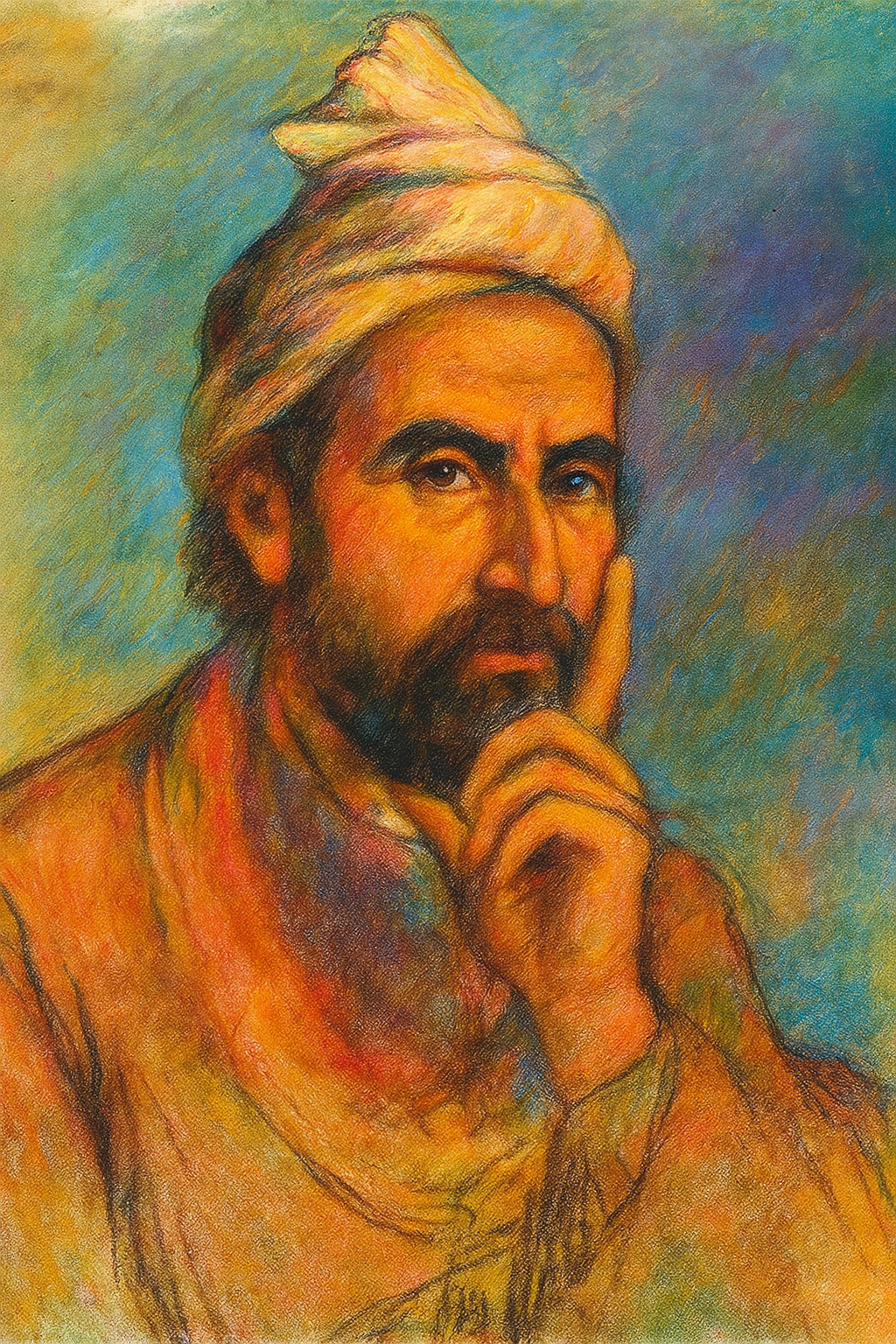
No. 234
This dome of azure, with its bowl of gold,
hath turned and turned, and long shall yet be rolled;
a while, by the turning decree of fate—
we came, and, like the rest, our tale is told.*
Philosophical Reflection
Three lines of cosmology, and then half a line for a human life. The proportion is not an accident of composition; it is the argument. Khayyam allocates space in the quatrain the way the universe allocates significance, and by the time our arrival is mentioned there is almost no poem left to put it in. Whatever the reader was expecting to be the subject has been given the position of an afterthought, and the reader notices the demotion before understanding it. The form has made the case before the sentence has.
The sky in the first line is a manufactured object. A dome of lapis, a golden basin turning inside it — vault and tableware, an artisan’s vocabulary rather than a temple’s. Khayyam returns to this image repeatedly: heaven as something fashioned, an overturned bowl, a vessel on a wheel. The effect is precise. Calling the sky a made thing removes its intention while leaving its beauty entirely intact. It is still azure, still gold; it simply is not looking at anything. Nothing in the poem needs to be ugly for the consolation to be withdrawn.
The verbs are where the quatrain does its finest work. It has turned many times; it will turn many more — a completed past and an open future, joined in a single line, with our own moment given no tense of its own. We occupy a bracket inside somebody else’s sentence. And when the last line arrives, the grammar performs one further move that most translations cannot carry: it does not say we passed. It says we came — and it passed. The subject changes mid-line. What arrives is us; what departs is the interval, the turn, the span. Being alive, in this construction, is not an action one performs but a condition of having something pass over one.
The third line names the mechanism, and it names it technically. Our while is held by what the revolution of fate requires — the word is the one philosophers use for what a thing necessarily entails, not what an agent decides. Nobody willed us. We are what the turning implies at a particular position, the way a consequence follows from a premise whether or not anyone wanted it. That is a colder proposition than being chosen, and also a cleaner one: there is no verdict in it, no favour withheld, nothing addressed to us at all. Khayyam held in his treatises that compulsion sits nearer the truth than choice, and here the compulsion is not even personal enough to resent.
What keeps the poem from despair is the source of its authority. The man reporting that the dome will not adjust its revolution for anyone had measured that revolution to a fraction of a day, and built a calendar on the measurement more accurate than the one Europe would adopt five centuries later. He is not guessing at indifference; he has the figures. And the phrase he ends on — like the rest — carries the sting and the consolation together in three words. There is no special dispensation, and there is also no exposure: we are not singled out, because nothing here singles anything out. We arrived at a position the turning entailed, and the turning went on.
Footnote
* Source: Tarabkhaneh, Homaei, no. 234, translated by Kam Austine for Philosophy in Verse.
این گنبد لاجوردی زرّین طشت
بسیار بگشتهاست و بسی خواهد گشت
یکچند زِ اقتضای دورانِ قضا
ما نیز چو دیگران رسیدیم و گذشت
Related Treatises: Ḍarūrat al-Taḍādd fī al-Wujūd, Risāla dar Kashf-e Ḥaqīqat-e Nawrūz
Internal Themes: #Existentialism #Determinism #Impermanence #CosmicIndifference #Mortality #DeepTime #Astronomy #PersianPhilosophy
Published as part of Philosophy in Verse — The Omar Khayyam Project


Leave a Reply