
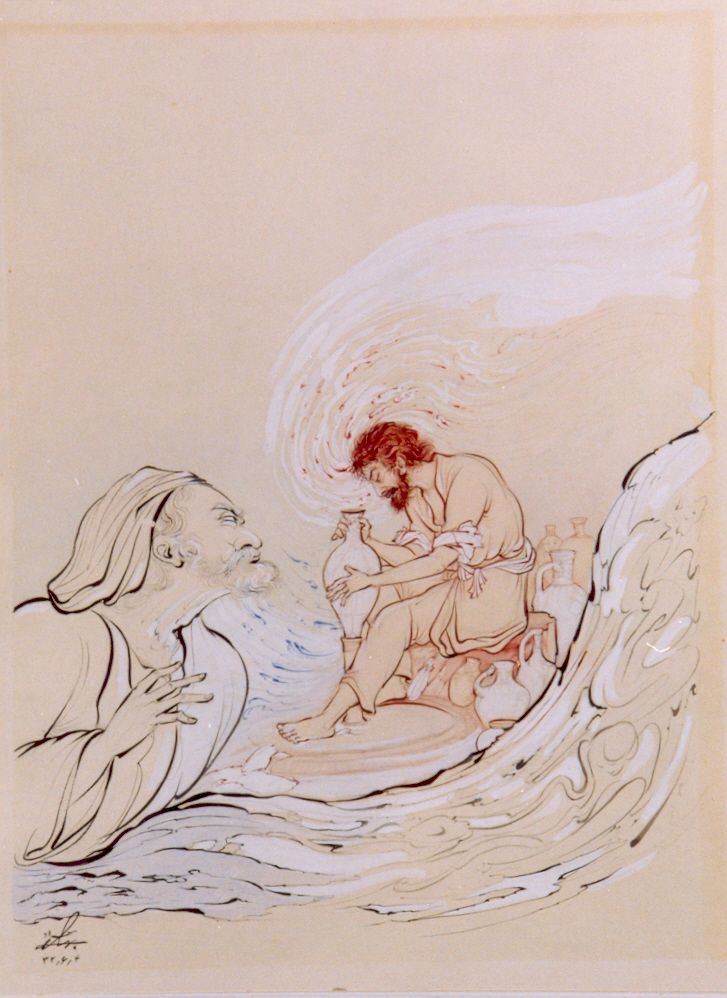
No. 101
For how long concerning mosque-lamps and the smoke of cloistered fire?
For how long talking of loss of hell and profit of heaven’s desire?
Look on the tablet of fate, for from the primordial day,
The Master wrote whatever was destined to transpire.*
Philosophical Reflection
The first line names two houses of worship, not one. The lamp belongs to the mosque. The smoke belongs to the other sanctuary, and the Persian word for it is the one that covers all of them at once — synagogue, church, fire-temple, whichever rival establishment stands across the street. That single word is doing the work of the line. Khayyam does not set Islam against one competitor; he sets it against the whole category of competitors, and then spends one exhausted question on the lot. And the two images he chooses are the same event: something is burning in each building, and the difference between the liturgies is the difference between calling the combustion light and calling it fumes. The opening move is not an attack on one religion from the standpoint of another. It is the refusal of the question which house is correct, on the ground that the chemistry is identical in all of them.
The second line changes vocabulary, and the change is the sharpest thing in the quatrain. One expects fear and hope — the emotional pair that normally attaches to the afterlife. What Khayyam writes instead is loss and profit: the trader’s words, the two columns of an account. Hell is not presented as terrifying and heaven is not presented as desirable; they appear as a debit and a credit. The believer in this line is not a frightened soul but a man working out his expected return, and his devotion is an investment strategy with an unusually long horizon. Nothing in the line says the calculation is wrong. It says what kind of activity it is, and the indignity is in the category rather than in any accusation.
Then the turn, and here the poem does something more rigorous than irreverence. The premise Khayyam brings against the bookkeepers is not a sceptical one. It is the most orthodox proposition available to him: a tablet of the decree, written from the primordial day — which any reader of his century would hear as the Preserved Tablet of scripture, and as the doctrine of divine foreknowledge that the theological schools competed to explain rather than to doubt. Note what this costs him: nothing. He need not hold the doctrine himself. He needs only his targets to hold it, and they do. There is no heresy anywhere in the argument, because the demolition is carried out entirely with licensed materials — the mosque’s own timber.
The word he chooses for the writer repays attention. Not the Creator, not the Merciful, none of the divine names a devotional poem would reach for, but the Master: the title of a master craftsman, the honorific of a guild expert, the word Khayyam applies to Avicenna in his own treatises. It belongs to the register in which poets address the maker as artificer rather than as lord. And the verb is wrote — not willed, not decreed, not ordained, but a scribe’s act, performed once, producing a finished artefact that is not revisited. Everything a believer wants from the author of his fate — attention, responsiveness, some interest in the ledger being kept on his behalf — is missing from the line, and missing without a word of denial. Khayyam stays inside the doctrine and empties it of relationship by choosing which noun and which verb to use.
What remains is the instruction, and it is a strange one: look. The poem’s single imperative directs us to inspect the one object that cannot be inspected — elsewhere in the corpus Khayyam states flatly that the secrets of eternity are closed to him and to us alike, and that his reason affords no demonstration of what stands behind the curtain. As reading, the command is unperformable. As orientation, it is exact. We are not told what the tablet says; we are told that there is one, and that both activities the poem opened with proceed as though there were not. Sectarian argument and eschatological accounting are forward-facing enterprises, wagers on an outcome still in play, and the tablet faces the other way — complete before the first lamp was lit. What the believer computes anxiously forward was finished backward, at a date before dates.
The strongest objection comes from the theologians themselves, and the poem is good enough to take it. A tablet that records everything records the piety too: if the devout man’s observance is written, then his observance is precisely the means by which his salvation turns out to have been written, and the calculation is not idle but constitutive. That reply works against a cruder poem than this one. What the written tablet voids is not the connection between a life and its outcome; it is the deliberative premise underneath lines one and two — that the dispute could move the entry. One may be saved by the lamp or by the smoke, but no amount of arguing about which is the true light can alter which was inscribed. The same holds for the poem itself, and Khayyam claims no exemption: this quatrain was written on the tablet along with the sermons it mocks. He is not telling us that conduct is free. He is telling us that two particular expenditures are transactions, and a transaction wants a counterparty who has not yet decided. The one thing he asks for is not an act but a perception, which is the only posture here that is not a bid for return. Twice he asks how long — and the commodity being spent in both lines is the one thing the poem concedes we hold: not the profit of heaven or the loss of hell, but the hours going into the argument.
Footnote
* Source: Tarabkhaneh, Homaei, no. 101, translated by Kam Austine for Philosophy in Verse.
تا کی ز چراغ مسجد و دود کنشت
تا کی ز زیان دوزخ و سود بهشت
بر لوح قضا نگر که از روز ازل
استاد هرآنچه بودنی بود نوشت
Related Treatises: Ḍarūrat al-Taḍādd fī al-Wujūd, Risāla fī al-Kawn wa al-Taklīf
Internal Themes: #Determinism #MockingTheSacred #Theology #Folly #Metaphysics #DivineDecree #Fate #PersianPhilosophy
Published as part of Philosophy in Verse — The Omar Khayyam Project


Leave a Reply