
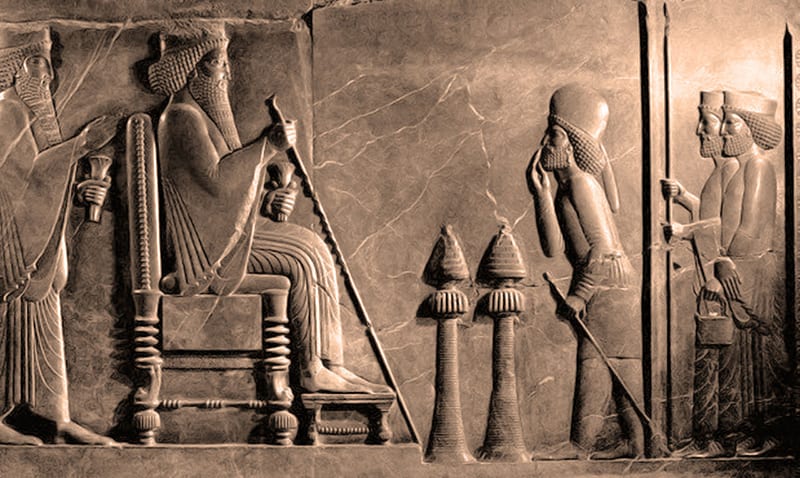
Part I traced the many forms of servitude in the Achaemenid world — the slippery vocabulary of dependence, the myth of a slave-free Persia, the rationed kurtaš of Persepolis, the household and business slaves of Babylonia, and the captives moved by war. This second part turns to the other half of the title: freedom. It asks how people escaped bondage, what liberty actually meant for the free majority under an absolute king, how royal ideology framed the whole order, and whether the Achaemenid Empire should be called a slave society at all.
How People Became Free: Manumission, Debt, and Temple Service
If slavery in the Achaemenid world was rarely absolute, neither was it always permanent. The same legal cultures that recorded the sale of human beings also recorded the routes out of servitude — and, just as importantly, the routes into it.
Debt was one of the commonest doors into dependence. A free person unable to repay a loan might pledge land, a family member, or their own labour as security; in bad years, parents could sell children, or individuals could sell themselves to survive. This kind of debt bondage was not always lifelong, and it was distinct from chattel slavery, but it blurred the line between free and unfree. It also shows that enslavement was often a product of poverty and misfortune rather than conquest.1
Manumission — the freeing of a slave — is documented most clearly in Babylonia and in the Aramaic papyri from Egypt. An owner might free a slave outright, release them by will, or use a legal act of adoption that turned a dependant into an heir with duties of support in the owner’s old age. The Aramaic archives from the Jewish military colony at Elephantine, on Egypt’s southern frontier, preserve exactly this kind of document under Persian rule: contracts of sale, slaves marked on the hand with an owner’s name, and a deed of 427 BC by which the owner Meshullam freed the slave-woman Tapmut and her daughter Yehoyishma. These texts let us watch individual people cross the line between bondage and freedom.2
A third status sat between slave and free. In Babylonian temples, people could be dedicated as oblates — širku — bound to the service of a god rather than owned by a private master. Marked as temple dependants, sometimes with a star of the goddess Ištar on the wrist, they worked temple estates and workshops but were not chattel to be sold at will. The oblate is a reminder that ancient societies recognised many degrees of belonging between absolute freedom and absolute ownership.3
Prices anchor all this in economic reality. In Babylonia an adult slave might sell for something on the order of one to two minas of silver — very roughly the equivalent of a hired labourer’s earnings over several years. That was enough to make a slave a serious investment, and to make manumission or self-purchase a genuine financial event, but not enough to make slave labour the foundation of the whole economy. Freedom, in this world, had a market value, and it could sometimes be bought.
Freedom in an Imperial Monarchy
What did freedom mean in Achaemenid Persia? It did not mean democratic citizenship. It did not mean equality before the law in a modern sense. It did not mean freedom from taxation, military service, hierarchy, or royal command. Most people in the empire were subjects of the king.
Freedom in this world was more practical and relational. A free farmer might own or lease land, marry, raise children, pay taxes, participate in local cults, appear in legal documents, and remain within a recognised community. A free artisan might inherit a craft, join a family workshop, receive payment, and move under certain conditions. A merchant might travel, contract, lend, borrow, and profit, though still under imperial authority.
By contrast, an enslaved person’s life was constrained by ownership or attachment. He or she could be sold, pledged, commanded, punished, or transferred. A dependent worker might not be legally enslaved but could still lack real freedom of movement. A royal subject might be free in household law but unfree before the king’s command.
This layered reality explains why Greek observers could call Persians “slaves” of the king while Persian documents could treat officials as honoured servants. The whole imperial order was built on dependence. But not all dependence was slavery.
Royal Ideology: Justice, Order, and the Limits of Power
Achaemenid kings did not present themselves as liberators of slaves. They presented themselves as restorers of order. Cyrus restored Babylonian cults. Darius defeated the Lie. Xerxes punished rebellion. Royal ideology was concerned with truth, proper rule, divine favour, and the suppression of disorder.
This has moral significance, but it is not modern humanitarianism. A king could be “just” by protecting temples, punishing rebels, regulating officials, restoring property, and maintaining order. He could also command forced labour, execute enemies, demand tribute, and relocate populations. Ancient justice was not the same as universal freedom.
The concept of asha — truth, order, rightness — gives this discussion a deeper philosophical dimension. A king who ruled according to asha was expected to uphold proper order against the Lie. But that order was hierarchical. It did not abolish masters, servants, nobles, dependants, or royal command.4
This is why slavery and freedom in Persia must be understood within the moral world of ancient monarchy. Achaemenid ideology could restrain cruelty, value order, and present kingship as divinely accountable. But it did not imagine society as a community of equal individuals.
Scholarly Discussion: Was Persia a Slave Society?
The major scholarly question is not whether slavery existed. It did. The question is whether the Achaemenid Empire should be described as a slave society — a distinction historians since Moses Finley have drawn between societies that merely have slaves and those in which slavery is central to production, wealth, and social order.5
By that measure, Classical Athens and much of the Roman world were slave societies: enslaved people made up a large share of the population and did much of the productive work that sustained citizen life. The Achaemenid Empire does not fit that model neatly. Slavery existed, but free farmers, tenants, artisans, soldiers, officials, dependants, and rationed workers remained central to the economy.
In Babylonia, slavery was more visible because legal archives preserve sale contracts, household slaves, and business dependants. In the Iranian heartland, the evidence points more strongly toward mixed labour: free workers, rationed workers, foreign dependants, captives, and estate labourers. The royal economy used coercion, but it did not rest on chattel slavery alone.
The best description, therefore, is that the Achaemenid Empire contained slavery within a wider system of dependence. Its labour world was imperial, regional, hierarchical, and mixed. To deny slavery is false. To reduce the empire to slavery is equally false.
Conclusion: Freedom Under the King
Slavery and freedom in ancient Persia reveal the deep structure of empire. The king stood above all; beneath him ranged nobles, satraps, officials, priests, soldiers, households, merchants, farmers, artisans, workers, servants, slaves, and captives — everyone placed within a hierarchy of dependence. Yet hierarchy did not erase difference. The empire classified people, and classification shaped how they lived, moved, married, and worked.
To understand Achaemenid freedom, then, is to understand a world where liberty was always relative: freedom from sale, freedom to own land, freedom to marry, freedom to travel, freedom to worship, freedom from hunger, freedom from arbitrary violence. No single word captures all of this. Ancient freedom was lived in degrees.
That is why the topic resists easy verdicts. The Achaemenid achievement was not the abolition of slavery but the creation of an imperial order that could hold many peoples, labour systems, and legal traditions under one monarchy — an order that could be flexible, tolerant, and restorative, yet also coercive, unequal, and exploitative. The moral language of Persian kingship, with its truth, order, and restoration, must be read alongside the social reality of dependence. The king protected order, but order included hierarchy; he opposed the Lie, but he did not abolish servitude; he could restore temples and communities, yet still command labour and profit from conquest.
Persia was neither a modern charter of human rights nor a uniquely cruel slave empire. It was an ancient monarchy that ruled through order, hierarchy, service, and negotiated dependence — an empire of kings, nobles, workers, captives, servants, and subjects. Some were free. Some were enslaved. Many lived somewhere in between.
References
Briant, Pierre. From Cyrus to Alexander: A History of the Persian Empire. Translated by Peter T. Daniels. Eisenbrauns, 2002.
Brosius, Maria. Women in Ancient Persia, 559–331 BC. Clarendon Press, 1996.
Cyrus Cylinder. Various editions and translations.
Dandamaev, Muhammad A. Slavery in Babylonia: From Nabopolassar to Alexander the Great. Northern Illinois University Press, 1984.
Dandamaev, Muhammad A. “Barda and Barda-dārī i. Achaemenid Period.” Encyclopaedia Iranica.
Darius I. The Behistun Inscription. Various editions and translations.
Finkel, Irving. The Cyrus Cylinder: The Great Persian Edict from Babylon. I.B. Tauris, 2013.
Finley, Moses I. Ancient Slavery and Modern Ideology. Viking, 1980.
Hallock, Richard T. Persepolis Fortification Tablets. Oriental Institute Publications 92. University of Chicago Press, 1969.
Henkelman, Wouter F. M. The Other Gods Who Are: Studies in Elamite-Iranian Acculturation Based on the Persepolis Fortification Texts. Nederlands Instituut voor het Nabije Oosten, 2008.
Herodotus. The Histories. Various translations.
King, Rhyne, and Reinhard Pirngruber. “Slavery in Achaemenid-period Babylonia: The Social World of Rībat, Son of Bēl-erība.” Journal of Ancient Near Eastern History 9, no. 1, 2022.
Kuhrt, Amélie. The Persian Empire: A Corpus of Sources from the Achaemenid Period. Routledge, 2007.
Porten, Bezalel. Archives from Elephantine: The Life of an Ancient Jewish Military Colony. University of California Press, 1968.
Root, Margaret Cool. The King and Kingship in Achaemenid Art: Essays on the Creation of an Iconography of Empire. Brill, 1979.
Stolper, Matthew W. Entrepreneurs and Empire: The Murašû Archive, the Murašû Firm, and Persian Rule in Babylonia. Nederlands Instituut voor het Nabije Oosten, 1985.
Waters, Matt. Ancient Persia: A Concise History of the Achaemenid Empire, 550–330 BCE. Cambridge University Press, 2014.
Xenophon. Anabasis. Various translations.
Encyclopaedia Iranica. “Banda ii. Old Persian Bandaka.”
Encyclopaedia Iranica. “Persepolis Administrative Archives.”
British Museum. Object record for the Cyrus Cylinder.
Footnotes
- Muhammad A. Dandamaev, Slavery in Babylonia: From Nabopolassar to Alexander the Great; Matthew W. Stolper, Entrepreneurs and Empire. ↩︎
- Bezalel Porten, Archives from Elephantine (on the manumission of Tapmut and Yehoyishma by Meshullam, and related slave documents); Amélie Kuhrt, The Persian Empire. ↩︎
- Dandamaev, Slavery in Babylonia (on temple oblates, širku); Kuhrt, The Persian Empire. ↩︎
- Behistun Inscription; Margaret Cool Root, The King and Kingship in Achaemenid Art; discussions of asha in Mary Boyce and later scholarship. ↩︎
- Moses I. Finley, Ancient Slavery and Modern Ideology; on the Achaemenid case, Pierre Briant, From Cyrus to Alexander. ↩︎

 Kam Austine
Leave a comment