
Death, Secrecy, and the Struggle for the Achaemenid Throne
Introduction: The Empire in Suspense
When Cambyses II died in 522 BC, the Achaemenid Empire entered one of the most dangerous moments in its early history. Cyrus the Great had built the empire. Cambyses had extended it into Egypt. Yet after Cambyses came uncertainty: a dead king, a disputed brother, a hidden murder, a possible impostor, frightened nobles, provincial unrest, and the sudden rise of Darius.
This was not a brief palace confusion. It was a crisis of legitimacy. Who had the right to rule the empire of Cyrus? Was the new king truly Bardiya, son of Cyrus and brother of Cambyses? Or was he Gaumata the Magian, an impostor who had taken advantage of secrecy, distance, and fear? Was Darius the restorer of the Achaemenid house, as he claimed, or a nobleman who used confusion to seize the throne?
The answer depends on which sources we trust, and none can be accepted without caution. Darius’s Behistun Inscription gives the official royal version. Herodotus gives a dramatic Greek narrative. Ctesias and later writers preserve further variations. Babylonian documents help with chronology, but they cannot tell us whether the man on the throne was Bardiya or Gaumata. The result is one of the great political mysteries of ancient Persia.
This article does not try to solve every detail of the Bardiya/Gaumata problem. Instead, it asks a broader question: what happens to an empire when kingship itself becomes uncertain? For several months in 522 BC, Persia was not simply without a king. It was without a king everyone could recognise.
The Evidence: Stone, Greek Narrative, and Babylonian Dates
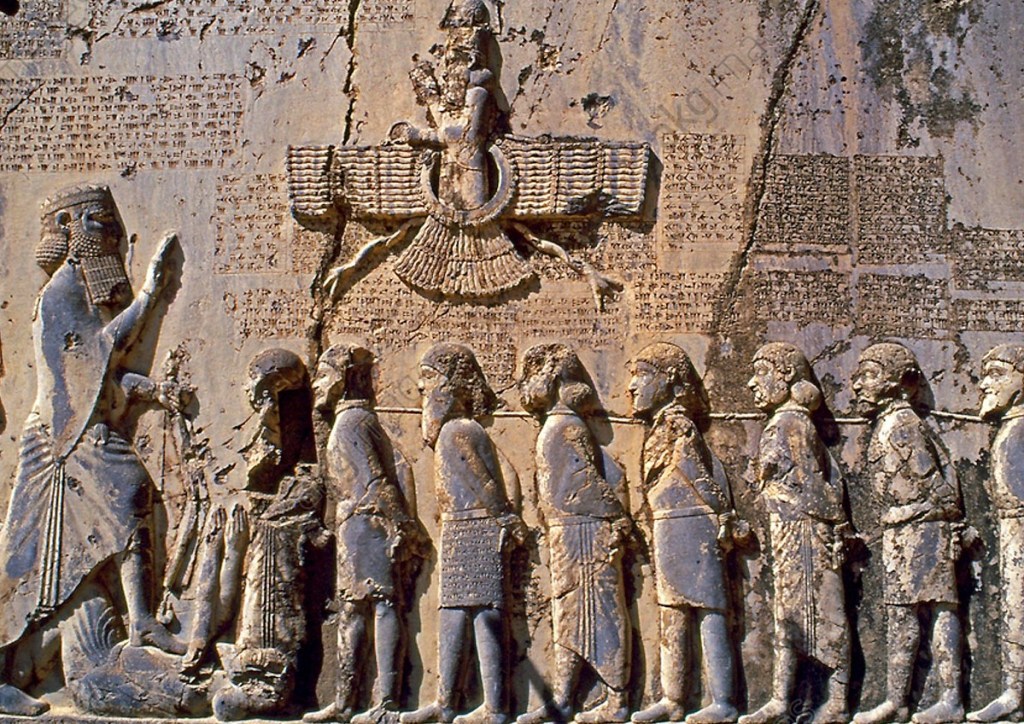
The most important source for the crisis is the Behistun Inscription, carved by Darius after he had secured the throne. It is both historical record and political argument. Darius describes Cambyses, Bardiya, Gaumata, the noble conspiracy, the killing of the impostor, and the rebellions that followed. He frames the entire crisis through the language of truth and the “Lie”. According to Darius, Gaumata rebelled on 11 March 522 BC, claiming to be Bardiya, and was killed by Darius and a small group of nobles on 29 September 522 BC.1
Behistun is indispensable, but it is not neutral. It is Darius’s defence of his own kingship, written after a violent seizure of power. It tells us what Darius wanted the empire to believe. This does not make it false, but it means every claim must be read with its political purpose in mind.
Herodotus gives a second major version. In his account, Cambyses secretly kills his brother Smerdis, the Greek name for Bardiya. While Cambyses is in Egypt, two Magian brothers exploit the secret: one of them resembles Smerdis and is placed on the throne. Cambyses hears of the revolt, understands too late what has happened, and dies on the return journey. Later, seven Persian nobles discover the deception and kill the false king.2
Herodotus’s version is vivid, but it too must be handled carefully. It contains dramatic speeches, court intrigue, symbolic accidents, and a famous constitutional debate among the conspirators after the coup. These elements make the story memorable, but they also show Greek narrative shaping. Herodotus is not simply reporting Persian archives; he is telling a political story for a Greek audience.
Ctesias, writing later from within the Persian court tradition, preserves a third and stranger version, with different names throughout. In his telling the Magus is called Sphendadates, the murdered brother is Tanyoxarces, and the killing is done in secret by forcing the victim to drink bull’s blood. Ctesias is often unreliable in detail, but his account is valuable precisely because it shows that no single, stable story of the crisis survived antiquity. Even the names could not be agreed upon.3
Babylonian documents add a further layer. They show that the man known in Persian sources as Bardiya or Gaumata was recognised in Babylonia and that his rule was not merely a rumour. Administrative and legal documents dated to his reign confirm that, whatever his identity, he functioned as king in parts of the empire. This is crucial. The crisis was not imaginary. The throne was occupied, documents were dated, and imperial business continued under the name of Bardiya.4
Together, these sources reveal the shape of the crisis. Darius gives ideology, Herodotus gives drama, Ctesias gives confusion, and Babylonian evidence gives chronology. None gives certainty.
The Shadow of Cyrus
The crisis after Cambyses cannot be understood without Cyrus. Cyrus had achieved what no Persian ruler before him had done. He defeated the Medes, conquered Lydia, entered Babylon, and created a new imperial order. His authority rested on victory, dynastic charisma, and the ability to present himself differently to different peoples.
But Cyrus also left behind the central problem of monarchy: succession. Cambyses, as king, possessed formal authority. Bardiya, as another son of Cyrus, possessed dynastic danger. Even if Bardiya was loyal, his existence mattered. A living brother of the king could become a focus for discontent among nobles, soldiers, provincial elites, or populations unhappy with Cambyses.
According to Darius, Cambyses killed Bardiya before departing for Egypt and kept the murder secret. This secrecy is the hinge of the whole story. If true, Cambyses removed a rival but created a political disaster: the empire still believed Bardiya was alive. If false, then Darius later invented the murder to explain why the man he killed was not really Cyrus’s son.5
Either way, Bardiya’s name carried enormous power. A claimant calling himself Bardiya was not claiming to be a minor prince. He was claiming to be the son of Cyrus.
Cambyses in Egypt: Victory and Distance
Cambyses’s conquest of Egypt in 525 BC was one of the great military achievements of the early empire. He defeated Psamtik III and brought Egypt under Persian rule. Yet this victory also placed him far from the Persian heartland at a dangerous moment.
Greek tradition portrays Cambyses in Egypt as increasingly unstable, impious, and cruel. Herodotus tells stories of sacrilege, family murder, irrational violence, and the killing of the Apis bull, though these stories are often shaped by Egyptian priestly hostility and Greek moral judgement.6 Modern scholarship has become more cautious. Cambyses was almost certainly not the cartoonish madman of later tradition, but the image of disorder attached itself to his memory because his reign ended in crisis.
Distance mattered more than madness. Cambyses was in Egypt when Gaumata or Bardiya took power. The king, the army, and the imperial centre of decision-making were separated by immense geography. Even with royal roads and messengers, communication took time. Rumour could outrun certainty.
The crisis began in the gap between imperial expansion and dynastic control. Cambyses had conquered Egypt, but in doing so he left the centre vulnerable.
Bardiya or Gaumata?
Darius’s version is clear. Cambyses killed Bardiya. Gaumata the Magian rebelled in Persia, claimed to be Bardiya, deceived the people, and seized the kingdom. Darius then destroyed the impostor and restored legitimate Achaemenid rule.7
Herodotus tells a similar story but makes it more theatrical. In his version, the deception depends on resemblance, palace secrecy, and the fear of those who know the truth. The Magian ruler is hidden from public view, and noble suspicion grows when Otanes learns through his daughter that the king lacks ears — a detail connected to an earlier punishment. This is almost certainly shaped by folktale and court gossip, but it captures one important idea: royal identity had to be verified through bodies, access, and witnesses.8
The central problem remains unresolved. Some scholars accept Darius’s account: Gaumata was a genuine impostor, and Darius restored the dynasty. Others argue that the man Darius killed may have been the real Bardiya, and that “Gaumata” was a propaganda invention used to justify a coup. The suspicion is not unreasonable. Darius was not a son of Cyrus. He benefited directly from the death of the man ruling as Bardiya. His inscription is a defence written by the victor.
Yet the impostor theory cannot simply be dismissed either. Several ancient traditions preserve some version of it, and the secrecy around Bardiya’s death makes the story plausible. The historian is left with a political truth even where personal identity remains uncertain: in 522 BC, the empire could not agree on who the king really was.
The Popular King?
One of the most interesting details in the sources is that the man ruling as Bardiya or Gaumata may have been popular. Herodotus says that when the Magian king died, all Asia mourned him except the Persians. He also claims the new ruler had granted relief from taxation and military service for three years.9 This may be Greek exaggeration, but it is too important to ignore.
Darius gives a different picture. In Behistun, Gaumata is a servant of the Lie who destroyed families, seized property, and threatened the proper order of the kingdom. Darius says he restored what Gaumata had taken away: pastures, herds, households, and cult places.10
These two accounts may preserve opposite sides of the same political reality. A ruler who reduced obligations for some groups might be remembered favourably by them but hated by Persian nobles whose privileges were threatened. If Gaumata or Bardiya weakened aristocratic control, redistributed property, or altered obligations, he could have gained broad support while provoking elite conspiracy.
This helps explain why the crisis was so dangerous. It was not simply a case of the “real” king versus a false one. It may also have been a struggle between royal centralisation, noble privilege, provincial interests, and popular relief. Behind the question of identity stood the question of who benefited from power.
The Problem of Secrecy
The crisis depended on secrecy. If Cambyses truly killed Bardiya and everyone knew it, no impostor could easily claim to be him. If Bardiya was alive, Darius’s later story required persuading the empire that he had been dead. In either case, information became power.
Ancient empires were vulnerable to uncertainty. News travelled by messenger, proclamation, letter, soldier, merchant, servant, and rumour. A king in Egypt could not instantly control what people in Persia, Media, Elam, or Babylonia believed. A royal death, a hidden murder, or a disputed identity could create a political space in which many versions of truth competed.
This is why Darius’s language of the “Lie” matters so much. In Behistun, rebellion is not merely disobedience. It is falsehood. Darius frames his struggle as a moral and cosmic battle between truth and lie, a theme that connects naturally to later Achaemenid ideas of royal legitimacy and asha.11
But Darius’s insistence also reveals anxiety. A claim carved in three languages on a mountain face is not casual record-keeping. It is persuasion on an imperial scale. Behistun was Darius’s answer to doubt.
The Death of Cambyses
Cambyses died while returning from Egypt, probably in Syria, though the details remain uncertain. Darius says only that Cambyses died “by his own death,” a phrase that has been interpreted in different ways. Herodotus gives a more dramatic version: Cambyses accidentally wounds himself in the thigh, recognises the fulfilment of an oracle, confesses the murder of Smerdis, and dies after warning the Persians against Median rule.12
The precise cause of death matters less than the political result. Cambyses was gone. He had no secure adult heir ready to command the empire. The throne was already claimed by the man known as Bardiya. The army, nobles, and provinces now had to decide where legitimacy lay.
Cambyses’s death transformed rebellion into succession. As long as Cambyses lived, the new ruler could be framed as a rebel against the reigning king. Once Cambyses died, the question changed. If the new king was Bardiya, he was the last surviving son of Cyrus. If he was Gaumata, he was the greatest impostor in Persian history.
The empire stood in suspense because the facts were hidden, distant, and dangerous to question.
The Seven and the Coup
According to Herodotus, the regime was overthrown by seven Persian nobles: Otanes, Intaphrenes, Gobryas, Hydarnes, Megabyzus, Aspathines, and Darius. Behistun also names Darius’s six helpers — Vidafarnā/Intaphrenes, Utāna/Otanes, Gaubaruva/Gobryas, Vidarna/Hydarnes, Bagabuxša/Megabyzus, and Ardumaniš — though its list differs from Herodotus by naming Ardumaniš instead of Aspathines.13
The story of the Seven is important because it shows that kingship did not rest on blood alone. The great Persian families mattered. A man could claim divine favour and Achaemenid descent, but he still needed armed support, court access, and noble recognition. Darius’s coup succeeded because he was not alone. The alliance also outlived the coup: Herodotus reports that the conspirators secured for themselves the permanent right to enter the king’s presence unannounced, and that the king would take his wives only from their families. The Seven thereby became a hereditary inner circle, and the crisis that made Darius king also fixed the shape of the Persian nobility around him.
Herodotus adds a famous constitutional debate after the killing of the Magian, in which the nobles discuss democracy, oligarchy, and monarchy. This debate is almost certainly Greek in form, but it serves an important narrative purpose. It asks what kind of government should follow tyranny and deception. The answer, of course, is monarchy — and Darius becomes king. Herodotus even records that the Persians long afterward kept a festival called the Magophonia, the “killing of the Magi,” on which no Magus was permitted to appear in public — a memory of the coup preserved as ritual.14
The coup itself was violent and narrow. Darius says he killed Gaumata at Sikayauvatiš in Media on 29 September 522 BC. The new king did not emerge from a peaceful coronation. He emerged from an armed attack inside a fortified place.15
Empire Without Certainty
Killing Gaumata did not end the crisis. It widened it. Darius soon faced revolts across the empire. Elam, Babylonia, Media, Persia, Armenia, Parthia, Margiana, Sagartia, and other regions appear in the Behistun narrative as centres of rebellion. Darius presents them all as eruptions of the Lie, and he summarises the whole struggle in a single startling boast: in one year he fought nineteen battles and captured nine rebel kings.16
The Babylonian revolt is especially revealing. A man named Nidintu-Bel claimed to be Nebuchadnezzar, son of Nabonidus, and seized power in Babylon. This was not a random name. It drew on Babylonian royal memory. Just as Bardiya’s name carried the charisma of Cyrus, Nebuchadnezzar’s name carried the memory of Babylonian kingship.17
Another rebel in Persia, Vahyazdata, also claimed to be Bardiya. This is one of the strongest signs that Bardiya’s identity remained politically explosive even after Darius killed Gaumata. If Darius had already settled the matter beyond doubt, why could another man successfully claim the same royal name? The answer is that the empire was still uncertain, and uncertainty was useful to rebels.18
The crisis after Cambyses therefore became a crisis of imperial truth. Every rebel, in Darius’s account, “lied” by claiming a royal identity. Every victory by Darius restored truth. This was not merely propaganda after the fact; it became the organising language of his reign.
Atossa and the Royal Women
The crisis also raises the question of royal women, especially Atossa. As daughter of Cyrus, sister of Cambyses and Bardiya, and later wife of Darius, Atossa stood at the centre of dynastic legitimacy. Her body, marriage, memory, and household connected competing reigns.
Greek traditions about Atossa must be read cautiously, but her political importance is clear. Darius’s marriage to her helped bind him to the house of Cyrus. He was an Achaemenid, but not a son of Cyrus. Atossa gave his kingship a more direct relationship to the founder’s bloodline.19
This does not mean Atossa was merely symbolic. Royal women in the Achaemenid world could possess estates, command resources, travel, and influence court politics. In a succession crisis, such women mattered because dynasty was not only inherited through men; it was also stabilised through marriage, motherhood, and household alliances.
Atossa herself stood inside the crisis, not beside it. If Bardiya was her brother, his overthrow was a family trauma. If Gaumata was an impostor, her brother’s name had been stolen and worn by a stranger. If Darius was a restorer, then the man who ended the crisis was also a husband whose rule had to be legitimised through her father’s house. She lived at the intersection of grief, danger, and political necessity — which is one reason her memory loomed so large in later Persian and Greek tradition alike.
Scholarly Discussion: Usurper or Restorer?
The central debate remains unresolved: did Darius kill an impostor, or did he kill the real Bardiya?
The traditional view follows Darius and Herodotus. Cambyses murdered Bardiya; Gaumata impersonated him; Darius and the Persian nobles killed the impostor and restored legitimate rule. This version has the strength of ancient testimony and explains why Darius made truth and falsehood central to his kingship.
The revisionist possibility is that Bardiya survived Cambyses, took the throne, and was later overthrown by Darius. In this reading, “Gaumata the Magian” was the ideological mask Darius placed over a royal murder. Darius’s repeated insistence on the Lie would then be not proof of truth, but the language needed to make a coup acceptable.
Darius’s own genealogy deepens the suspicion. He traced his line not to Cyrus but to a supposed common ancestor, Achaemenes, through a separate branch descending from Ariaramnes and Arsames. Many scholars suspect that Darius emphasised — and perhaps largely constructed — this “Achaemenid” family identity to bind himself to Cyrus after the fact; there is little sign that Cyrus’s own house had described itself that way before Darius. If so, the very name we give the dynasty may be part of Darius’s legitimising project rather than a neutral fact.20
A balanced position must admit uncertainty. Darius had every reason to shape the story. Herodotus wrote later and from outside Persia. Babylonian documents confirm rule under the name Bardiya but cannot reveal the ruler’s body. Ctesias and later authors complicate rather than solve the problem.
What is beyond doubt is the consequence. Darius came to power through violence and then had to persuade the empire that his violence had restored order. Behistun is therefore not simply the report of a victory. It is the foundation document of a reign born in suspicion.
Interpretation and Significance: Darius’s Second Foundation
The crisis after Cambyses marks the dividing line between conquest and consolidation. Cyrus created the empire. Cambyses expanded it. Darius had to make it governable after legitimacy had nearly collapsed.
Darius did this through several strategies. He defeated rebels militarily. He carved his version of events at Behistun. He used the language of truth against the Lie. He married into Cyrus’s line. He reorganised imperial administration. He made kingship appear not only inherited but divinely supported, morally justified, and administratively effective.
This is why the crisis matters far beyond the identity of Bardiya or Gaumata. It forced the Achaemenid Empire to develop a stronger ideology of rule. After 522 BC, kingship could not rest only on the memory of Cyrus. It needed inscriptions, rituals, noble alliances, royal marriages, satrapal order, and the constant performance of legitimacy.
In this sense, Darius was not merely the successor of Cyrus. He was the empire’s second founder — though the violence of that founding would echo forward, as later Achaemenid successions repeatedly turned on murder, secrecy, and disputed identity.
Conclusion: Persia Without Certainty
The crisis after Cambyses was the moment when the Achaemenid Empire almost lost the line of Cyrus. A dead king, a hidden or disputed brother, a ruler whose identity could not be trusted, and an ambitious noble coalition brought the empire to the edge of fracture.
For a few dangerous months, Persia was not without a ruler in the literal sense. Someone sat on the throne. Documents were dated. Orders were given. But Persia was without certainty. It did not know whether the man ruling was the son of Cyrus or a man wearing his name.
Out of that uncertainty came Darius. His victory did not simply end a crisis; it created a new language of kingship. Truth, lie, divine favour, royal blood, noble support, and imperial order became the foundation stones of his reign.
The empire Cyrus built survived Cambyses. But it was the crisis after Cambyses that forced Persia to decide what kingship meant when blood, memory, and truth no longer pointed clearly to the same man.
From History to Story: Princess of Pasargadae
The crisis after Cambyses is not only a scholarly puzzle; it is a human one. Where the sources fall silent — on what was hidden, who was truly killed, and what the women of Cyrus’s house knew — history leaves a space that only imagination can enter. The historical novel Princess of Pasargadae takes up this very mystery. Told through the eyes of Atossa — daughter of Cyrus, sister of Cambyses and Bardiya, and later wife of Darius — it follows the disputed succession from inside the royal family and offers one possible solution to the Bardiya–Gaumata question. That solution is imaginative rather than academic, and it makes no claim to proof. But by giving the puzzle a shape and a face, the book hopes to reopen questions that formal scholarship has left closed, and perhaps to point future researchers toward paths still worth exploring.
References
Briant, Pierre. From Cyrus to Alexander: A History of the Persian Empire. Translated by Peter T. Daniels. Eisenbrauns, 2002.
Brosius, Maria. Women in Ancient Persia, 559–331 BC. Clarendon Press, 1996.
Darius I. The Behistun Inscription. Various editions and translations.
Herodotus. The Histories. Various translations.
Justin. Epitome of the Philippic History of Pompeius Trogus. Various translations.
Kuhrt, Amélie. The Persian Empire: A Corpus of Sources from the Achaemenid Period. Routledge, 2007.
Root, Margaret Cool. The King and Kingship in Achaemenid Art: Essays on the Creation of an Iconography of Empire. Brill, 1979.
Waters, Matt. Ancient Persia: A Concise History of the Achaemenid Empire, 550–330 BCE. Cambridge University Press, 2014.
Wiesehöfer, Josef. Ancient Persia. I.B. Tauris, 1996.
Ctesias. Persica (fragments). In Jan P. Stronk, Ctesias’ Persian History. Wellem, 2010.
Encyclopaedia Iranica. “Bardiya.”
Encyclopaedia Iranica. “Cambyses.”
Encyclopaedia Iranica. “Gaumāta.”
Encyclopaedia Iranica. “Darius iii. Darius I the Great.”
Livius. “Darius’ Coup.”
Livius. “Gaumata / Smerdis.”
Livius. “Capture of Babylon.”
Footnotes
- Darius I, Behistun Inscription, Column I; Pierre Briant, From Cyrus to Alexander; Livius, “Darius’ Coup.” ↩︎
- Herodotus, Histories 3.61–88; Amélie Kuhrt, The Persian Empire. ↩︎
- Ctesias, Persica (fragments), in Jan P. Stronk, Ctesias’ Persian History; on the divergent name-traditions see Briant, From Cyrus to Alexander. ↩︎
- Babylonian legal and administrative documents dated to Bardiya’s reign; see Kuhrt, The Persian Empire; Pierre Briant, From Cyrus to Alexander; Encyclopaedia Iranica, “Bardiya.” ↩︎
- Behistun Inscription, Column I; Encyclopaedia Iranica, “Bardiya.” ↩︎
- Herodotus, Histories Book 3; on the hostile traditions around Cambyses, see Matt Waters, Ancient Persia, and Encyclopaedia Iranica, “Cambyses.” ↩︎
- Behistun Inscription, Column I, sections concerning Cambyses, Bardiya, Gaumata, and the Lie. ↩︎
- Herodotus, Histories 3.68–69; on the narrative problems in Herodotus, see Briant, From Cyrus to Alexander. ↩︎
- Herodotus, Histories 3.67; Pierre Briant, From Cyrus to Alexander. ↩︎
- Behistun Inscription, Column I; Encyclopaedia Iranica, “Gaumāta.” ↩︎
- Behistun Inscription; for the ideological language of truth and lie, see Briant, From Cyrus to Alexander; Root, The King and Kingship in Achaemenid Art. ↩︎
- Behistun Inscription; Herodotus, Histories 3.64–66; Encyclopaedia Iranica, “Cambyses.” ↩︎
- Herodotus, Histories 3.70–79; Behistun Inscription, Column IV, naming Darius’s helpers. ↩︎
- Herodotus, Histories 3.84 (the privileges secured by the conspirators) and 3.79 (the Magophonia festival). ↩︎
- Behistun Inscription, Column I; Livius, “Darius’ Coup.” ↩︎
- Behistun Inscription, Column IV, §52 (the summary of nineteen battles and nine captured kings); Pierre Briant, From Cyrus to Alexander. ↩︎
- Behistun Inscription, Column I–II; Livius, “Capture of Babylon”; Encyclopaedia Iranica, “Babylonia i.” ↩︎
- Behistun Inscription, Column III; Encyclopaedia Iranica, “Bardiya.” ↩︎
- Maria Brosius, Women in Ancient Persia, 559–331 BC; Herodotus, Histories 3.88; Pierre Briant, From Cyrus to Alexander. ↩︎
- On Darius’s genealogy and the Achaemenid eponym see Pierre Briant, From Cyrus to Alexander; Matt Waters, Ancient Persia; Josef Wiesehöfer, Ancient Persia. ↩︎


Leave a Reply