
Weights, Land, Roads, and the Numerical Order of Achaemenid Rule
Introduction: The Empire of Counted Things
The Achaemenid Empire was built not only by kings, armies, roads, and inscriptions, but also by numbers. Grain had to be measured, silver weighed, land assessed, roads counted in stages, palaces built to plan, taxes calculated, workers paid, animals rationed, canals maintained, and tribute converted into standard units of value. Without measurement, empire becomes guesswork. With measurement, command becomes administration.
This article is not about mathematics in the modern classroom sense. We do not possess an Achaemenid Persian treatise on geometry, algebra, or arithmetic, and the surviving evidence does not show Persian scholars writing mathematical theory the way Babylonian scribes had done for centuries. Instead, it shows mathematics as a practical language of rule. The Persians inherited the numerical cultures of Babylonia, Elam, Egypt, and Lydia and used them to govern a vast imperial system.
The central question is therefore not “Did the Persians invent mathematics?” but “How did mathematics and measurement help the Achaemenid Empire function?” The answer lies in scribes, weights, measures, coins, cadasters, construction, irrigation, roads, and archives. Mathematics was not separate from government. It was one of government’s hidden tools.
The Evidence: Where Numbers Survive
The evidence for Achaemenid mathematics is scattered across administrative and material sources. The Persepolis Administrative Archives — the Fortification Archive and the Treasury Archive — preserve the practical arithmetic of the Persian heartland, recording rations, work groups, silver payments, foodstuffs, livestock, storehouse transfers, and official allocations.
Babylonia provides another major body of evidence, since Babylonian scribes continued to write contracts, temple accounts, business records, and astronomical texts under the Achaemenids. The Egibi and Murašû archives, along with the Eanna and Ebabbar temple records, reveal a world of loans, leases, land, tax obligations, interest, and accounting. Greek sources add a different perspective: Herodotus gives a famous list of tribute assessments under Darius, expressed in talents of silver, that reveals a Greek awareness of how far Achaemenid rule depended on quantified obligation.1 Material culture matters too — inscribed weights, coins, measuring vessels, foundation deposits, and monumental architecture all show measurement at work. Darius’s palace inscription from Susa, DSf, records materials and craftsmen drawn from across the empire, a coordination that required planning, transport, standardisation, and calculation.2 Together these sources show mathematics not as abstract speculation but as imperial practice.
Babylonian Inheritance: The Older Science of Number
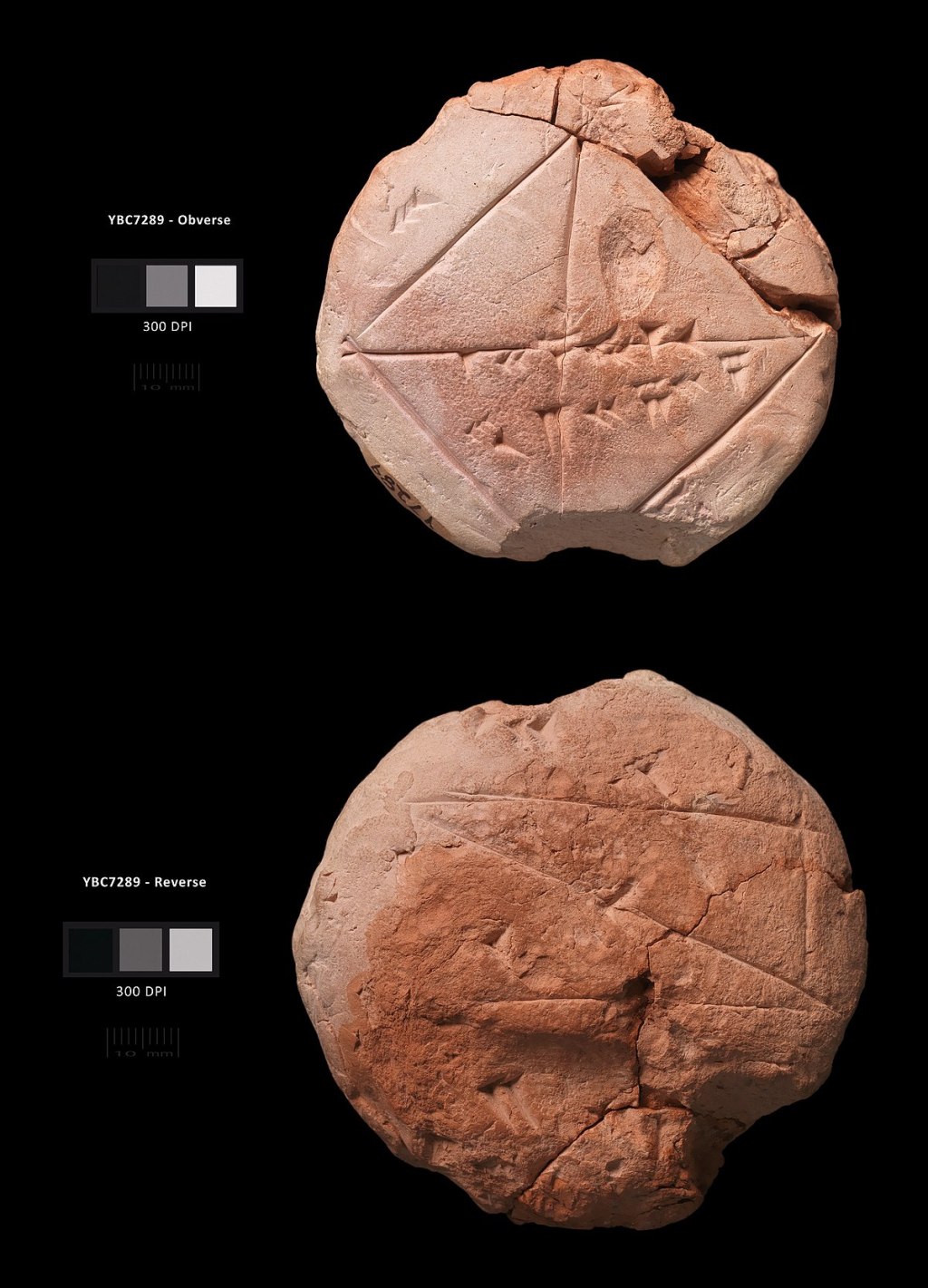
The Persians entered a world where mathematics was already ancient. Babylonia had long traditions of arithmetic, accounting, metrology, geometry, astronomy, and scribal education, using sexagesimal (base-60) calculation, tables, and sophisticated systems of weights and measures. That base-60 habit still shapes the world: it survives in the sixty minutes of an hour and the three hundred and sixty degrees of a circle, and it structured the very units the empire weighed its silver in.
Achaemenid rule did not abolish this knowledge; it used it. Babylonian legal and economic documents continued in cuneiform, and temples and business families still calculated silver, barley, land, labour, and interest — most loans of silver running at a standard rate of about twenty per cent a year, a figure that turned every debt into a running calculation and every bad harvest into a spiral. The Murašû Archive from Nippur shows a fifth-century world of leases, fields, tax obligations, livestock, equipment, payments, and agents; behind every contract stood arithmetic.3 The empire did not need to create mathematical knowledge centrally. It inherited regional expertise — Babylonian scribes who could calculate interest and manage estates, Egyptian scribes skilled in land measurement, Lydian traditions of coinage and metal exchange, and Elamite scribes recording royal administration in the heartland — and connected these systems to royal rule.
Weights: Shekel, Mina, Talent, and Karša
Weight was one of the foundations of ancient economy. Silver, gold, tribute, and precious objects were all weighed, and even coins were trusted partly because they represented standard weights of metal. The older Mesopotamian system centred on the shekel, the mina (sixty shekels), and the talent (sixty minas) — itself a base-60 structure — though local standards varied. In Achaemenid contexts the Old Persian karša was especially important as a royal weight unit.
Inscribed Achaemenid weights associated with Darius show deliberate attempts at standardisation. One famous example in the British Museum is marked as two karša and weighs about 166.7 grams, implying a karša of roughly 83.3 grams and a shekel of about 8.33 grams — close to the weight of the gold daric.4 Such numbers may seem dry, but they were politically powerful. A standard weight is a promise of authority: when a merchant, treasurer, or tax official weighed silver “according to the stone of the king,” royal power entered the transaction, and measurement became trust. Weights also protected the state, because tribute assessed in silver could not be left to local guessing; standard units helped turn the diverse wealth of Egypt, Babylonia, Lydia, Media, and Bactria into comparable imperial accounting.
Coins: Daric, Siglos, and Measured Metal
Coinage added another layer. Darius I is usually associated with the imperial gold daric and silver siglos, coins carrying the image of the royal archer; the daric weighed about 8.4 grams of gold, close to the Babylonian shekel standard, and the siglos about 5.6 grams. Coinage did not replace weighed silver everywhere, but it offered a more portable and recognisable form of royal value.5
Its use was uneven. In Babylonia, weighed silver remained central to many contracts; in western Anatolia and the Aegean world, coinage played a larger role. The Achaemenid economy was not a single modern monetary system but a layered world where coins, weighed metal, goods, rations, credit, and payment in kind coexisted. Still, a coin was measured metal carrying royal imagery — value that depended on weight, purity, recognition, and trust, with the archer marking it as part of the king’s order. For merchants in markets and caravans, a gold daric, a silver siglos, weighed silver, a local coin, and a Babylonian contract might all appear in the same transaction, and a good merchant had to know how to compare them.
Measures of Grain, Wine, and Rations
Measurement was not limited to metal. Grain, flour, wine, beer, oil, dates, fruit, livestock, and fodder all moved through the imperial economy, and the Persepolis Fortification Archive is filled with this world of measured provisions issued to workers, travellers, officials, women, children, and animals. Such records required units of dry and liquid capacity: the Babylonian logogram QA appears in the Persepolis material as a measure connected to a vessel of roughly one litre, though exact values remain debated.6
This kind of measurement shaped daily life. A worker’s ration was not an abstract number but food; a traveller’s allocation could decide whether a journey was possible; an animal’s fodder affected transport and military movement; and a storehouse official who miscounted grain could create hunger, suspicion, or accusation. Ration systems also expose social hierarchy, since men, women, children, skilled workers, officials, and animals received different quantities. The mathematics of the archive therefore reveals the social structure of the empire — who was valued, how labour was organised, and how the state fed those under its control.
Land, Taxation, and the Measured Field
Land measurement was central to taxation. Herodotus says Darius organised tribute from the provinces and assessed payments by region, most subject peoples paying silver and some providing goods such as horses, grain, or gold dust; he totals the annual tribute at over fourteen thousand talents of silver, a figure that, however rough, conveys the scale of quantified obligation. Later scholarship connects Achaemenid taxation with cultivated land, fertility, cadasters, and average harvest yields.7
A cadaster is a register of land — who holds it, where its boundaries lie, what it produces, and what obligations attach to it. Such records are unglamorous but essential to fiscal rule: to tax land, one must first know where it is, how large it is, who works it, and what it can yield. Babylonia again gives the clearest evidence, with estates, temple lands, royal lands, military holdings, and private plots recorded through legal documents; the Murašû Archive shows land leased, subleased, managed, taxed, and tied to service obligations — a system requiring not only writing but measurement. In Egypt, where the Nile could flood, shift, and renew fields, Egyptian scribal traditions had long experience measuring land for agriculture and tax, expertise Persian rule inherited. The empire measured land not as a neutral exercise but as a way to transform soil into obligation.
Roads, Distance, and Imperial Space
The Royal Road from Sardis to Susa, described by Herodotus, shows another form of measurement: distance. Herodotus gives stages, parasangs, and travel time, presenting the road as a measured imperial corridor; whether or not every figure is exact, the empire clearly understood itself through routes that could be counted.8 The parasang — a Persian measure of roughly an hour’s march, conventionally about thirty stades — became one of the ways outsiders imagined Persian space, and Xenophon uses it repeatedly in the Anabasis to record the march of the Ten Thousand through Persian territory.
Distance mattered because administration moved through space. Couriers needed stations, armies needed provisions, satraps needed communication, and merchants needed estimates. A journey from Sardis to Susa was not merely “far”; it could be broken into stages, days, river crossings, and supply points — geography turned into a schedule.
Architecture, Geometry, and Royal Construction
Achaemenid architecture required measurement at a grand scale. The terrace of Persepolis, the Apadana, the palaces of Susa, columned halls, staircases, gates, drainage systems, and foundation deposits all depended on planning, proportion, geometry, and labour coordination. The Persepolis terrace alone required levelling, stone cutting, drainage, retaining walls, stairways, and the careful placement of buildings against the mountain. Even without the architects’ calculations, the architecture itself testifies to measurement — and to a standard unit of length: Herodotus notes a “royal cubit” slightly longer than the common cubit, the kind of official standard by which such buildings were laid out.9
Darius’s DSf inscription from Susa gives a vivid sense of the organisational scale behind royal construction, listing materials and workers from across the empire: cedar from Lebanon, timber from Gandhara and Carmania, gold from Sardis and Bactria, lapis lazuli and carnelian from Sogdia, silver and ebony from Egypt, ivory from Ethiopia, India, and Arachosia, and craftsmen from many lands. It is not a mathematical text, but it describes a mathematical achievement: materials counted, transported, shaped, fitted, and allocated; bricks and tiles with dimensions; columns with proportions; foundations with depth. The palaces show mathematics without numbers on their walls — measurement present in every aligned column, fitted stone, and planned courtyard.
Irrigation, Qanats, and Practical Engineering
Water management was another field where measurement mattered. The Iranian plateau required careful handling of water through canals, wells, reservoirs, and qanats — underground channels that bring water from higher ground to fields and settlements, requiring knowledge of slope, distance, soil, ventilation shafts, and labour organisation. The Achaemenids did not invent every form of irrigation they used; they inherited older Near Eastern, Elamite, Mesopotamian, and Egyptian hydraulic traditions. Yet Persian rule helped extend and coordinate water management, and some scholarship connects Achaemenid expansion with the spread of qanats in parts of the empire, including Oman and southeastern Arabia, though the evidence varies by region.10
Irrigation shows mathematics as survival. If a channel’s slope is wrong, water stagnates or rushes destructively; if a field is mismeasured, tax and yield are distorted; if labour is badly counted, canals fail. Engineering depends on calculation even when no formula survives, and for farmers and officials alike, water was counted in time, distance, labour, and share.
Treasuries and Accounting
Treasuries were places where mathematics became power. The royal treasuries at Persepolis, Susa, Babylon, Ecbatana, and Pasargadae received, stored, issued, and recorded wealth in silver, gold, textiles, vessels, and rations. The Persepolis Treasury Tablets are especially important because they show payments to workers and craftsmen and the partial transition from payment in kind to payment in silver — not a cash economy across the whole empire, but a royal economy able to use multiple forms of payment and accounting at once.11
A treasury official needed to know weight, purity, quantity, recipient, date, and authorisation; a mistake could be costly and a dishonest record could become corruption, so a seal, tablet, weight, and witness together secured each transaction. Treasury mathematics also shaped imperial ideology, because the king’s generosity in gifts, banquets, building projects, and military rewards depended on accumulated and measured wealth. Luxury was not only display. It was accounted display.
Scholarly Discussion: Mathematics or Administration?
The main scholarly problem is terminology. If “mathematics” means abstract theoretical writing, the Achaemenid Persian evidence is limited: Babylonian mathematics existed under Persian rule, but as the continuation of an older Mesopotamian tradition, and we should not claim that the Persians created a distinct mathematical school comparable to the Babylonian or Greek. If, however, mathematics means practical calculation — measurement, standardisation, accounting, surveying, weighing, and planning — then the Achaemenid Empire was deeply mathematical, because it could not function otherwise. Its mathematics lived in archives, treasuries, roads, buildings, fields, and storehouses.
This distinction prevents exaggeration while still recognising the intelligence of Persian administration. The Persians were not passive inheritors; they used inherited systems at imperial scale. The result was a numerical empire without a surviving Persian mathematics textbook.
Conclusion: The Hidden Arithmetic of Empire
Measurement turned diversity into administration. The empire’s peoples spoke many languages, produced different goods, and lived in different landscapes; standard weights, assessed tribute, measured land, dated documents, road stages, and treasury accounts made that diversity governable. Measurement created both trust and conflict — a fair weight could support trade while a false one provoked dispute, a measured field could stabilise taxation while also exposing people to heavier obligation, a coin could simplify exchange while symbolising royal control. Numbers were never neutral, and the Achaemenid genius lay in binding them to monarchy: the king’s order appeared in the karša, the daric, the tribute list, the treasury tablet, the road station, the palace foundation, and the ration account. The empire counted because the king ruled.
The Persians inherited older numerical traditions from Babylonia, Egypt, Elam, and Lydia, and their achievement was to use those traditions across an empire of extraordinary scale — not one uniform mathematical culture, but systems that could translate local wealth, labour, land, and distance into imperial order. Mathematics and measurement weighed the silver, valued the tribute, assessed the land, planned the palaces, supplied the workers, coordinated the roads, managed the water, and recorded the royal economy. Persia was not ruled by numbers alone. But without numbers, it could not have been ruled.
References
Briant, Pierre. From Cyrus to Alexander: A History of the Persian Empire. Translated by Peter T. Daniels. Eisenbrauns, 2002.
Cameron, George G. Persepolis Treasury Tablets. Oriental Institute Publications 65. University of Chicago Press, 1948.
Curtis, John, and Nigel Tallis, eds. Forgotten Empire: The World of Ancient Persia. British Museum Press, 2005.
Dandamaev, Muhammad A., and Vladimir G. Lukonin. The Culture and Social Institutions of Ancient Iran. Cambridge University Press, 1989.
Darius I. DSf inscription from Susa. Various editions and translations.
Hallock, Richard T. Persepolis Fortification Tablets. Oriental Institute Publications 92. University of Chicago Press, 1969.
Herodotus. The Histories. Various translations.
Jursa, Michael. Studies on first-millennium Babylonian economic history.
Stolper, Matthew W. Entrepreneurs and Empire: The Murašû Archive, the Murašû Firm, and Persian Rule in Babylonia. Nederlands Instituut voor het Nabije Oosten, 1985.
Xenophon. Anabasis. Various translations.
Encyclopaedia Iranica. “Ābyārī.”
Encyclopaedia Iranica. “Achaemenid Dynasty ii. The Empire.”
Encyclopaedia Iranica. “Achaemenid Taxation.”
Encyclopaedia Iranica. “Babylon under the Achaemenids.”
Encyclopaedia Iranica. “Coins and Coinage.”
Encyclopaedia Iranica. “Daric.”
Encyclopaedia Iranica. “Economy iii. In the Achaemenid Period.”
Encyclopaedia Iranica. “Persepolis Elamite Tablets.”
Encyclopaedia Iranica. “Susa iii. The Achaemenid Period.”
Encyclopaedia Iranica. “Weights and Measures i. Pre-Islamic Period.”
Livius. “Darius’ Weights.”
Livius. “DSf.”
Footnotes
- Herodotus, Histories 3.89–97; Encyclopaedia Iranica, “Achaemenid Taxation”; Pierre Briant, From Cyrus to Alexander. ↩︎
- Darius I, DSf inscription from Susa; Encyclopaedia Iranica, “Susa iii. The Achaemenid Period”; Livius, “DSf.” ↩︎
- Matthew W. Stolper, Entrepreneurs and Empire; Michael Jursa, studies on first-millennium Babylonian economy (including the standard c. 20 per cent annual interest on silver loans); Encyclopaedia Iranica, “Babylon under the Achaemenids.” ↩︎
- Encyclopaedia Iranica, “Weights and Measures i. Pre-Islamic Period”; Livius, “Darius’ Weights”; Dandamaev and Lukonin, The Culture and Social Institutions of Ancient Iran. ↩︎
- Encyclopaedia Iranica, “Daric”; Encyclopaedia Iranica, “Coins and Coinage”; Pierre Briant, From Cyrus to Alexander. ↩︎
- Richard T. Hallock, Persepolis Fortification Tablets; Encyclopaedia Iranica, “Weights and Measures i. Pre-Islamic Period”; Matthew W. Stolper, “Persepolis Administrative Archives.” ↩︎
- Herodotus, Histories 3.89–97 (the tribute total at 3.95); Encyclopaedia Iranica, “Achaemenid Taxation” and “Economy iii. In the Achaemenid Period.” ↩︎
- Herodotus, Histories 5.52–54; Xenophon, Anabasis (the march measured in parasangs); Pierre Briant, From Cyrus to Alexander. ↩︎
- Darius I, DSf inscription; Herodotus, Histories 1.178 (the royal cubit); Encyclopaedia Iranica, “Susa iii. The Achaemenid Period”; John Curtis and Nigel Tallis, eds., Forgotten Empire. ↩︎
- Encyclopaedia Iranica, “Ābyārī”; Pierre Briant, From Cyrus to Alexander. ↩︎
- George G. Cameron, Persepolis Treasury Tablets; Encyclopaedia Iranica, “Persepolis Elamite Tablets”; Encyclopaedia Iranica, “Achaemenid Dynasty ii. The Empire.” ↩︎


Leave a Reply