
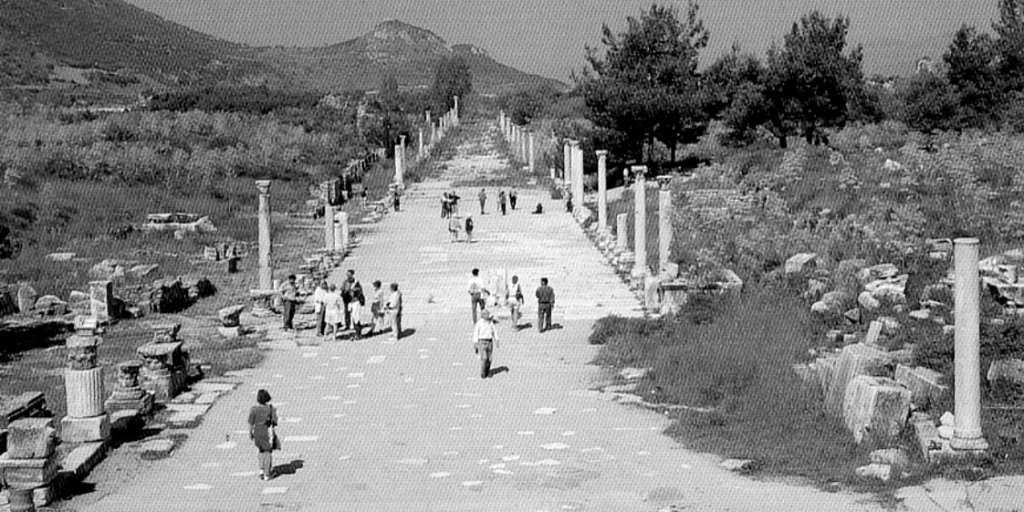
Part I followed the empire’s goods along its roads, into its cities and markets, and through the hands of its merchants and moneylenders. This second part turns from the machinery of exchange to the people who worked it — the languages they bargained in, the hidden labour that moved every load, the frontier and maritime routes that stretched the empire east and south, and the risks, laws, and identities that trade set in motion.
Languages of the Market
Achaemenid markets were multilingual. Old Persian was the language of royal inscriptions, but it was not the everyday commercial language of the empire. Elamite, Babylonian, Aramaic, Egyptian, Greek, Lydian, Phrygian, and many Iranian and local languages all existed within imperial space. Aramaic, a Semitic language that originated in the Levant and had spread widely across the Near East before the rise of the Achaemenids, was especially important as an administrative and communicative language across many regions.
A merchant moving between Babylon and Susa might need different linguistic skills from one trading between Sardis and Greek coastal cities. A caravan from Bactria would pass through Iranian-speaking regions but might meet Elamite scribes, Aramaic documents, Babylonian traders, and Persian officials. Language shaped profit. The person who could translate, read documents, or speak with officials had power.
Weights and measures also formed a kind of language. A deal required agreement about quantity, quality, and value. How much grain? What kind of silver? Which weight standard—Babylonian shekels and minas, Egyptian deben, or Persian karsha? How many animals? What condition? Who witnesses? Who guarantees? Where is delivery? What penalty applies? Every transaction had to turn trust into form.
Seals helped answer these questions. A seal impression could identify a person, office, household, or authority. In an age before signatures in the modern sense, seals were essential to administration and business. They linked identity to clay, jar, door, tablet, or container. A sealed document could travel farther than a spoken promise. Among the most commonly used were cylinder seals, which were rolled across wet clay to create continuous scenes; stamp seals, which pressed a single image or symbol; and administrative seals bearing royal names, official titles, or divine imagery. These designs often included animals, mythological figures, or inscriptions that made each seal distinctive and recognisable.
In the market, therefore, literacy was not only reading. It was the ability to understand seals, marks, weights, coins, gestures, languages, reputations, and rules. A good merchant had to read people as well as documents.
Women, Labour, and the Hidden Economy
Market life was not only male. The evidence for women in Achaemenid commerce is uneven, but women appear in economic records, especially in relation to labour, rations, estates, family property, and royal or elite households. The Persepolis Fortification Tablets show women workers and women of rank within the administrative economy. Babylonian documents also show women participating in property and family transactions, though their roles varied by region and status.1
Women may have appeared in markets as buyers, sellers, household managers, textile workers, food preparers, brewers, servants, estate representatives, or members of trading families. In many ancient societies, textile production was deeply connected to women’s labour. Cloth was not merely domestic; it was economic. Wool, linen, weaving, dyeing, repair, and garment production linked households to wider exchange.
The hidden economy also included porters, animal handlers, servants, cooks, guards, inn workers, water carriers, boatmen, scribal assistants, and labourers. Merchants are often remembered because they left contracts, but the movement of goods depended on many people whose names rarely survive.
A caravan required people to load animals, repair harnesses, find water, cook, guard, negotiate, interpret, and care for the sick. A market required cleaners, measurers, carriers, makers, and watchers. A royal storehouse required scribes, sealers, guards, accountants, and labourers. The economy was not only the person who owned the goods. It was the entire chain of hands that moved them.
This matters for the social imagination of the empire. The Achaemenid economy was not an abstract system. It was bodies carrying sacks, women grinding grain, scribes pressing seals, boys leading donkeys, men arguing over silver, servants buying oil, guards watching gates, and animals sweating under loads.
Roads to the East: India, Bactria, Sogdia, and Beyond
The eastern side of the empire connected Persia to Central Asia and the Indus region. These routes are harder to reconstruct than the famous Sardis-Susa road, but they were vital. Bactria, Sogdia, Arachosia, Gandhara, and the Indus lands linked the empire to horses, precious materials, mountain routes, river systems, and eastern trade.
The Achaemenid presence in the Indus region is debated in detail, but Persian inscriptions include eastern lands among the king’s territories, and Greek sources associate India with gold and tribute. Whether every claim is straightforward or exaggerated, the larger point remains: the Achaemenid court imagined its empire as reaching toward the far east, and eastern goods had a place in imperial wealth.
Bactria and Sogdia were not merely frontiers of war. They were corridors of exchange. Horses, textiles, stones, metalwork, animal products, and steppe goods could move through these regions. Merchants, soldiers, migrants, and officials all contributed to cultural contact. These eastern roads would later form part of the broader Silk Road world, but they already mattered in the Achaemenid period as routes of empire.
For a traveller from the Persian heartland, the eastern roads would have felt different from the road to Babylon or Sardis. The distances were vast, climates harsh, and cultural transitions sharp. Mountain passes, desert edges, fortified settlements, river crossings, and steppe contacts created a world of risk and opportunity.
Such routes are especially useful for understanding the empire as more than a western-facing power. Persia did not only look toward Greece. It looked east, south, and north as well. Merchant life reminds us of that wider geography.
Persian Gulf and Maritime Trade
The Achaemenid Empire was also connected by water. The Persian Gulf linked southern Mesopotamia, Elam, Arabia, and the Iranian coast with wider maritime routes. Rivers such as the Tigris, Euphrates, Nile, and Karun mattered enormously for transport, because bulk goods often moved more efficiently by water than by land.
In the western part of the empire, the Mediterranean Sea also played a role, especially along the coasts of Egypt, Phoenicia, and the Levant. The Persians did not rely on the Mediterranean as a single continuous highway from Egypt to the eastern provinces of the empire. Instead, goods from Egypt could move by sea along the eastern Mediterranean coast—through ports such as those in Phoenicia—and then continue inland by road toward Syria, Mesopotamia, and beyond. Phoenician cities, with their long maritime traditions, were especially important in this system, providing ships, sailors, and coastal transport.
Darius I is also associated with the canal linking the Nile to the Red Sea, but he did not originate the idea. Earlier Egyptian rulers, possibly as far back as the Middle Kingdom and certainly under Necho II in the 6th century BC, had already begun such a project. Darius ordered the canal to be cleared, extended, and completed, as confirmed by inscriptions found along its route. His work made the waterway navigable again, allowing ships to travel between the Nile and the Red Sea, and reflecting Achaemenid interest in connecting imperial regions by both land and sea.2
Maritime trade involved different people from overland caravans: sailors, pilots, shipwrights, dock workers, harbour officials, fishermen, merchants, interpreters, and guards. Goods moved in jars, sacks, bundles, baskets, and sealed containers. Aromatics, textiles, grain, wine, oil, timber, metals, stone, and luxury goods could all pass through riverine and maritime systems.
The Persian Gulf should not be treated as peripheral. It was one of the empire’s southern corridors. Through it, the Iranian plateau could connect to Mesopotamia, Arabia, and the Indian Ocean world. Major ports such as Siraf, however, belong to a later period, flourishing especially under the Sasanian Empire rather than the Achaemenids. Even so, the geographic importance of the Persian Gulf was already clear in earlier times.
For world-building, ports and river markets offer scenes very different from inland caravan roads. There are docks, mudbrick warehouses, reed boats, sea-going vessels, fish smells, foreign sailors, officials counting goods, and rumours arriving from places no courtier has seen.
Risk, Law, and Protection
Trade required protection. Roads could be threatened by bandits, rebels, corrupt officials, harsh weather, disease, animal loss, and political instability. A caravan might lose profit through robbery, broken wheels, dead animals, spoiled goods, unpaid debts, or sudden military requisition. Merchants had to calculate not only price but danger.
Imperial authority could reduce some risks. Roads, garrisons, satrapal administration, royal stations, and legal systems made movement more predictable. The king’s peace was economically valuable. A road watched by royal power was safer than a road controlled by local raiders. A contract enforceable before officials was better than a promise in a camp.
But imperial authority could also create burdens. Taxes, tolls, requisitions, military needs, and official corruption could all affect trade. A merchant might welcome order but fear officials. The same state that protected the road could demand animals, grain, labour, or payment.
Legal documents helped manage risk. Babylonian contracts record obligations, witnesses, seals, penalties, and terms. Such documents transformed uncertain relationships into enforceable claims. They also created archives. A business family’s strength lay partly in memory: who owed what, under which conditions, before which witnesses.
Trust and law therefore worked together. A merchant wanted friends, family, patrons, and documents. In a multi-ethnic empire, reputation could travel through networks. A known house, a trusted agent, or a reliable seal might open doors that language alone could not.
Markets and Imperial Identity
Markets did not simply move goods. They moved identity. A person entering a large Achaemenid market might see Persian officials, Babylonian scribes, Elamite workers, Median horsemen, Lydian traders, Egyptian cloth, Arab aromatics, Greek wine jars, Bactrian animals, Phoenician sailors, Jewish families, and local farmers. Not all of these would be present in every city, but the empire made such encounters possible.
This diversity did not create equality. Empire was hierarchical. Persians and royal officials held privileged positions. Subject peoples paid taxes, supplied labour, and served imperial needs. Yet markets also created spaces where people met through necessity. A Persian official might need a Babylonian scribe. A noble household might depend on foreign craftsmen. A caravan leader might trust an Arab guide more than a courtier. A merchant might profit from knowing many worlds.
In this way, markets softened and exposed imperial boundaries at the same time. They made difference useful. The empire’s wealth depended on the fact that its peoples did not all produce the same goods, speak the same language, or occupy the same landscape. Diversity was not merely tolerated; it was harvested, organised, taxed, displayed, and consumed.
The Apadana reliefs present this in ceremonial form: peoples of the empire bringing gifts toward the king. Markets presented it in daily form: people exchanging, bargaining, translating, measuring, and moving goods. One was stone ideology. The other was lived practice.
Scholarly Discussion: Trade, State, and Private Enterprise
Scholars have long debated how to characterise the Achaemenid economy. Was it dominated by palace and state? Did private enterprise flourish? How much did coinage change exchange? Were roads primarily administrative or commercial? Did imperial rule encourage trade, or mainly extract resources?
The safest answer is that several systems overlapped. The Achaemenid state was powerful and extractive. It collected tribute, mobilised labour, supplied armies, maintained communication, and drew goods toward royal centres. Palace and administrative institutions mattered enormously. At the same time, private and family-based business activity clearly continued, especially in Babylonia. Merchants, lenders, agents, and land managers found opportunities within the imperial system.
Roads were not built only for merchants. They served royal communication, military movement, and administration. But commerce naturally followed infrastructure. A road that moved couriers could also move caravans. A station that supplied officials could also shape travel routes. A secure empire made some forms of exchange easier, even when taxation remained heavy.
Coinage also needs balance. The daric and siglos were important, especially in the west and in imperial payments, but they did not instantly monetise the whole empire. Older systems of silver weight, grain accounting, rations, credit, and local exchange continued. The empire was financially innovative, but not economically uniform.
This complexity is what makes the Achaemenid economy historically interesting. It was not a simple story of royal command or free trade. It was a layered system in which king, satrap, temple, household, merchant, farmer, scribe, soldier, and labourer all participated in different ways.
Interpretation and Significance: The Road as Empire
The Achaemenid Empire can be imagined as a set of roads before it is imagined as a set of borders. Borders are drawn on maps; roads are lived. The road tells us how power moved, how goods travelled, how rumours spread, how people encountered difference, and how the king’s authority entered local life.
Markets show the same truth at a smaller scale. A market gathers the empire into one place. Grain from one district, cloth from another, metal from another, aromatics from another, animals from another, and news from everywhere can meet in a single street. The market is where geography becomes touchable.
Merchant life therefore belongs at the centre of Achaemenid history, not at the edge. Without movement, the empire could not function. Without merchants, agents, scribes, caravan leaders, animal handlers, boatmen, and market sellers, imperial wealth could not circulate. The palace may have displayed power, but roads and markets supplied it.
This also changes how we imagine Persia. The Achaemenid Empire was not only a royal court speaking in inscriptions. It was a noisy, multilingual, practical world of exchange. It was bags of grain, jars of oil, stamped seals, silver weights, camel bells, dusty cloaks, riverboats, donkey loads, legal tablets, and bargaining voices.
Conclusion
Markets, caravans, and merchant life reveal the Achaemenid Empire from below and across. They show how imperial rule entered the daily rhythms of buying, selling, travelling, storing, lending, measuring, and provisioning. They connect the king’s court to the farmer’s field, the caravan road to the palace storeroom, the Babylonian archive to the Persian heartland, and the Persian Gulf to inland cities.
The empire did not invent exchange, but it enlarged the world in which exchange took place. By joining older routes and economies under Persian rule, the Achaemenids created conditions in which goods, people, languages, and ideas could move across extraordinary distances. The result was not a modern economy, but an imperial web.
The Achaemenid Empire was built by kings, but it was carried by roads.
References
Briant, Pierre. From Cyrus to Alexander: A History of the Persian Empire. Translated by Peter T. Daniels. Eisenbrauns, 2002.
Brosius, Maria. Women in Ancient Persia, 559–331 BC. Clarendon Press, 1996.
Curtis, John, and Nigel Tallis, eds. Forgotten Empire: The World of Ancient Persia. British Museum Press, 2005.
Dandamaev, Muhammad A., and Vladimir G. Lukonin. The Culture and Social Institutions of Ancient Iran. Cambridge University Press, 1989.
Graf, David F. Studies on Achaemenid roads and communication systems.
Hallock, Richard T. Persepolis Fortification Tablets. Oriental Institute Publications 92. University of Chicago Press, 1969.
Henkelman, Wouter F. M. The Other Gods Who Are: Studies in Elamite-Iranian Acculturation Based on the Persepolis Fortification Texts. Nederlands Instituut voor het Nabije Oosten, 2008.
Herodotus. The Histories. Various translations.
Jursa, Michael. Studies on Babylonian economic history in the first millennium BC.
Kuhrt, Amélie. The Persian Empire: A Corpus of Sources from the Achaemenid Period. Routledge, 2007.
Root, Margaret Cool. The King and Kingship in Achaemenid Art: Essays on the Creation of an Iconography of Empire. Brill, 1979.
Stolper, Matthew W. Entrepreneurs and Empire: The Murašû Archive, the Murašû Firm, and Persian Rule in Babylonia. Nederlands Instituut voor het Nabije Oosten, 1985.
Waters, Matt. Ancient Persia: A Concise History of the Achaemenid Empire, 550–330 BCE. Cambridge University Press, 2014.
Xenophon. Anabasis. Various translations.
Xenophon. Cyropaedia. Various translations.
Institute for the Study of Ancient Cultures, University of Chicago. Persepolis Fortification Archive Project.
Footnotes
- Maria Brosius, Women in Ancient Persia, 559–331 BC; Hallock, Persepolis Fortification Tablets; Kuhrt, The Persian Empire. ↩︎
- Herodotus, Histories 4.44; Briant, From Cyrus to Alexander; discussions of Darius, Scylax, and Achaemenid maritime policy in modern scholarship. ↩︎


Leave a Reply