
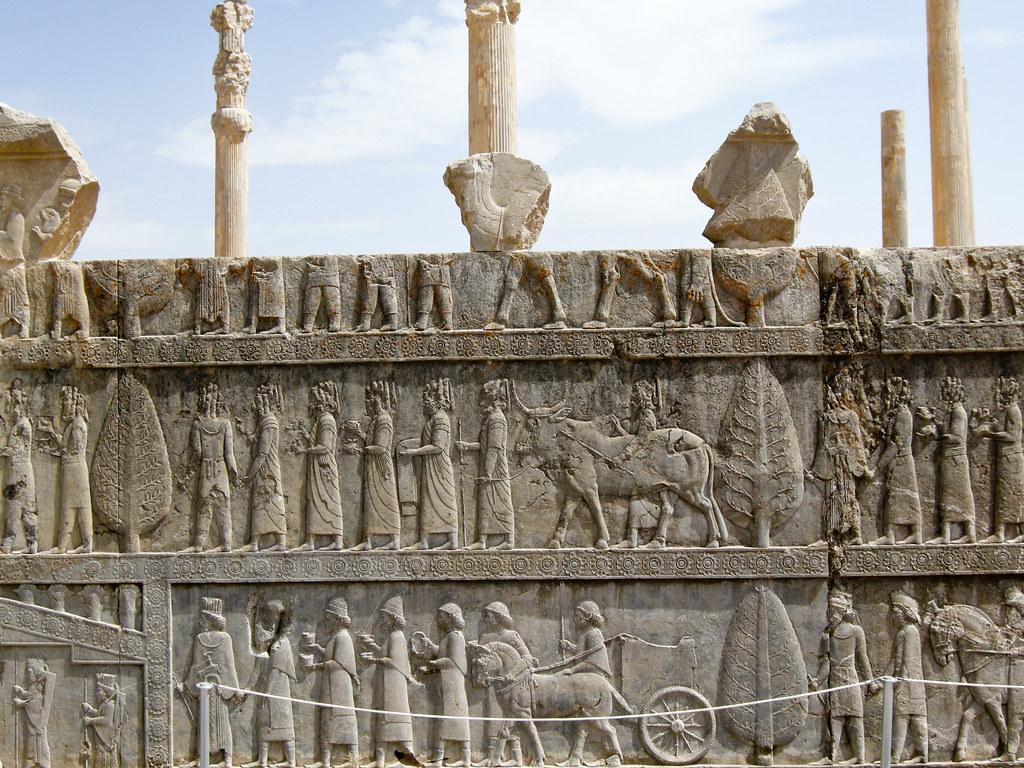
The Price of Empire: Revenue, Obligation, and the Economics of Persian Rule
Introduction: What Did It Cost to Belong to an Empire?
Somewhere in Babylonia, a farmer stood before a scribe to settle an obligation that could not be postponed. His harvest might have been poor, his silver insufficient, or his land already pledged against another debt. Yet the assessment remained. A contract was written, witnesses named, and the transaction impressed into clay. Far away, the Great King commanded armies, maintained palaces, and rewarded nobles. Between these two worlds stood the fiscal machinery of the Achaemenid Empire.
The Persian Empire was sustained by more than military conquest and political loyalty. Its subjects provided silver, gold, grain, livestock, labour, military service, and provisions for travelling officials. These obligations supported a monarchy whose territories stretched from the Aegean to the Indus and from Central Asia to Egypt. But they were not collected everywhere in the same way.
This raises a question central to understanding Achaemenid governance: how could Persian kings extract the resources needed to maintain an enormous empire without destroying the provincial economies on which their power depended?
The answer lies in a fiscal system that combined inherited institutions, regional assessments, local intermediaries, and royal authority. The Achaemenids neither invented taxation nor imposed one uniform financial structure upon their subjects. They adapted older methods of collecting revenue, introduced new demands, and connected local economies to imperial needs.
Behind the splendour of Persepolis stood an empire that had to be financed. Understanding who paid that price reveals a history considerably more complicated than the dignified processions carved into its palace staircases.
The Evidence: Herodotus and the Administrative Tablets
For generations, the principal account of Persian taxation came from Herodotus. In Histories 3.89–97, he describes Darius I dividing his dominions into twenty tribute districts and assigning annual payments. His catalogue offers a remarkable geographical survey of imperial wealth, with assessments expressed largely in silver.
Yet Herodotus wrote for a Greek audience, and his descriptions contain geographical difficulties, literary conventions, and figures that cannot always be reconciled with contemporary evidence.
The picture has changed through the study of cuneiform documents. The Persepolis Fortification Archive, Persepolis Treasury Archive, Babylonian temple records, and Murašû Archive reveal how revenue and obligations were actually administered. Egyptian papyri, Aramaic correspondence, and royal inscriptions provide further perspectives.
Kristin Kleber’s chapter “Taxation in the Achaemenid Empire” in The Oxford Handbook of Ancient Iran is especially important because it brings these sources together. Her analysis demonstrates that Herodotus’s tribute schedule represents only one perspective on a much more varied system. Pierre Briant, Amélie Kuhrt, Michael Jursa, and Matthew Stolper likewise emphasise the need to understand Achaemenid fiscal policy through local institutions rather than assume a single imperial model.1
These records allow us to move beyond the wealth received by the king and investigate the mechanisms through which it was produced.
Taxation, Tribute, and the King’s Share
The terms taxation and tribute are often used interchangeably, but they describe different aspects of imperial obligation.
Tribute usually refers to wealth demanded from a subordinate political community by a superior ruler. Taxation concerns the collection of resources from individuals, estates, businesses, institutions, or other taxable units. The former emphasises political subordination; the latter, administrative procedure.
The distinction, however, is largely analytical. Ancient terminology did not always separate these concepts.
The Old Persian word bāji, reflected in Elamite as baziš and corresponding to Akkadian mandattu in the Behistun Inscription, conveyed the idea of a payment owed to a superior authority. Kleber interprets the expression as essentially the king’s share.2
Its significance was political as well as economic. In the Behistun Inscription, Darius associates the submission of conquered peoples with obedience and the delivery of what was owed to him. Payment acknowledged sovereignty.
Not every transfer of wealth, however, was an ordinary tax. Royal estates generated income; communities supplied labour; subject peoples presented ceremonial gifts; and officials received provisions while travelling.
These distinctions matter. The earlier article The Gift Economies of the Achaemenid Empire examined the symbolic language of exchange. The present question concerns what happened when the obligation was compulsory, measurable, and enforceable.
Cyrus, Cambyses, and the Fiscal Reforms of Darius
Herodotus makes a memorable distinction between three Persian kings. Cyrus, he reports, was remembered as a father, Cambyses as a harsh master, and Darius as a merchant or shopkeeper. His explanation was that Cyrus and Cambyses received gifts, whereas Darius established fixed assessments.3
The anecdote is revealing, but it cannot be accepted literally.
Babylonia possessed taxation systems long before Cyrus conquered it in 539 BCE. Land obligations, temple assessments, labour services, and financial administration continued under Persian rule. Nor did imperial taxation begin only when Darius came to power in 522 BCE.
What changed under Darius was the organisation and development of the existing fiscal structure. His reign followed the political upheavals described in The Crisis After Cambyses, when rebellion challenged Persian authority across several provinces.
Restoring royal power required more than defeating opponents. The empire needed dependable resources to maintain armies, reward supporters, sustain officials, and supply royal establishments.
Muhammad Dandamayev associates Darius’s fiscal reorganisation with approximately 519 BCE, while Kleber identifies changes in Babylonian taxation terminology and the more systematic provision of resources for the royal court.4
The precise extent of these reforms remains debated, but Darius appears to have strengthened the regularity and reach of imperial demands. His achievement was not the creation of taxation from nothing, but its expansion into a more dependable instrument of monarchy.
Herodotus and the Twenty Tribute Districts
Herodotus’s tribute catalogue is the most famous numerical description of Persian imperial finance. He attributes to Darius twenty assessment districts, each responsible for particular payments.
According to his account, Babylonia and the remaining Assyrian territories contributed 1,000 Babylonian talents of silver annually. Egypt and its associated territories paid 700 talents. Lydia and neighbouring peoples contributed 500 talents, while the western Anatolian district including Ionia paid 400.
The twentieth district, India, was exceptional. Herodotus records its contribution as 360 talents of gold dust, which he describes as the greatest assessment when converted into silver value. He is careful to explain his arithmetic: the Babylonian talent is reckoned at seventy Euboic minae, and gold at thirteen times the value of silver, so that India’s gold became 4,680 Euboic talents of silver.5
The catalogue also records peoples who paid no tribute at all. The Persians, Herodotus says, inhabited a land exempt from assessment. Others brought gifts instead: the Ethiopians bordering Egypt presented unrefined gold, two hundred logs of ebony, five boys, and twenty elephant tusks every third year; the Colchians sent a hundred boys and a hundred girls every fifth year; and the Arabians delivered a thousand talents of frankincense annually.6 The line between tribute and gift, which the Gift Economies article explored, ran through Herodotus’s own list.
The figures appear impressively precise. Yet their historical interpretation is difficult.
Herodotus’s twenty districts cannot simply be treated as twenty permanent satrapies. Taxation districts and administrative provinces were not necessarily identical, and their boundaries changed over time. His geographical catalogue may also reflect information available during the fifth century BCE rather than a complete record of Darius’s original arrangements.
Nor can his combined annual total of approximately 14,560 Euboic talents be independently verified.
Briant considers that the figures may preserve information derived from administrative traditions. Jursa and Kleber are more sceptical of their value as a description of actual receipts, particularly because many obligations documented in Babylonia consisted of labour and services rather than silver delivered to the king.
Herodotus therefore gives us something valuable, but not a complete fiscal account: an ancient representation of how the empire’s wealth was organised and imagined.
From the Province to the Treasury
The satraps were important participants in the collection of provincial revenue, but taxation did not operate simply as a chain in which every subject paid a governor who forwarded everything to the king.
The surviving evidence reveals several administrative layers. Local communities, temple authorities, estate managers, fiscal officials, and scribes could all participate in assessment and collection.
A useful, though later and imperfect, perspective appears in Book II of the Oeconomica, traditionally attributed to Aristotle but generally treated as the work of another author. It distinguishes royal, satrapal, civic, and private economic spheres, each associated with particular sources of revenue.7
The king nevertheless held his governors to account for what their provinces owed. Thucydides reports that in 412 BCE Tissaphernes, satrap in western Anatolia, had been pressed by the king for tribute he was unable to collect from Greek cities under Athenian protection, and that the arrears were charged against him personally. Xenophon adds that when Cyrus the Younger later took control of those same cities, he continued to forward their tribute to the king.8 The assessment, in other words, did not lapse because collection had become difficult. It became the satrap’s debt.
Much of the detailed bureaucracy is examined in Bureaucratic and Administrative Innovations. The fiscal significance is that collection often depended on officials who already understood local property, production, and legal practices.
The king’s authority reached the provinces through institutions that frequently predated Persian conquest.
Babylonia: Land, Service, and the Murašû Archive
Babylonia provides the richest surviving evidence for the practical workings of Persian taxation.
Its agricultural economy depended on irrigation, organised labour, and extensive property records. Landholding carried obligations that could involve silver payments, crops, military service, or labour.
The fifth-century Murašû Archive from Nippur is particularly revealing. The business house of Murašû managed leases, agricultural holdings, loans, and transactions involving land whose occupants owed services or payments to the crown.
Some holdings were associated with military obligations. Babylonian documents distinguish bow land, horse land, and chariot land, categories connected with supplying different forms of military service. These arrangements had roots in earlier Mesopotamian institutions and were extended under Persian rule.9
Such land did not necessarily require its occupant to serve personally. Obligations could sometimes be fulfilled through payments or substitutes, creating opportunities for intermediaries who possessed silver, credit, and administrative connections.
The organisation known as the ḫaṭru brought groups of landholders under officials responsible for managing holdings and obligations. Here taxation was inseparable from land tenure, military organisation, and local authority.
The Murašû records are therefore more informative about fiscal practice than a simple list of provincial tribute. They show how imperial demands entered contracts between private parties.
They also reveal the importance of credit. A person who possessed land but lacked ready silver might borrow against anticipated production or pledge property to meet an obligation.
As explored in Bankers of Babylon, credit helped maintain economic activity. Yet when repayment became difficult, the same system could expose families to mounting debt and the loss of control over their assets.
Temples and the Labour Owed to the King
Babylonian temples were not merely religious institutions. They controlled land, employed dependants, maintained workshops, and administered substantial economic resources.
The Eanna temple at Uruk and the Ebabbar temple at Sippar provide important evidence for fiscal obligations under Persian rule.
Kleber’s examination of temple records shows that such institutions could owe agricultural assessments, military personnel, transport services, provisions, and compulsory labour. The Eanna temple, for example, was expected to provide a substantially larger body of workers for royal projects than the smaller Ebabbar establishment.10
Labour service was particularly significant. The Akkadian term ilku could describe obligations associated with landholding, including military or other services. Some individuals performed these duties themselves; others discharged obligations through payments or hired substitutes.
Royal construction was consequently financed partly through labour that did not appear as a conventional silver tax.
Darius’s DSf inscription from Susa celebrates the craftsmen and materials brought from different lands for his palace. Although it does not distinguish every worker’s legal status, it illustrates how imperial building depended on resources and expertise mobilised across the empire.
The beautiful Apadana Palace of Susa was therefore both an architectural achievement and a product of obligations imposed upon the empire’s peoples.
The resources extracted by the monarchy were not always objects that could be placed in a treasury. Sometimes they were days, skills, and human labour.
Feeding the King: The Burden of Royal Provisioning
One of the most revealing fiscal obligations concerned the provision of food for the king and his travelling court.
Royal establishments needed grain, flour, livestock, wine, transport animals, and other supplies. When the king moved between residences, nearby communities and institutions could be required to furnish provisions.
Herodotus gives the scale of this burden in a single remark: of the twelve months of the year, Babylonia alone fed the king and his army for four, and the rest of Asia for the remaining eight, over and above its tribute. He illustrates it with the household of Tritantaechmes, the satrap of Babylonia, who drew an artaba of silver every day, kept eight hundred stallions and sixteen thousand mares, and maintained so many Indian hounds that four large villages were exempted from all other dues simply to feed them. The same expectation travelled with the army. When Xerxes marched through northern Greece in 480 BCE, the Thasians reportedly spent four hundred talents of silver on a single meal for his forces, and Herodotus describes communities grinding grain and fattening livestock for months in advance of the king’s arrival.11
Babylonian records from the reign of Cambyses illuminate the same burden from below. Kleber discusses documents concerning the king’s stay at Abanu, during a period when poor harvest conditions had placed pressure on local resources.
An extraordinary Babylonian legal account concerns a temple dependant named Bēlšunu. During a violent confrontation over a temple sheep, he invoked Gubāru, the governor of Babylonia, and Parnakku, an official associated with royal provisioning, while expressing resentment about the treatment of local people.12
The incident cannot tell us how all Babylonians regarded Persian rule. Nevertheless, it exposes something absent from monumental royal imagery: the tensions created when provisioning the court collided with local scarcity.
Royal consumption could be celebrated as magnificence by those invited to the banquet, while experienced as an obligation by those supplying it.
This offers an important fiscal counterpart to Royal Banquets and Court Ceremony in Persia: behind the abundance of the King’s Table stood a complicated network of collection, storage, transport, and labour.
Persia Itself: Was the Imperial Heartland Exempt?
Herodotus states that Persia was exempt from tribute. This claim has often encouraged the idea that the Persians governed an empire funded entirely by conquered peoples.
The surviving administrative evidence complicates that picture.
The Persepolis Fortification Archive contains references to baziš associated with livestock. Kleber interprets these as evidence that fiscal obligations could exist in the Iranian heartland, although the precise nature of the payments is not entirely clear.13
The archive primarily records the movement and allocation of goods rather than a comprehensive schedule of taxation. It documents provisions for officials, workers, travellers, women, children, and animals, but not every transaction represents tax revenue.
This distinction is essential. A ration issued from a storehouse is expenditure, not automatically evidence of how the food was originally obtained.
The most defensible interpretation is that Persia may have enjoyed privileges concerning certain forms of imperial tribute without being wholly free of obligations to the crown.
Status mattered. A Persian noble, a dependent worker, a royal estate manager, and a pastoral community did not necessarily experience fiscal authority in the same way.
Egypt: Customs, Temples, and Local Administration
Egypt illustrates how Persian taxation could operate through a deeply established provincial system.
Egyptian agricultural administration, temple estates, and scribal practices continued under Achaemenid rule. The satrap at Memphis exercised authority over provincial finances, but indigenous officials remained important in assessment and collection.
Continuity did not mean exemption. A Demotic text preserved on the back of a later papyrus records an order of Cambyses cutting the deliveries of cattle, fowl, silver, and timber that the Egyptian temples had received from the crown under the last native kings, sparing only a few favoured sanctuaries. The copy is late and its tone hostile, so its precise terms must be treated with care, but it belongs to the same Egyptian memory of Cambyses that produced the story of the Apis bull. It also agrees with Herodotus, who notes that Egypt’s 700 talents came on top of the grain, some 120,000 medimnoi, that fed the Persian garrison at the White Fort of Memphis.14
The Elephantine Papyri and Aršāma correspondence help reconstruct the wider administrative environment, including property management, payments, legal obligations, and communication between officials. One of the satrap’s letters is the clearest surviving example of the travelling official’s entitlement to provisions mentioned at the start of this article. Aršāma instructs the stewards of his estates in Babylonia, Assyria, and Syria to issue his officer Nakhthor and his party daily rations of flour, wine or beer, a sheep, and fodder for their horses, estate by estate, until they reach Egypt.15 The route was fed by the land it crossed.
A particularly valuable document is the Memphis Customs Account, an Aramaic register recording dues associated with ships and cargoes. It is generally dated to 475 BCE, during the reign of Xerxes, although a date under Artaxerxes I has also been proposed.16
Unlike Herodotus’s enormous imperial totals, this document brings us close to the activity of a customs office. Ships arrived, commodities were registered, and payments were calculated according to the applicable obligations.
The account demonstrates that Persian provincial revenue could derive from trade and movement as well as agricultural production.
For merchants operating through Egyptian ports, imperial authority was encountered not only through soldiers and governors but through declarations, assessments, and the collection of customs.
Anatolia and the Negotiation of Revenue
In western Anatolia, the Persians inherited a world of cities, local rulers, agricultural wealth, and established commercial networks.
Herodotus provides a particularly useful account of fiscal reassessment after the Ionian Revolt. In Histories 6.42, he reports that Artaphernes measured territories and organised tribute assessments for the Greek cities according to their lands.
The passage suggests a relationship between surveying, productive capacity, and fiscal obligation. It also demonstrates that assessments could be revised in response to political events.
Cilicia offers another revealing example. Herodotus lists 500 talents of silver and an obligation involving 360 white horses, one for each day of the year. He also reports that 140 of those talents never left the province: they were spent locally to maintain the cavalry that guarded it.17
This is significant because the empire’s resources were not necessarily transferred in their entirety to distant royal treasuries. Provincial expenditure was itself part of imperial finance. Garrisons, transport routes, officials, and military forces required resources where they operated, and taxation financed the infrastructure through which Persian authority remained effective.
Weighing Silver: When Payment Was Not Enough
Even when taxes were payable in silver, collection was more complicated than counting coins.
Much of the Achaemenid economy operated through weighed metal. Silver might be delivered in different forms and degrees of purity, requiring assessment before it could be accepted at an agreed value.
A Babylonian-language tablet discovered at Persepolis, dating to the nineteenth and twentieth regnal years of Darius I, records silver associated with payments from several individuals. The material was examined for weight and quality, and the amounts credited were adjusted accordingly.18
The account offers a remarkably concrete picture of fiscal procedure.
A taxpayer might arrive with silver that appeared sufficient by weight, only to discover that its purity reduced the amount credited. What had been delivered was not necessarily what the treasury recognised as payment.
The process required specialists, standard weights, record-keeping, and authorised officials.
The fiscal importance of such practices is discussed from a numerical perspective in Mathematics and Measurement in the Persian Empire. Here their significance is social and political: royal authority determined not only what was owed, but how the payment would be valued.
Exemptions, Resistance, and the Human Cost
Taxation was never equally burdensome.
A wealthy estate holder might meet an obligation through stored silver or agricultural surplus. A smaller landholder could be compelled to borrow, lease property, or seek assistance from powerful intermediaries.
The Murašû records demonstrate how economic obligations created opportunities for financial entrepreneurs, but also exposed less secure landholders to dependency.
The biblical Book of Nehemiah, particularly chapter 5, describes families mortgaging fields and vineyards and borrowing to meet the king’s tax. It is a religious and literary account, not an official Persian tax register, yet it offers an important perspective on how fiscal pressure could be experienced within a provincial community.19
Exemptions could also be political instruments. In Ezra 7:24, certain religious personnel are represented as exempt from various dues. The historical status of the decree must be considered critically, but the passage reflects the idea that fiscal privilege could be granted and used to secure cooperation.
Taxation therefore had consequences beyond revenue. It could reinforce local hierarchies, reward favoured institutions, encourage borrowing, and create resentment.
The Achaemenid Empire was capable of considerable administrative flexibility, but flexibility should not be mistaken for universal fairness.
Where Did the Wealth Go?
The empire’s fiscal resources sustained armies, officials, royal households, building projects, and provincial administration. Royal estates generated additional income, while treasuries stored precious metals and other valuables.
Herodotus describes tribute silver being melted and stored in earthen vessels, then removed when required. His account conveys an image of enormous royal accumulation, but it should not be treated as a complete description of Persian monetary circulation.
The daric and siglos formed part of the imperial monetary world, yet coinage was far from universal. In Babylonia, weighed silver and contractual payments remained important throughout Persian rule.
The older view that Persian kings systematically drained the provinces of precious metal and caused economic stagnation has been challenged. Stolper and Jursa’s research on Babylonian economic records does not support a simple narrative of continuous monetary scarcity under Achaemenid government.20
This does not mean taxation was light or that wealth was evenly redistributed. It means that accumulation and circulation coexisted.
Scholarly Discussion: How Standardised Was Persian Taxation?
The historical interpretation of Achaemenid taxation has changed substantially.
Older accounts often accepted Herodotus’s silver assessments as a reasonably complete picture of imperial revenue. Darius consequently appeared as the creator of a highly standardised taxation system. The administrative tablets reveal something more complicated: regional diversity, a heavy weight of labour services, and fiscal institutions that evolved out of those of earlier states.
An important disagreement concerns how far Herodotus’s figures reflect genuine royal assessments. Some scholars consider that his information may preserve authentic administrative material. Others argue that the figures and their organisation are too inconsistent with contemporary records to support confident calculations of imperial revenue.
There is also the question of Darius’s responsibility. His fiscal reforms were undoubtedly important, but the empire’s tax system developed across successive reigns and remained dependent on institutions inherited from earlier states.
It is therefore more accurate to describe Achaemenid taxation as a network of interconnected fiscal practices under royal sovereignty than as a perfectly uniform system directed from a single office.
Conclusion: The Price of Imperial Order
The Achaemenid Empire did not survive through conquest alone. It endured because its rulers could convert the resources of diverse territories into the means of governing them.
Herodotus remembered Darius as a king who measured the empire’s wealth. The Babylonian archives reveal the obligations behind that measurement. The Persepolis tablets show resources moving through royal establishments. Egyptian customs records demonstrate fiscal authority at work in commercial life. Together, these sources reveal an empire sustained by calculation, administration, negotiation, and coercion.
That system depended on cooperation as well as compulsion. Local administrators possessed knowledge the monarchy needed. Temples controlled resources and labour. Business families provided credit and services. Provincial elites helped sustain royal power while advancing their own interests. The Persian fiscal system could therefore be both adaptable and coercive: its survival depended on preserving productive institutions, but its demands fell hardest on those least able to meet them.
At Persepolis, delegations present valuable objects in a vision of orderly imperial harmony. The imagery communicates political relationships, not the procedures of taxation. In the administrative records, that ideal becomes a world of assessed payments, labour duties, transport costs, and debts. One shows how the empire wished its authority to be understood; the other reveals how that authority was exercised.
For the monarchy, these resources maintained power. For provincial institutions, they created responsibilities and opportunities. For ordinary people, they could mean a portion of the harvest, a payment in silver, a period of compulsory service, or a debt that remained long after the assessment was due.
The splendour of the Achaemenid court was visible in stone and gold. The cost of sustaining it was recorded in clay.
References
Primary sources and documentary collections
Cameron, George G. Persepolis Treasury Tablets. Oriental Institute Publications 65. Chicago: University of Chicago Press, 1948.
Darius I. Behistun Inscription. Old Persian, Elamite, and Babylonian versions.
Darius I. DSf Inscription from Susa. Various editions and translations.
The Demotic Chronicle, verso (Papyrus Bibliothèque Nationale 215). The decree of Cambyses on Egyptian temple revenues.
Hallock, Richard T. Persepolis Fortification Tablets. Oriental Institute Publications 92. Chicago: University of Chicago Press, 1969.
Herodotus. The Histories. Books I, III, VI, and VII.
Porten, Bezalel, and Ada Yardeni. Textbook of Aramaic Documents from Ancient Egypt. Jerusalem: Hebrew University, 1986–1999.
Pseudo-Aristotle. Oeconomica. Book II.
The Hebrew Bible. Ezra and Nehemiah.
Thucydides. History of the Peloponnesian War. Book VIII.
Xenophon. Anabasis. Book I.
Modern scholarship
Briant, Pierre. From Cyrus to Alexander: A History of the Persian Empire. Translated by Peter T. Daniels. Winona Lake: Eisenbrauns, 2002.
Briant, Pierre, and Raymond Descat. “A Customs Register from the Satrapy of Egypt in the Achaemenid Period.” In Kings, Countries, Peoples, 2017.
Dandamayev, Muhammad A. “Achaemenid Taxation.” Encyclopaedia Iranica. Online article.
Dandamayev, Muhammad A. “Fiscal System i. Achaemenid.” Encyclopaedia Iranica. Online article.
Jursa, Michael. Aspects of the Economic History of Babylonia in the First Millennium BC. Münster: Ugarit-Verlag, 2010.
Kleber, Kristin. “Taxation in the Achaemenid Empire.” In The Oxford Handbook of Ancient Iran, 2015. Oxford Academic.
Kuhrt, Amélie. The Persian Empire: A Corpus of Sources from the Achaemenid Period. London: Routledge, 2007.
Stolper, Matthew W. Entrepreneurs and Empire: The Murašû Archive, the Murašû Firm, and Persian Rule in Babylonia. Leiden: Nederlands Instituut voor het Nabije Oosten, 1985.
Further relevant research
Kleber, Kristin, and collaborators. Achaemenid Taxation Project, University of Münster.
“Trips to the King, Taxation, and the New Year in the Persepolis Fortification Archive.” Iran, published online 2022.
Footnotes
- Herodotus, Histories 3.89–97; Kristin Kleber, “Taxation in the Achaemenid Empire”, in The Oxford Handbook of Ancient Iran (2015); Pierre Briant, From Cyrus to Alexander (2002), pp. 390–399. ↩︎
- Darius I, Behistun Inscription; Kleber, “Taxation in the Achaemenid Empire”, section “Taxation Versus Tribute”. ↩︎
- Herodotus, Histories 3.89; Encyclopaedia Iranica, “Herodotus vi. Darius According to Herodotus”. ↩︎
- Muhammad A. Dandamayev, “Achaemenid Taxation”, Encyclopaedia Iranica; Kleber, “Taxation in the Achaemenid Empire”, section “Darius, Tax Reforms, and Empire Building”. ↩︎
- Herodotus, Histories 3.89 (the Babylonian talent reckoned at seventy Euboic minae), 3.90–94 (the district assessments), 3.95 (gold valued at thirteen times silver; the total of 14,560 Euboic talents); Briant, From Cyrus to Alexander, pp. 390–399; Kleber, “Taxation in the Achaemenid Empire”. ↩︎
- Herodotus, Histories 3.97, on the exemption of Persia and the gifts of the Ethiopians, Colchians, and Arabians. ↩︎
- Pseudo-Aristotle, Oeconomica, Book II; Kleber, “Taxation in the Achaemenid Empire”, discussion of the four economic spheres. ↩︎
- Thucydides, History of the Peloponnesian War 8.5.5, on the arrears charged to Tissaphernes; Xenophon, Anabasis 1.1.8, on Cyrus the Younger forwarding the tribute of the Ionian cities. ↩︎
- Matthew W. Stolper, Entrepreneurs and Empire: The Murašû Archive, the Murašû Firm, and Persian Rule in Babylonia (1985); Kleber, “Taxation in the Achaemenid Empire”, section “State Land with Encumbrances”. ↩︎
- Kleber, “Taxation in the Achaemenid Empire”, section “Taxes and Services Paid by Temples”; Michael Jursa, Aspects of the Economic History of Babylonia in the First Millennium BC (2010). ↩︎
- Herodotus, Histories 1.192, on Babylonia’s four months of provisioning and the household of Tritantaechmes; 7.118–120, on the Thasians’ four hundred talents and the preparations made for Xerxes’ army. ↩︎
- Kleber, “Taxation in the Achaemenid Empire”, discussing the Babylonian legal account analysed by Jursa (2014). ↩︎
- Richard T. Hallock, Persepolis Fortification Tablets (1969); Kleber, “Taxation in the Achaemenid Empire”, section “Taxation in Iranian Texts”. ↩︎
- The Demotic Chronicle, verso (Papyrus Bibliothèque Nationale 215), the so-called decree of Cambyses on temple revenues; Kuhrt, The Persian Empire (2007), chapter 4; Briant, From Cyrus to Alexander, on Cambyses in Egypt; Herodotus, Histories 3.91, on the grain for the garrison at Memphis. ↩︎
- Bezalel Porten and Ada Yardeni, Textbook of Aramaic Documents from Ancient Egypt, A6.9 (Aršāma’s travel authorisation for Nakhthor); Kuhrt, The Persian Empire, on the Aršāma correspondence. ↩︎
- Porten and Yardeni, Textbook of Aramaic Documents from Ancient Egypt, C3.7; Amélie Kuhrt, The Persian Empire: A Corpus of Sources from the Achaemenid Period (2007), section 14.10; Pierre Briant and Raymond Descat, “A Customs Register from the Satrapy of Egypt in the Achaemenid Period” (2017). ↩︎
- Herodotus, Histories 3.90 (Cilicia: 500 talents, 360 white horses, and the 140 talents retained for the cavalry) and 6.42 (Artaphernes’ reassessment); Kleber, “Taxation in the Achaemenid Empire”. ↩︎
- George G. Cameron, Persepolis Treasury Tablets (1948), pp. 200–203; Dandamayev, “Fiscal System i. Achaemenid”, Encyclopaedia Iranica. ↩︎
- Nehemiah 5:1–5; Ezra 7:24; Amélie Kuhrt, The Persian Empire, on the historical use and limitations of biblical evidence. ↩︎
- Stolper, Entrepreneurs and Empire, pp. 143–146; Jursa, Aspects of the Economic History of Babylonia; Dandamayev, “Fiscal System i. Achaemenid”. ↩︎


Leave a Reply