

Seasons, Scribes, and the Ordering of Imperial Time
Introduction: The Empire That Counted Days
The Achaemenid Empire was not only organised by space. It was organised by time. Roads measured distance, archives preserved memory, and calendars gave order to journeys, festivals, taxes, rations, royal commands, and agricultural life. A king could rule many lands only if his officials knew not merely where people and goods were, but when they moved, when they were due, when they were paid, and when rituals or obligations had to be performed.
Timekeeping in Achaemenid Persia was not a single simple system. The empire contained several calendars at once: the Old Persian calendar of the royal heartland, the Babylonian calendar used in Mesopotamia and in imperial Aramaic documents, the Egyptian civil calendar, local provincial calendars, and religious time cycles that later became clearer in Zoroastrian tradition. Like language and law, calendars were governed not by uniformity but by imperial flexibility: Persian power managed these systems rather than erasing them.
This article asks a broader question: how did the Achaemenid Empire organise time across so many peoples? The answer is both practical and symbolic. Calendars let officials record payments, campaigns, journeys, and royal orders; they let communities preserve festivals and agricultural rhythms; and they let kings turn political events into dated memory. In the Behistun Inscription, Darius did not merely say he defeated rebels — he placed events on specific days and months, making his version of history measurable. Time, in Persia, was another of the hidden structures through which the empire was lived and ruled.
The Evidence: Dates in Stone, Clay, Papyrus, and Memory
The evidence for Achaemenid timekeeping comes from many types of source. Royal inscriptions such as Behistun preserve dated political events. The Persepolis Fortification Archive and Treasury Archive record administrative time through months, regnal years, rations, payments, and deliveries. The Elephantine Papyri preserve Aramaic documents from Egypt that use Babylonian and Egyptian dating side by side. Babylonian chronicles and business archives preserve regnal dates, intercalary months, and legal formulae, while Egyptian Demotic documents record Persian rule through Egyptian civil dating.1
This range of evidence is both helpful and difficult. We do not possess a Persian calendar handbook from the court of Darius. We reconstruct the system from dated tablets, month names, royal inscriptions, Aramaic letters, Egyptian papyri, and later religious traditions. Time survives, in short, because administrators needed to record it — and it survives unevenly, in whichever languages and materials the empire happened to keep.
The Old Persian Calendar
The earliest fully preserved Iranian calendar belongs to the Achaemenid period, though the evidence is uneven. Not all the Old Persian month names survive in Old Persian script; several are reconstructed by comparison with their Elamite and Babylonian forms in the Persepolis tablets. This is typical of Achaemenid history: we often understand Persian institutions through multilingual evidence.
The Old Persian calendar was lunisolar. It followed months tied to the moon but needed adjustment to keep the year aligned with the seasons, because a purely lunar year slips steadily through the solar cycle, and an agricultural and imperial year could not ignore sowing, harvest, travel, and festival. Intercalary months — extra months inserted when the drift grew too large — kept the calendar roughly in step with seasonal reality.
Some month names are known from Behistun and the Persepolis material. Bāgayādiš, the seventh month (roughly September–October), appears in Darius’s account of the killing of Gaumata; Anāmaka, the tenth month (roughly December–January), recurs in the Behistun text and corresponds to Akkadian Ṭebētu and Elamite Šermi; Viyaxana, the twelfth month, is tied to Gaumata’s rebellion in the Behistun chronology.2 These names were more than labels. When Darius dated rebellion, battle, and victory, he placed his reign within a calendar intelligible to the imperial heartland, giving Persian political memory its own Iranian rhythm. The month was not only a measure of time; it was a way of making royal history belong to Persian order.
Babylonian Time and Imperial Administration
The Babylonian calendar was one of the most sophisticated systems the Achaemenids inherited. Babylonia had long traditions of astronomy, lunar observation, intercalation, omen scholarship, temple record-keeping, and royal chronology. When Cyrus entered Babylon in 539 BC, he did not conquer a blank administrative space. He entered one of the oldest timekeeping cultures in the world.
The calendar was lunisolar and began its year in spring, around the month Nisannu, with intercalary months added to keep the lunar months aligned with the solar year. Its greatest refinement came during Persian rule itself. Across the fifth century BC, Babylonian astronomers regularised intercalation into a fixed nineteen-year cycle of seven added months — the scheme later known in the West as the Metonic cycle — turning the insertion of months from a matter of royal or priestly decision into a predictable rule. Babylonian scholars also kept the Astronomical Diaries, dated night-by-night records of the sky and of notable events, forming a continuous observational archive that runs through the Achaemenid period and remains one of the longest scientific records ever compiled.3 Calendar-making, in other words, was becoming an exact science on Persian soil — part of the same world of Achaemenid astronomy.
Achaemenid rule did not abolish any of this. Babylonian legal documents, temple archives, and chronicles kept using Babylonian dating under Persian kings, most often by regnal year — “year X of King Darius,” “year Y of King Artaxerxes.” The Egibi and Murašû archives, the Eanna records from Uruk, and the Ebabbar records from Sippar all belong to this documentary world. Babylonian month names even circulated through imperial Aramaic administration, from Elephantine to elsewhere: not every Persian subject lived by a Babylonian calendar, but Babylonian time had become one of the empire’s administrative languages.
Egypt and the Civil Calendar
Egypt brought another ancient time system into the empire. The Egyptian civil calendar ran twelve months of thirty days followed by five additional days — a regular 365-day year that was not based on visible lunar months but on administration, agriculture, temple life, and the rhythm of the Nile. Under Persian rule, Egyptian documents kept using it: Demotic papyri, legal deeds, and administrative texts, including the Rylands Papyri and the petition of Petesi, preserve this Egyptian scribal continuity.
The Elephantine Papyri are especially valuable because they reveal calendar contact in action. At Elephantine, a Jewish military colony served under Persian authority on Egypt’s southern frontier, and its Aramaic papyri connect Babylonian-Aramaic month names with the Egyptian civil calendar. Some documents even carry double dates, letting modern scholars watch two systems used side by side.4 For the Achaemenid state this was simply practical. A Persian satrap in Egypt did not need to abolish Egyptian time to rule Egypt; he needed to understand it, tax through it, and coordinate it with wider imperial administration. The empire governed by translation.
Regnal Years: Time Under the King
In much of the Achaemenid world, time was counted through kingship. Documents were dated by the regnal year of the reigning king — the fifth year of Darius, the seventh year of Artaxerxes — tying ordinary legal life to royal authority. A farmer leasing land, a business house lending silver, a temple recording income, or a soldier receiving pay might all appear in records dated by the king’s reign. The king did not need to stand in the room; his year was already there.
This mattered intensely during succession crises. When Cambyses died and the Bardiya–Gaumata crisis unfolded, dating documents became part of recognising rule. A tablet dated to Bardiya’s reign tells us that someone, somewhere, accepted his kingship as administratively real; when Darius took power, his own regnal years reorganised the empire’s written time. To date a document by a king is to acknowledge that his rule structures time itself.
Behistun: Darius Dates the Crisis
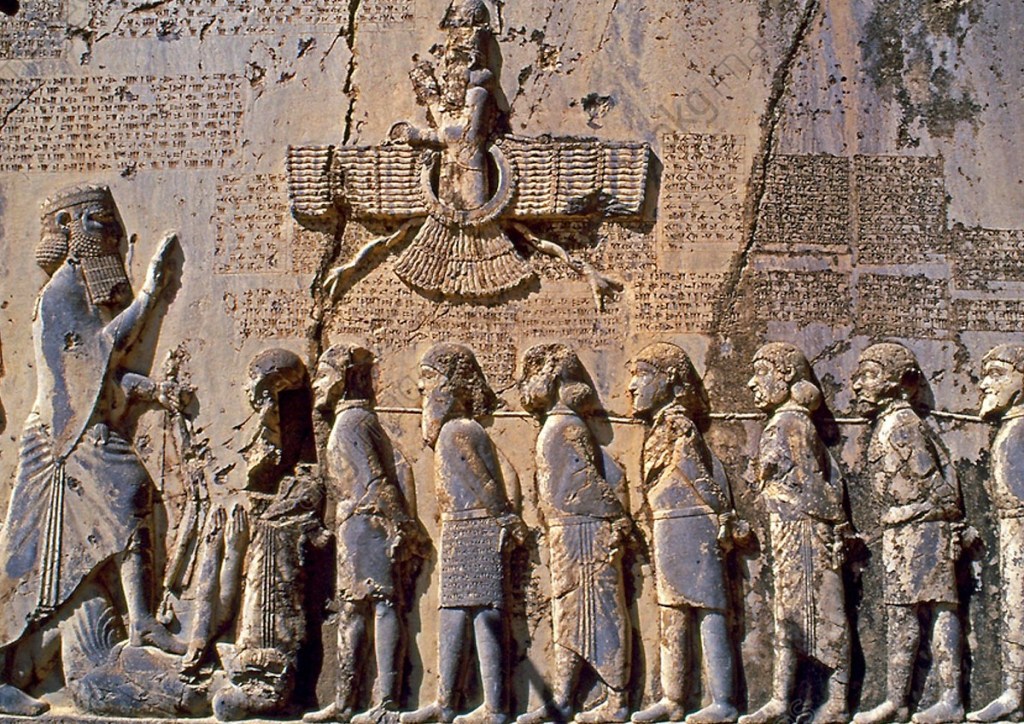
The Behistun Inscription is one of the most important sources for Achaemenid timekeeping because Darius gives precise dates for rebellion, battle, and victory. It is not merely a dramatic royal narrative; it is a chronological argument.
Darius says Gaumata rebelled on the fourteenth day of Viyaxana, corresponding approximately to 11 March 522 BC, and that he killed Gaumata on the tenth day of Bāgayādiš, about 29 September 522 BC, before listing a sequence of further rebellions and battles tied to named months and days.5 The precision serves a political purpose. Darius had seized power in a contested crisis; by dating events, he gave his version the authority of order, presenting himself not as a man carried by rumour but as the ruler who could measure rebellion, defeat it, and record it. Behistun also binds time to legitimacy: the king’s enemies are the servants of the Lie, his victories restore truth, and the dated sequence turns chaos into ordered narrative.
Persepolis: Administrative Time
If Behistun gives us royal time, Persepolis gives us administrative time. The Fortification Archive records transfers of food, wine, animals, flour, and fruit across the imperial heartland, mostly from the reign of Darius I, and it is full of practical time: month, year, allocation, delivery, journey, work group, storehouse, and official responsibility. The Treasury Archive continues the picture, recording payments — including silver — to workers and craftsmen at Persepolis.6
This kind of time was essential to empire. A worker had to be fed at regular intervals; a traveller needed provisions for a journey; an animal had to be assigned and accounted for; a storehouse had to know when goods were received and issued. A delayed record could mean hunger, suspicion, or loss. The tablets also remind us that ancient calendars were not abstract — they were used by scribes, workers, women, children, ration officials, travellers, and supervisors. A calendar could determine when a woman received an allocation, when a group moved, or when grain was transferred.
Festivals, Seasons, and Sacred Time
Calendars did not only organise administration; they organised ritual and emotion. Agricultural communities needed seasons, priests needed ritual days, courts needed festivals, and families remembered births, deaths, marriages, and vows. Time was social before it was bureaucratic.
Mithrakāna — later Mehragān — is one of the most important festival names in Iranian tradition. Associated with Mithra and with the seventh month, Bāgayādiš, it is the festival on which, according to Greek-preserved tradition, the Persian king was allowed to drink and dance “the Persian” — a rare image of royal restraint ritually loosened, and one that belonged to the wider world of court ceremony.7
The later Zoroastrian calendar must be handled with care for the Achaemenid period, but its shape is worth describing. In its developed form it was a 365-day year of twelve thirty-day months plus five additional days, in which each of the thirty days and each of the twelve months bore the name of a divinity — so that the Magi and the faithful moved through a year saturated with sacred names. Alongside it ran the six gāhānbār festivals, seasonal observances known from later tradition that may preserve older agricultural rhythms. Exactly when this religious calendar took its 365-day form is debated: some of its roots may be Achaemenid, some attestations are later, and the reconstructions remain contested.8 A related debate surrounds a remark by Quintus Curtius Rufus, who, describing Alexander’s encounter with Persia, says that 365 young men followed the Magi, matching the days of the year — often cited as evidence for a Persian 365-day calendar by the late Achaemenid period, though the interpretation is far from certain.9
Above all there was the New Year. Nowruz, celebrated at the spring equinox, became the great festival of Iranian time, and a long-standing (if debated) interpretation reads the Apadana procession of gift-bearing delegations at Persepolis as the image of a New Year ceremony in which the empire’s peoples came before the king. Whether or not Persepolis was literally built for such a festival, the reading captures something true: the turning of the year was an occasion on which imperial order could be displayed and renewed.10
The safest conclusion is that sacred time and administrative time overlapped but were never identical. A royal official dated a ration tablet by month and regnal year; a priest thought in ritual recitation and festival; a farmer measured time by rain, heat, harvest, and animal cycles. The empire contained all of these clocks at once.
Time, Travel, and the Royal Road
Time mattered intensely on the road. The Royal Road from Sardis to Susa, described by Herodotus, is one of the great examples of imperial time organised through infrastructure: he gives distances and stations and praises the speed of the royal couriers who moved through snow, rain, heat, and night to overcome delay. The Aršāma letters, written in Aramaic on leather, show the same world of orders, travel, estates, and command from the administrative side — not calendars in themselves, but part of a system in which time, distance, and written order were inseparable.11
A road was not just a line across land; it was a schedule. Couriers needed stations, fresh horses, guards, and predictable stages. Merchants and officials measured journeys in days, river crossings, and safe stopping points; military campaigns depended on season and travel time; and royal movement between Susa, Babylon, Ecbatana, Persepolis, and Pasargadae required planning. For ordinary travellers time was less precise but no less pressing: a caravan had to reach water before its animals weakened, a merchant to arrive before a market closed, a soldier to report before an officer marked him absent. Time could be profit, danger, duty, or survival.
Measuring the Day
The evidence for timekeeping within the day is thinner than for calendars. Most people did not live by mechanical clocks but by sun, shadow, dawn, dusk, meals, watches, ritual moments, and labour rhythms. In urban and administrative settings, more formal methods existed: sundials and water clocks were known in the Babylonian and Egyptian worlds the Persians absorbed, and the same astronomical traditions that refined the calendar could measure the passing hours. But we should not imagine every village or caravan using such instruments.12
For most people, the time of day was practical: before sunrise, after sacrifice, at the heat of the day, before the gate closed, when the shadow lengthened, before the courier departed. Administrative documents needed dates far more often than hours; exact minutes did not govern life, sequences and obligations did. Ancient time was precise where institutions required precision and flexible where life allowed it.
Scholarly Discussion: One Calendar or Many?
The main scholarly danger is simplification. It is tempting to speak of “the Persian calendar” as if the whole empire followed one system, but the evidence does not support that. The Old Persian calendar mattered in royal and Iranian contexts; the Babylonian calendar remained central in Mesopotamia and shaped Aramaic administration; the Egyptian civil calendar continued in Egypt; the Elephantine Papyri show systems meeting in a single document; and later Zoroastrian traditions preserve religious structures whose Achaemenid development is debated.
The second danger is projecting later Iranian festivals backwards too confidently. Nowruz, Mehragān, the gāhānbār, and the 365-day Zoroastrian calendar all matter for the history of Iranian time, but their Achaemenid form must be treated carefully: some roots may be old, some attestations are late, and some reconstructions remain contested. The best interpretation is that Achaemenid calendrical practice was imperial rather than uniform — the Persians governed time as they governed language and law, using local systems while binding them through royal authority.
Conclusion: The Calendar of Empire
Timekeeping was one of the hidden foundations of Achaemenid power. Without calendars the empire could not coordinate taxation, labour, travel, correspondence, food distribution, festivals, campaigns, or royal memory; without dates, archives and administration lose their force; without regnal years, documents lose their political placement; without intercalation, the seasons drift. Royal time and local time met on the same surfaces — a tablet naming a Persian king and a Babylonian month, a papyrus combining Aramaic and Egyptian dating, an inscription turning a violent coup into a sequence of dated victories. To govern time was to govern memory, obligation, and expectation.
The Achaemenid achievement was not the creation of one calendar for all peoples but the ability to rule through several at once. The Old Persian calendar gave the heartland its month names; the Babylonian calendar carried an ancient — and, under Persian rule, increasingly exact — science of months and intercalation; the Egyptian civil calendar continued along the Nile; the Persepolis archives counted administrative life; the Elephantine Papyri preserved frontier double dating; and Behistun fixed Darius’s crisis into measured political memory. The Persians did not need every subject to name the month in the same language. They needed taxes collected, workers fed, messages delivered, festivals recognised, documents dated, and kings remembered. In Persia, power was not only carved in stone or carried along roads. It was counted in days.
References
Athenaeus. Deipnosophistae. Various translations.
Boyce, Mary. A History of Zoroastrianism. Brill, 1975–1991.
Briant, Pierre. From Cyrus to Alexander: A History of the Persian Empire. Translated by Peter T. Daniels. Eisenbrauns, 2002.
Cameron, George G. Persepolis Treasury Tablets. Oriental Institute Publications 65. University of Chicago Press, 1948.
Ctesias. Persica (fragments). In Jan P. Stronk, Ctesias’ Persian History. Wellem, 2010.
Darius I. The Behistun Inscription. Various editions and translations.
Depuydt, Leo. “Regnal Years and Civil Calendar in Achaemenid Egypt.” Journal of Egyptian Archaeology 81, 1995.
Driver, G. R. Aramaic Documents of the Fifth Century B.C. Oxford University Press, 1954.
Duris of Samos. Fragments preserved in Athenaeus.
Hallock, Richard T. Persepolis Fortification Tablets. Oriental Institute Publications 92. University of Chicago Press, 1969.
Herodotus. The Histories. Various translations.
Jursa, Michael. Studies on first-millennium Babylonian economic and scholarly history.
Neugebauer, Otto. A History of Ancient Mathematical Astronomy. Springer, 1975.
Parker, Richard A., and Waldo H. Dubberstein. Babylonian Chronology 626 B.C.–A.D. 75. Brown University Press, 1956; later editions.
Porten, Bezalel. Archives from Elephantine: The Life of an Ancient Jewish Military Colony. University of California Press, 1968.
Porten, Bezalel, and Ada Yardeni. Textbook of Aramaic Documents from Ancient Egypt. Hebrew University, 1986–1999.
Quintus Curtius Rufus. Histories of Alexander. Various translations.
Root, Margaret Cool. The King and Kingship in Achaemenid Art: Essays on the Creation of an Iconography of Empire. Brill, 1979.
Sachs, Abraham J., and Hermann Hunger. Astronomical Diaries and Related Texts from Babylonia. Austrian Academy of Sciences, 1988–.
Stolper, Matthew W. “Persepolis Administrative Archives.” Encyclopaedia Iranica.
Encyclopaedia Iranica. “Anāmaka.”
Encyclopaedia Iranica. “Aršāma.”
Encyclopaedia Iranica. “Bāgayādiš.”
Encyclopaedia Iranica. “Calendars i. Pre-Islamic Calendars.”
Encyclopaedia Iranica. “Clocks.”
Encyclopaedia Iranica. “Dance i. In Pre-Islamic Iran.”
Encyclopaedia Iranica. “Dates and Dating.”
Encyclopaedia Iranica. “Elephantine.”
Encyclopaedia Iranica. “Festivals i. Zoroastrian.”
Encyclopaedia Iranica. “Gāhānbār.”
Encyclopaedia Iranica. “Mehragān.”
Encyclopaedia Iranica. “Nowruz.”
Livius. “Behistun” and related Behistun inscription resources.
Footnotes
- Encyclopaedia Iranica, “Calendars i. Pre-Islamic Calendars” and “Dates and Dating”; Richard T. Hallock, Persepolis Fortification Tablets; George G. Cameron, Persepolis Treasury Tablets; Parker and Dubberstein, Babylonian Chronology 626 B.C.–A.D. 75 (which allows Babylonian dates to be converted to Julian equivalents). ↩︎
- Encyclopaedia Iranica, “Calendars i. Pre-Islamic Calendars,” “Bāgayādiš,” and “Anāmaka”; Darius I, Behistun Inscription. ↩︎
- Parker and Dubberstein, Babylonian Chronology; on the standardisation of the nineteen-year intercalation cycle in the Achaemenid period, studies of Babylonian intercalation and calendar; Sachs and Hunger, Astronomical Diaries and Related Texts from Babylonia; Michael Jursa, studies on first-millennium Babylonian scholarship. ↩︎
- Encyclopaedia Iranica, “Elephantine”; Bezalel Porten, Archives from Elephantine; Porten and Yardeni, Textbook of Aramaic Documents from Ancient Egypt; Leo Depuydt, “Regnal Years and Civil Calendar in Achaemenid Egypt.” ↩︎
- Darius I, Behistun Inscription; Livius, “Behistun”; Encyclopaedia Iranica, “Dates and Dating.” ↩︎
- Richard T. Hallock, Persepolis Fortification Tablets; George G. Cameron, Persepolis Treasury Tablets; Matthew W. Stolper, “Persepolis Administrative Archives,” Encyclopaedia Iranica. ↩︎
- Encyclopaedia Iranica, “Mehragān”; Athenaeus, Deipnosophistae 10.434; Ctesias and Duris fragments; Encyclopaedia Iranica, “Dance i. In Pre-Islamic Iran.” ↩︎
- Mary Boyce, A History of Zoroastrianism; Encyclopaedia Iranica, “Calendars i. Pre-Islamic Calendars,” “Festivals i. Zoroastrian,” and “Gāhānbār.” ↩︎
- Quintus Curtius Rufus, Histories of Alexander 3.3.10; Encyclopaedia Iranica, “Calendars i. Pre-Islamic Calendars.” ↩︎
- Encyclopaedia Iranica, “Nowruz”; on the debated interpretation of the Apadana reliefs as a New Year procession, Margaret Cool Root, The King and Kingship in Achaemenid Art, and later discussion. ↩︎
- Herodotus, Histories 5.52–54 and 8.98; Pierre Briant, From Cyrus to Alexander; on the Aršāma correspondence, G. R. Driver, Aramaic Documents of the Fifth Century B.C., and Encyclopaedia Iranica, “Aršāma.” ↩︎
- On sundials, water clocks, and day-measurement in the Babylonian and Egyptian traditions absorbed by the empire, Encyclopaedia Iranica, “Clocks”; Otto Neugebauer, A History of Ancient Mathematical Astronomy. ↩︎


Leave a Reply