
Sound, Performance, and the Sensory Life of Achaemenid Power
Introduction: The Sound of the Court
The Achaemenid court was not silent. Behind the stone reliefs of Persepolis, the royal inscriptions, the formal audiences, and the guarded palaces stood a world of sound: hymns chanted by Magi, singers in royal tents, women entertainers at banquets, spoken poetry, ceremonial announcements, diplomatic speeches, court gossip, musicians, dancers, hunting parties, festival cries, and the murmuring of many languages. The empire was not only seen through robes, reliefs, and royal architecture. It was also heard.
Music and entertainment in the Persian court are difficult to reconstruct. No Achaemenid musical notation survives. We do not possess a Persian court songbook, a musician’s manual, or a detailed palace programme listing singers, dancers, and performers. Much of the written evidence comes from Greek authors who saw Persia through admiration, rivalry, and stereotype, and later Iranian traditions preserve magnificent images of court music — especially in the Sasanian period — that cannot simply be projected backwards onto the Achaemenids.
Yet the absence of complete evidence does not mean the absence of music. Ancient courts did not function without performance. Royal banquets, religious rites, festivals, weddings, diplomatic receptions, victory celebrations, hunting expeditions, and private palace life all required sound, rhythm, speech, song, and controlled pleasure. In an empire that gathered peoples from Anatolia, Egypt, Babylonia, Elam, Media, Bactria and Sogdia, India, and the Persian Gulf, the court stood at the meeting point of many musical and poetic traditions.
This article asks a wider question: how did music, poetry, and entertainment shape the emotional and ceremonial life of the Achaemenid court? The answer is not simply that the Persians enjoyed music. Performance helped create atmosphere, rank, memory, and power. It softened diplomacy, intensified ritual, marked festivals, entertained nobles, trained elite bodies, and turned royal life into an experience that could be remembered long after the audience ended.
The Evidence: Scattered but Suggestive
The evidence for Achaemenid court entertainment must be handled carefully. Herodotus, Xenophon, Athenaeus, Ctesias, Duris, Plutarch, and other Greek or Greek-preserved authors provide many of the most vivid references, but they write from outside the Persian court or through later literary traditions. Their testimony is useful, but never neutral.
Herodotus gives one of the earliest descriptions of Persian ritual sound. He says that Persian sacrifices did not use altars, fire, libations, garlands, barley meal, or the music of the pipe. Yet he also says that a Magus stood by and chanted a theogony, a song of the birth of the gods, without which sacrifice could not be performed.1 This is an important distinction. Herodotus denies one kind of ritual music — Greek-style pipe music — but confirms another: sacred chant.
Xenophon, writing in the fourth century BC, refers several times to singing women or music-girls in royal and elite contexts. In the Cyropaedia, Cyrus receives a splendid tent, a beautiful woman of Susa, and two accomplished music-girls as part of the captured Median luxury world.2 Xenophon’s work is not straightforward history; it is partly philosophical and didactic. Even so, it preserves a Greek memory of music as part of the Persian courtly environment.
Athenaeus, writing much later but preserving earlier materials, gives another set of clues. Through Ctesias and Duris, he reports that at the festival of Mithra the Persian king was allowed to drink and dance “the Persian”, while others abstained from that dance on that day.3 The detail is striking because it suggests that dance was not merely entertainment but part of royal ritual exception: the normally controlled body of the king could, under special conditions, perform joy.
The Persepolis Fortification Archive does not describe music in a literary way, but it reveals the kind of palace economy that made performance possible. A court that fed thousands, moved officials, supported travellers, supplied storehouses, and managed labour groups also required attendants, specialists, servants, and controlled spaces of ceremony.4 Performers may not always be visible in the tablets, but they belonged to the same world of court service and provision.
Crucially, the silence of the texts is not total. Sound leaves no notation, but instruments and ensembles were carved in stone, and the visual record of the wider Near East lets us picture what a Persian court could hear. The evidence must therefore be reconstructed from many hints together: chants at sacrifice, singing women, banquet customs, festival dance, courtly luxury, inherited traditions, and the images of musicians that survive on palace walls.
The Instruments and the Multicultural Soundscape
Because the Achaemenid court gathered peoples from across the empire, its music cannot have been purely “Persian” in a narrow ethnic sense. Elamite, Babylonian, Assyrian, Median, Egyptian, Lydian, Greek, Phoenician, and Bactrian traditions all stood within imperial reach, and the Persians, as with their architecture, inherited, selected, and reorganised rather than inventing from nothing.
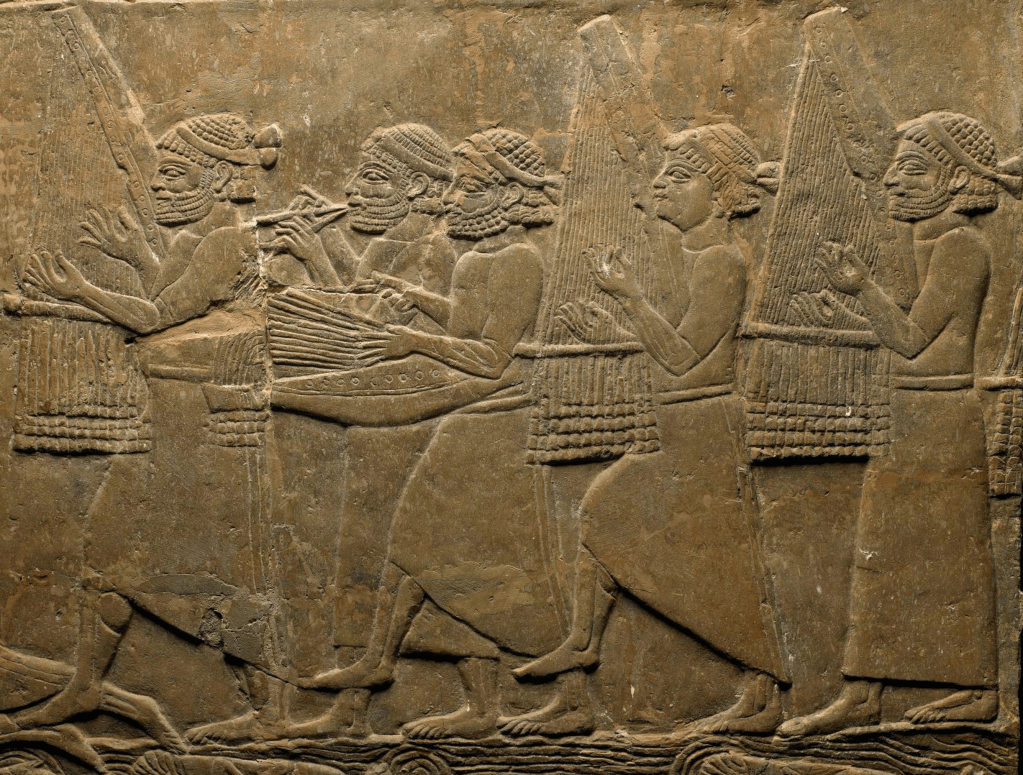
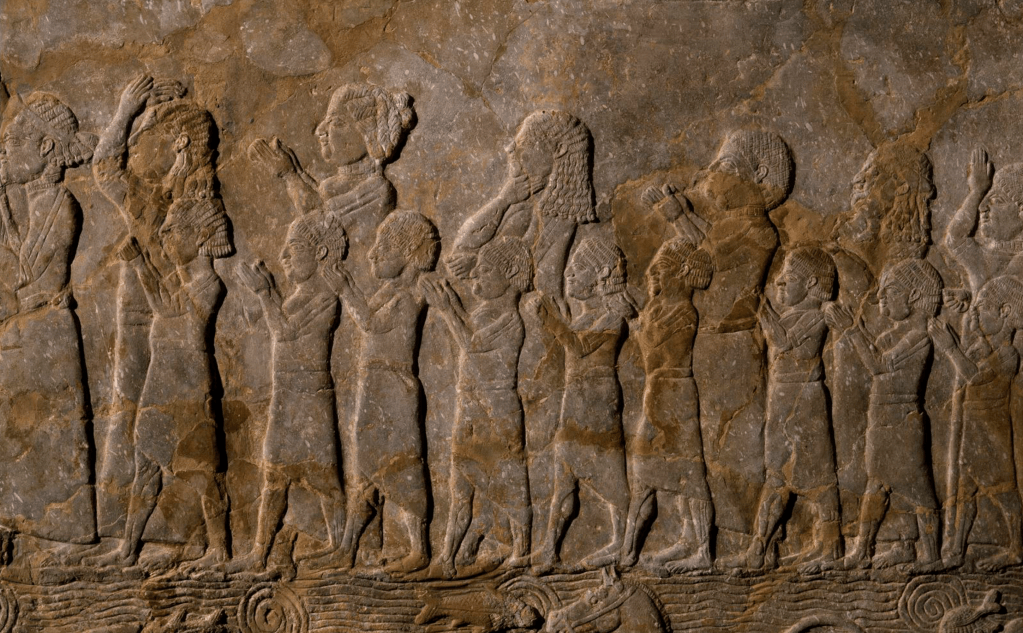
The clearest picture comes from just before the empire. An Assyrian relief from Nineveh, carved a century before Cyrus, shows an orchestra of musicians from Susa — harpists, pipers, and a chorus of singers, some of them children clapping in time — performing to mark a royal occasion. Because Susa became one of the great Achaemenid capitals, this Elamite musical world was not a foreign curiosity but part of the empire’s own inheritance.5 The instruments of this world recur across Near Eastern art even where securely Achaemenid depictions are scarce: the angular harp, the lyre, the long-necked lute (ancestor of the later barbat), double reed-pipes, and frame drums.
Babylonia had ancient traditions of temple chant, lamentation, and festival music; Egypt had ritual singers, dancers, and long-established ceremonial forms. The Book of Daniel, though composed later, remembers a Babylonian court assembling to the sound of “horn, pipe, lyre, trigon, harp, and drum” — a list whose exact terms are debated, but which reflects the kind of ensemble a Near Eastern court could command.6 The traffic ran both ways. Greek music theory itself named two of its principal scales the “Lydian” and “Phrygian” modes, after regions of Anatolia that lay within the Persian Empire — a small sign of how the sound-worlds of the Aegean and the Near East were entangled under Achaemenid rule.7
Yet this diversity was arranged under Persian authority. Foreign sound could enter the court, but the king remained the centre. A feast at Susa or Persepolis might include performers, instruments, and melodies whose origins lay far from Pars, and in gathering them the empire did with music what it did with tribute: it drew the world toward the throne and made it serve royal splendour.
Sacred Sound: The Magi and Chanted Ritual
The most secure form of Achaemenid “music” is not courtly pleasure but religious chant. Herodotus’s description of Persian sacrifice is valuable because it shows that sound had sacred authority. The Magus did not simply stand as an observer; he chanted over the sacrifice. The spoken or sung word gave ritual form to the act.
This matters because ancient Iranian religion placed deep value on sacred utterance. The later Avesta preserves hymns, prayers, and ritual recitations in which sound itself has power — the concept of the manthra, the potent holy word whose correct recitation was efficacious in its own right. The Gathas, attributed by tradition to Zoroaster, are poetic compositions meant to be sung; and although the exact Achaemenid relationship to Zoroastrian practice remains debated, the importance of chanted religious language is difficult to deny.8
In the Achaemenid court, sacred chant would have connected religion and kingship. Royal sacrifice, fire ritual, oath-taking, funerary observance, and festival ceremony all required words spoken in proper form. The king’s relationship with Ahura Mazda, so central in the inscriptions of Darius and Xerxes, was not only carved in stone. It was also voiced in ritual.
This gives the Persian court a different sound from the Greek symposium or theatre. The most authoritative sound was not necessarily instrumental music. It may have been the disciplined voice of the priest: chanting, invoking, blessing, naming, and preserving divine order through formula. In such a world, poetry and ritual were not far apart.
Music at Banquets and Courtly Gatherings
Royal banquets were natural settings for music and entertainment. Food, wine, gifts, ranked seating, precious vessels, and controlled access created the structure; music and performance gave the scene its emotional texture. A banquet without sound would be incomplete.
Greek sources often associate Persian elite life with singing women, entertainers, and pleasure after formal dining. Not every such story should be accepted literally, but the pattern is plausible: large courts across the ancient Near East employed musicians, singers, dancers, storytellers, and attendants, and the Persian court inherited and expanded these traditions.
Music also structured mood. A diplomatic feast required one atmosphere; a wedding another; a military victory another; a mourning gathering another. Soft singing, rhythmic clapping, string instruments, pipes, drums, and recitation may all have played roles, chosen to fit the occasion. The safest reconstruction is not a fixed orchestra but a flexible courtly soundscape shaped by region, occasion, and rank.
Poetry, Storytelling, and Royal Memory
Poetry in the Achaemenid court is harder to document than music, but it is almost impossible to imagine the court without oral performance. Ancient Iranian culture had strong traditions of praise, heroic memory, genealogy, sacred utterance, and storytelling. Much of what later becomes visible in Iranian epic must have had older oral roots, even if we cannot reconstruct its Achaemenid form in detail.
Court poetry served several purposes. It entertained, but it also remembered. It preserved names, victories, lineages, moral examples, and the fame of kings. In a society where royal legitimacy depended on descent, conquest, truth, and divine favour, memory was political: a good story could make a king larger than life, and a dangerous one could damage him. Royal inscriptions themselves are not poetry in the ordinary sense, but they have formal qualities — repetition, formula, rhythm, parallel structure, and moral contrast. Darius’s inscriptions repeatedly oppose truth and the Lie, loyalty and rebellion, order and chaos. Such language is shaped to be remembered.9
Later Iranian tradition remembered the professional minstrel — the gōsān of Parthian times — who sang praise, genealogy, and heroic tale at courts and in villages alike. The institution is documented only for later centuries, but the role it filled, the singer who carried a people’s memory, is exactly the kind of figure an Achaemenid court would have needed.10 In a multilingual empire such performers could move stories between Persian, Median, Elamite, Babylonian, Aramaic, and Greek traditions. The court was therefore a place where memory was performed: a written archive preserved commands, and oral performance preserved feeling. Both mattered.
Dance and the Royal Body
Dance appears only briefly in the evidence, but the references are fascinating. Duris, preserved by Athenaeus, says that Persians learned to dance as they learned to ride, as training for bodily strength, and that at the festival of Mithra the king alone could drink and dance “the Persian”. Xenophon, who marched through the empire with the Ten Thousand, adds a rare eyewitness-adjacent glimpse: at a feast he describes soldiers of different nations rising in turn to perform their native dances, and one performing “the Persian”, crouching and springing in time to the pipe.11 It is a soldier’s memory, not a court record, but it shows the Persian dance alive outside the palace as well as within it.
Even where such stories are coloured by Greek fascination, they reveal something important: dance was connected to the body, discipline, and identity. Persian nobility valued controlled movement. Riding, archery, hunting, walking in court robes, bowing before the king, and dancing all required bodily training.
The king’s dance is especially striking because the Achaemenid monarch usually appears still, elevated, and controlled. At Persepolis he is not shown leaping, laughing, or losing composure; he stands or sits in ordered dignity. A ritual moment in which the king danced would therefore have been powerful precisely because it was exceptional. It did not destroy royal control; it temporarily transformed it.
Dance also belonged to entertainment below the king. Women entertainers, musicians, and festive gatherings likely included movement, gesture, clapping, and rhythm — some dances regional, others courtly. Like clothing, dance made identity visible. It showed who was trained, who was free to move, who performed for others, and who was allowed to watch.
Entertainment Beyond the Banquet
Entertainment in the Persian court was not limited to music and song. Hunting was one of the central aristocratic pleasures. Royal and noble hunts were not casual sport: they trained the body for war, displayed courage, created bonds among elite men, and allowed the king to perform mastery over nature. Parks and enclosed hunting grounds, often connected with the Persian idea of the paradise garden, provided ideal settings for this activity.12
Hunting was entertainment, but also ideology. A king who mastered lions, bulls, wild asses, or dangerous terrain demonstrated the same qualities needed to master an empire: strength, courage, control, and divine favour. For nobles, hunting reinforced hierarchy — to ride with the king was honour, to fail before him humiliation.
Games and competitions may also have existed, though the evidence is thinner. Archery, riding, wrestling, spear-throwing, and displays of strength could all serve as elite amusements. The education of Persian boys, as reported by Greek authors, emphasised riding, archery, and truth-telling — training that could easily become public display in courtly contexts. Gardens offered another form of refined leisure: places of walking, drinking, conversation, music, and controlled nature that softened the severity of monarchy without removing hierarchy. To be invited into such a space was itself a mark of favour.
The Achaemenid court therefore entertained through many layers: music for the ear, poetry for memory, dance for the body, hunting for aristocratic energy, gardens for pleasure, and banquets for political theatre.
Women, Performers, and the Hidden Labour of Pleasure
The entertainment of the court depended on people whose names are mostly lost. Singers, dancers, musicians, cupbearers, servants, cooks, dressers, guards, animal handlers, grooms, and attendants all contributed to courtly pleasure. Some were honoured specialists; others were vulnerable dependants. The beauty of a performance often rested on hierarchy, training, and the dependence of those who entertained the powerful — for entertainment was also labour.
Women performers deserve particular caution. Greek sources describe them through male eyes, as objects of pleasure or signs of luxury, and some may have been professional singers while others were enslaved or dependent entertainers attached to the court, to elite households, or to the world of the harem. That framing should not lead us to dismiss them. A skilled singer or dancer could shape the mood of a room, soften a negotiation, entertain a prince, or carry rumours between spaces. Yet such proximity to power was dangerous: entertainment gave access, but not necessarily security.
Royal and noble women also experienced entertainment differently from men. Some gatherings may have included elite women; others separated them from male banqueting spaces. Herodotus and later authors suggest that Persian women could be present at certain meals, while other entertainments involved women performers only after wives had withdrawn.13 The pattern probably varied by setting, status, and occasion — one more way the court used performance to mark who belonged where.
Scholarly Discussion: How Much Can We Know?
The main scholarly problem is scarcity. Achaemenid music was mostly oral and performative, and sound disappears unless someone writes about it, depicts it, or preserves its instruments. We therefore know much less about Achaemenid music than about architecture, inscriptions, administrative tablets, or relief sculpture — and what survives comes filtered through two distorting lenses.
The first is anachronism. The Sasanian court is far better known for named musicians, court songs, and elaborate musical traditions; later Persian music is extraordinarily rich, but it cannot simply be read back into the court of Darius or Xerxes. There may be continuities, but they must be argued cautiously. The second is Greek stereotype. When Greek writers describe Persian music, women entertainers, luxury, drinking, or dance, they often use these details to contrast Persian monarchy with Greek self-image, so that entertainment becomes a sign of “eastern” decadence. Modern readers should not repeat that stereotype uncritically.
The safest position is balanced. We cannot reconstruct exact melodies, instruments, or court repertoires. But we can say with confidence that chant, song, dance, and performance were present in Persian ritual and courtly life — that they were part of the sensory machinery of empire, as real as its roads and its walls even if far harder to hear.
Conclusion: The Empire Heard
The music of the Achaemenid court is mostly lost, but not entirely beyond imagination. We can still catch faint traces: the Magus chanting over sacrifice, the singing women of Xenophon’s courtly world, the harpists of Susa carved on an Assyrian wall, the king’s exceptional dance at the Mithra festival, the songs of banquets, the cries of hunting grounds, the murmurs of palace gardens, and the many languages of imperial gathering.
To study music, poetry, and entertainment in the Persian court is to recover the emotional life of empire. It reminds us that Achaemenid power was not only visual and administrative. It was sensory. It entered the ear as well as the eye.
References
Athenaeus. Deipnosophistae. Various translations.
Boyce, Mary. A History of Zoroastrianism. Brill, 1975–1991.
Boyce, Mary. “The Parthian gōsān and Iranian Minstrel Tradition.” Journal of the Royal Asiatic Society 89, no. 1–2, 1957.
Briant, Pierre. From Cyrus to Alexander: A History of the Persian Empire. Translated by Peter T. Daniels. Eisenbrauns, 2002.
Ctesias. Persica fragments. In Jan P. Stronk, Ctesias’ Persian History. Wellem, 2010.
Darius I. The Behistun Inscription. Various editions and translations.
Duris of Samos. Fragments preserved in Athenaeus.
Hallock, Richard T. Persepolis Fortification Tablets. Oriental Institute Publications 92. University of Chicago Press, 1969.
The Hebrew Bible, Book of Daniel. Various translations.
Henkelman, Wouter F. M. The Other Gods Who Are: Studies in Elamite-Iranian Acculturation Based on the Persepolis Fortification Texts. Nederlands Instituut voor het Nabije Oosten, 2008.
Herodotus. The Histories. Various translations.
Plutarch. Moralia. Various translations.
Root, Margaret Cool. The King and Kingship in Achaemenid Art: Essays on the Creation of an Iconography of Empire. Brill, 1979.
West, M. L. Ancient Greek Music. Oxford University Press, 1992.
Xenophon. Anabasis. Various translations.
Xenophon. Cyropaedia. Various translations.
Encyclopaedia Iranica. “Music History i. Pre-Islamic Iran.”
Encyclopaedia Iranica. “Iran xi. Music.”
Encyclopaedia Iranica. “Dance i. In Pre-Islamic Iran.”
Encyclopaedia Iranica. “Magi.”
Encyclopaedia Iranica. “Harem i. In Ancient Iran.”
Institute for the Study of Ancient Cultures, University of Chicago. Persepolis Fortification Archive Project.
Footnotes
- Herodotus, Histories 1.132; Encyclopaedia Iranica, “Music History i. Pre-Islamic Iran”; Encyclopaedia Iranica, “Magi.” ↩︎
- Xenophon, Cyropaedia 4.6.11; 5.1.1; 5.5.2; 5.5.39; Encyclopaedia Iranica, “Music History i. Pre-Islamic Iran.” ↩︎
- Athenaeus, Deipnosophistae 10.434; Ctesias and Duris fragments; Encyclopaedia Iranica, “Dance i. In Pre-Islamic Iran.” ↩︎
- Richard T. Hallock, Persepolis Fortification Tablets; Wouter Henkelman, The Other Gods Who Are; Institute for the Study of Ancient Cultures, Persepolis Fortification Archive Project. ↩︎
- On the “Elamite orchestra” relief from the North Palace of Ashurbanipal at Nineveh, and on pre-Islamic instruments, see Encyclopaedia Iranica, “Music History i. Pre-Islamic Iran”; British Museum, reliefs from Nineveh. ↩︎
- Book of Daniel 3:5–15; the passage is later than the Achaemenid period and its instrument-names include Greek loanwords, but it reflects the sound of a Near Eastern court assembly. ↩︎
- On the “Lydian” and “Phrygian” modes and the Anatolian names of Greek scales, see M. L. West, Ancient Greek Music; on Greek framing of eastern music, Pierre Briant, From Cyrus to Alexander. ↩︎
- Mary Boyce, A History of Zoroastrianism (on the Gathas, the Yasna liturgy, and the manthra); Encyclopaedia Iranica, “Music History i. Pre-Islamic Iran.” ↩︎
- Darius I, Behistun Inscription; Margaret Cool Root, The King and Kingship in Achaemenid Art; Pierre Briant, From Cyrus to Alexander. ↩︎
- Mary Boyce, “The Parthian gōsān and Iranian Minstrel Tradition,” Journal of the Royal Asiatic Society, 1957. ↩︎
- Athenaeus, Deipnosophistae 10.434 (Duris on dance and the Mithra festival); Xenophon, Anabasis 6.1 (the dances performed at the feast, including “the Persian”); Encyclopaedia Iranica, “Dance i. In Pre-Islamic Iran.” ↩︎
- Xenophon, Cyropaedia; Herodotus, Histories 1.136; on Persian gardens and royal parks, Pierre Briant, From Cyrus to Alexander. ↩︎
- Herodotus, Histories 5.18; Plutarch, Moralia 140B; Encyclopaedia Iranica, “Harem i. In Ancient Iran.” ↩︎


Leave a Reply